

Paper
James M. Acton, Ankit Panda
{
  "authors": [
    "James M. Acton"
  ],
  "type": "other",
  "centerAffiliationAll": "dc",
  "centers": [
    "Carnegie Endowment for International Peace"
  ],
  "collections": [
    "Hypersonic Weapons"
  ],
  "englishNewsletterAll": "ctw",
  "nonEnglishNewsletterAll": "",
  "primaryCenter": "Carnegie Endowment for International Peace",
  "programAffiliation": "NPP",
  "programs": [
    "Nuclear Policy"
  ],
  "projects": [],
  "regions": [],
  "topics": [
    "Security",
    "Nuclear Policy",
    "Arms Control",
    "Foreign Policy"
  ]
}
Source: Getty
James Acton, co-director of Carnegie’s Nuclear Policy Program, explains hypersonic weapons.
With the recent testing and media attention on Russia’s hypersonic developments, news stories have often focused on the idea that the United States is behind its adversaries, Russia and China, in the development and testing of these weapons. James Acton, co-director of Carnegie’s Nuclear Policy Program and a physicist by training, explains what these weapons actually are and some of the pervasive myths around their discussion.
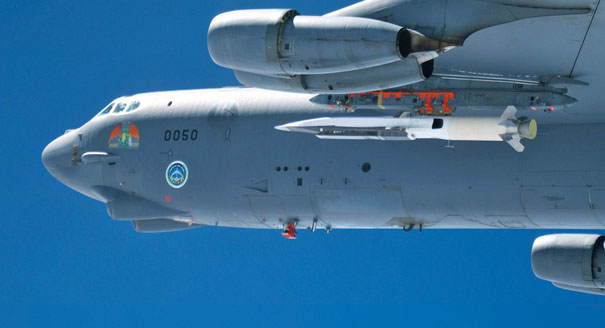
ACTON: A hypersonic weapon is anything that travels faster than Mach 5—five times faster than the speed of sound. When we talk about hypersonic weapons, we generally mean one of two different kinds of technologies. Hypersonic cruise missiles are similar to existing cruise missiles in that they sustain themselves by aerodynamic lift, like an airplane, and are powered throughout the whole flight. Maneuverable reentry vehicles are launched like ballistic missiles, but whereas a ballistic missile arcs high above the atmosphere, maneuverable reentry vehicles are put on a trajectory that leads them to reenter the atmosphere fairly quickly before gliding unpowered—like a hang glider. Reentry vehicles that can glide for hundreds or even thousands of miles are often called boost-glide vehicles.
ACTON: It is very commonly asserted that there is an arms race in hypersonic technology and that the United States is losing. There is certainly an arms race, but I’m not convinced the United States is losing. Experts often argue the United States is behind in this technology because Russia and China appear to be testing more frequently. This is true, but in many ways, the United States is running a different race from Russia and China.
Russia and China appear to be focused primarily on the delivery of nuclear warheads, and in this case, accuracy doesn’t really matter very much. The United States is interested in the delivery of non-nuclear warheads, and here, accuracy is absolutely critical for the weapon to be militarily effective. The United States wants to be landing weapons within a few meters of the target. So U.S. goals are much more demanding than Russian and Chinese goals.
The United States also has a very long history of testing in this area, which gives the United States an advantage in its current efforts. For instance, the most successful U.S. boost-glide weapon R&D program, the Advanced Hypersonic Weapon, has seen a glider tested over about 4,000 kilometers. China, by contrast, appears to have been testing boost-glide weapons at a range of less than 2,000 kilometers.
So, to summarize, there are two considerations here: the U.S. history in this area, and the inherently more demanding technology that the United States is pursuing. When you take those factors into account, I actually doubt the United States is behind in this competition.
ACTON: The development of hypersonic weapons in the United States, in my opinion, has been largely motivated by technology, not by strategy. In other words, technologists have decided to try and develop hypersonic weapons because it seems like they should be useful for something, not because there is a clearly defined mission need for them to fulfill. The first-order task for the Department of Defense is, therefore, to decide what missions it is that it wants hypersonic weapons for. Then we can have a conversation about what the most cost-effective way of achieving those goals are—is it indeed hypersonic weapons, or is there a better alternative? The real priority task here is for the DOD to develop a strategy for the acquisition of hypersonic weapons, and that isn’t possible until it’s decided what these weapons might be used for.
ACTON: In his speech at the beginning of March, President Vladimir Putin presented an extraordinary list of new weapons that he claims Russia is developing or has deployed. This list included a number of hypersonic capabilities.
The most significant is a boost-glide weapon called Avangard. This maneuvering weapon, according to Putin, has been designed to defeat U.S. missile defenses. Since Putin’s speech, Russia has indicated that the Avangard glider is going to be deployed on at least two different kinds of ballistic missiles and will carry nuclear warheads. It’s possible that this weapon could, in the future, be used for the delivery of non-nuclear warheads, if its accuracy can be refined. But in the short term, its only purpose appears to be the delivery of nuclear warheads.
Second, Putin announced a novel boost-glide weapon, called Kinzhal, which means “dagger” in Russian. This weapon is launched from an aircraft and has a shorter range than Avangard. The media reporting we’ve seen coming out of Russia suggests that this weapon is also nuclear armed.
Perhaps counterintuitively, I think the development of nuclear-armed boost-glide vehicles by Russia should be less worrying to us than the development of non-nuclear boost-glide vehicles. Russia already has the capability to deliver nuclear weapons to U.S. and allied targets—and, frankly, we can’t deny it that capability. Russian nuclear-armed boost-glide vehicles do not, therefore, change the status quo. If, however, Russia developed boost-glide weapons with non-nuclear warheads, it would present a new and potentially very significant security threat to the United States and its allies. Such weapons would allow Russia to threaten, with non-nuclear warheads, targets in Europe and eventually the continental United States that, previously, it could only have destroyed with nuclear weapons.
ACTON: China, like Russia, is developing boost-glide weapons and hypersonic cruise missiles—but let me focus on the boost-glide part of China’s program. China is developing a glider that’s named WU-14 by the Pentagon and, it’s been reported, DF-ZF by China. This glider has been tested repeatedly—at least seven times—over a range of up to 2,000 kilometers, which makes its range substantially shorter than the U.S. Advanced Hypersonic Weapon. It’s not clear whether it will be armed with a nuclear warhead, a non-nuclear warhead, or could accommodate either. On balance, it’s likely, I think, that in the first instance, it will be armed with nuclear warheads (though the evidence is far from conclusive). Perhaps, over time, China will subsequently develop a non-nuclear-armed glider.
Very much like Russia, China already has the ability to attack U.S. and allied targets with nuclear weapons, and there’s nothing we can do to prevent it. So Chinese nuclear-armed boost-glide weapons would merely serve to reinforce the status quo. By contrast, if China develops non-nuclear boost-glide weapons, especially if those could hit the continental United States, it would present the United States with a new and very real technical and military challenge.
ACTON: It’s often asserted that it’s impossible to defend against hypersonic weapons because they go too fast. That’s empirically not true. The United States has already developed fairly effective “point defenses”—like Patriot and Terminal High-Altitude Area Defense (THAAD)—that can defend small areas against ballistic missiles, which are actually moving faster than hypersonic weapons. (We don’t normally class ballistic missiles as a type of hypersonic weapon because they have no ability to maneuver.) So, speed, in and of itself, is not an insuperable barrier for missile defenses. Those point-defense systems, and particularly THAAD, could very plausibly be adapted to deal with hypersonic missiles. The disadvantage of those systems is that they can only defend small areas. To defend the whole of the continental United States, you would need an unaffordable number of THAAD batteries. The United States has deployed one missile defense system, the Ground-Based Midcourse System, that is designed to try to defend the whole of the United States against ballistic missiles. For a variety of technical reasons, however, using these “area defenses” to deal with hypersonic weapons is more or less impossible.
So, it’s a nuanced picture when it comes to defenses—you can probably defend small areas fairly effectively against gliders, but it’s likely to be much more challenging to defend large areas.

Jessica T. Mathews Chair, Co-director, Nuclear Policy Program
Acton holds the Jessica T. Mathews Chair and is co-director of the Nuclear Policy Program at the Carnegie Endowment for International Peace.
Recent Work

James M. Acton, Ankit Panda
James M. Acton
Carnegie does not take institutional positions on public policy issues; the views represented herein are those of the author(s) and do not necessarily reflect the views of Carnegie, its staff, or its trustees.

In an interview, Ian Lustick and Eli Clifton discuss their new book on why a prominent ally has so much influence in America.

Michael Young

By failing to address Palestinian representation, the current process is bound to lead to just another temporary arrangement.

Nathan J. Brown

In an interview, Marc Lynch discusses his new book decrying the post-1990 U.S.-dominated order in the Middle East.
Michael Young

Just look at Iraq in 1991.

Marwan Muasher

A coalition of states is seeking to avert a U.S. attack, and Israel is in the forefront of their mind.
Michael Young