The twin shocks of the Euro debt crisis and the Arab Spring are forcing members of the Gulf Cooperation Council to grapple with old and new challenges, including overreliance on oil, changing trade relationships, and regional integration.
The oil-rich economies of the Gulf Cooperation Council (GCC), a loose economic and political alliance among the Gulf states of Bahrain, Kuwait, Oman, Qatar, Saudi Arabia, and the United Arab Emirates, are facing twin challenges to their stability. To the north, the eurozone sovereign debt crisis has depressed the price of oil and presents the risk of contagion to Gulf financial markets. In the region itself, the events of the Arab Spring have triggered a massive wave of domestic spending, which is straining fiscal balances and threatens to reignite inflation. These factors—along with the GCC’s responses to them—raise tough questions about the Gulf economies.
The Eurozone Crisis
The direct impact of the sovereign debt crisis on the GCC has been relatively muted. Five of the six members of the GCC maintain currency pegs to the U.S. dollar (the sixth, Kuwait, pegs its dinar to a basket of currencies heavily weighted toward the dollar). This has created a preference for holding official reserves in U.S. dollar–denominated government securities over their European counterparts, meaning the GCC economies face limited exposure to toxic European debt. The impact of the eurozone crisis has, instead, been felt largely through three indirect channels.
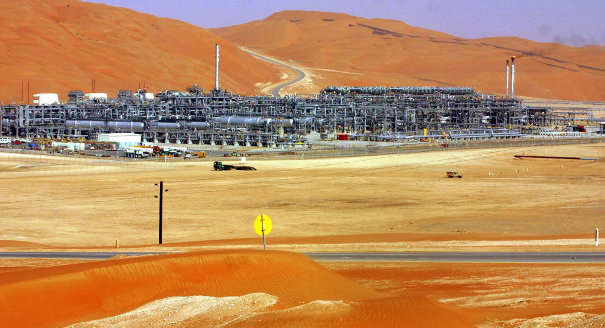
First and foremost, the crisis has exerted downward pressure on the price of oil, exports of which typically account for between 70 and 90 percent of GCC government revenue.1 Following a sharp rise in response to the events of the Arab Spring, the price of oil crept lower for most of 2011 (see figure).
Decreased demand from the Organization for Economic Cooperation and Development (OECD) generally, and Europe specifically, is a key source of downward pressure. And European demand for oil could well be depressed for some time—in January, the World Bank slashed its eurozone growth forecast for 2012 to -0.3 percent from 1.8 percent just six months prior to that.
Second, the crisis has raised the possibility of widespread financial contagion, which would affect the GCC economies in two ways: It would entail massive losses for the Gulf’s institutional investors (including sovereign wealth funds) with substantial holdings in distressed European banks (see figure). Further, a severe financial crisis would raise the prospect of a decline of foreign direct investment (FDI) and of restricted access to wholesale funds (financing outside of core demand deposits) for Gulf banks if liquidity dries up. Forecasts already suggest a contraction of inflows to the region. For example, projected FDI into Saudi Arabia for 2012 is just $5.5 billion, down from $38.1 billion in 2008.
The third major effect of the crisis on the GCC comes via the exchange rate channel—and has proved to be a silver lining. Gulf currencies pegged to the dollar have risen against both the euro and the pound sterling (see figure), making European imports cheaper and putting welcome downward pressure on inflation. High inflation continues to be a worry for the GCC economies—as recently as 2008, average inflation across the GCC stood at an alarming 10.7 percent. As of 2010, it was a much more reassuring 2 percent.2
The importance of these three effects varies widely across the GCC. It is difficult, for example, to generalize about the investment behavior of sovereign wealth funds, in part because their investment activities are often opaque.3
Moreover, the economic and financial conditions in each country are different. In some countries, conditions have mitigated the adverse effects of the crisis. Saudi Arabia’s reliance on European imports, for example, has enabled the country to benefit from the euro’s depreciation, as this has relieved inflationary pressure. But other nations are in a more precarious position. Dubai, for example, is highly vulnerable to a sharp increase in borrowing costs given its ongoing need to refinance $10 billion in government debt.
The Arab Spring
The short-term effect of the Arab Spring on GCC economies has been positive—in contrast to the case for every non-oil economy in the Middle East—with the disruption to regional trade being more than offset by a sharp though short-lived increase in the price of oil. The main concern here stems from the GCC’s response to social unrest in the region, which has partly taken the form of huge domestic social spending pledges, amounting to an estimated $150 billion (12.8 percent of the GCC’s total GDP for 2011) since the start of the Arab Spring.4
Saudi Arabia has been by far the most spendthrift of the GCC nations, accounting for two-thirds of this expenditure. The composition of this spending is also important to note. Abu Dhabi and Qatar, for example, have together spent billions on across-the-board and difficult-to-reverse public sector wage increases.
This reaction is motivated primarily by political rather than economic considerations—governments hope that a flurry of domestic spending will help stave off instability by buying popular acquiescence. However, such spending has considerable economic ramifications.
First of all, expansions of social welfare schemes tend to be politically difficult to reverse, and these new spending programs may become unsustainable should oil prices decline. Second, these huge expenditures will contribute to inflationary pressure, risking a return to the excessively high rates that the region registered in 2008. Third and most important, the composition of this social spending has a distorting effect on the structure of the GCC economies. To the extent that spending packages focus on expanding public sector employment and increasing public sector wages, they undermine rather than address the goal of stimulating private sector–led growth and its ability to create jobs outside of the oil and gas sectors. Without a diverse economy based on a range of profitable sectors, the GCC economies will continue to be exposed to economic volatility in the short term and will struggle to sustain their growth rates once their resources dwindle in the long term.
Besides sharp increases in domestic spending, the GCC states have also reacted to the events of the Arab Spring by pledging aid to Jordan and Morocco as part of a five-year development plan for each. The decision to provide support to Jordan and Morocco in particular—fellow monarchies—was clearly made with an eye toward political considerations. Unlike indiscriminate public sector pay hikes, however, investing in neighboring economies is a policy with the potential for significant economic returns insofar as it facilitates mutually beneficial regional trade.
Reassessments
The GCC has so far been able to maneuver through the challenges presented by both the eurozone crisis and the Arab Spring. But these epochal events remind the region of the need to confront some tough long-term challenges.
The first challenge is diversification away from the oil and gas sectors. The eurozone crisis has highlighted the demand-side volatility of these sectors, with continuing uncertainty over the growth prospects of advanced economies. The Arab Spring, meanwhile, has highlighted the oil sector’s supply-side volatility, as oil prices fluctuated in response to actual and expected disruptions to output.
The second challenge is the GCC’s geographic diversification. Stronger Asian demand has been a key factor in maintaining both oil prices and non-oil exports during the eurozone crisis. The role of emerging markets in driving global growth over the coming decade will reinforce the existing trend toward greater trade between the GCC and emerging economies (see figure).
Still, the GCC is not turning and should not turn its back on Europe or the OECD, which are likely to remain important economic partners for the Gulf states, especially in knowledge-intensive sectors. Most recently, the 91st session of the GCC Financial and Economic Committee reaffirmed the council’s intention to enhance Gulf contact with the European Union.
The third challenge is to build the underpinnings of stronger regional economic integration. On the one hand, the events of the Arab Spring have led the GCC to consciously forge closer ties with Jordan and Morocco. This development suggests that closer economic integration, at least at the subregional level, might be a key policy focus in the upcoming years.
On the other hand, the eurozone experience could prompt a healthy reassessment of regional integration plans in general and subdue momentum toward forming a Gulf currency union in particular. The crisis has brought to the fore the need for consistent fiscal policies and policy coordination mechanisms—neither of which is sufficiently developed in the GCC. GCC leaders will surely watch eurozone developments closely to determine which lessons they should draw on for their own purposes.
The twin shocks of the eurozone crisis and the Arab Spring highlight a number of fundamental issues facing the GCC economies, including the need to diversify exports, the question of orienting trade toward the developing East as opposed to the developed West, and prospects for regional integration.
So far, the GCC has not reacted with a decisive stance on any of these issues, instead using its fiscal space to absorb and adapt to external shocks. But this is not an approach that will work in the long run. A clearer strategy for growth and investment as well as a sustainable social contract between Gulf states and their citizens are needed.
Ibrahim Saif is a resident scholar at the Carnegie Middle East Center. Rand Fakhoury is an economics research intern at the Carnegie Middle East Center.
1.An analysis of central bank data, most recent years. For a convenient but less recent compilation, see http://www.gic.com.kw/site_media/uploads/presentations-or-research/gcc_econ_stat_6th_edit.pdf.
2.IMF World Economic Outlook database, September 2011, and author’s calculations.
3.Abu Dhabi Investment Authority (ADIA) and the Saudi Arabian Monetary Agency (SAMA) rank particularly low in the Linaberg-Maduell Transparency index.
4 Bank of America Merrill Lynch Global Research Note, September 2011.
Saif is an economist specializing in the political economy of the Middle East. His research focuses on international trade and structural adjustment programs in developing countries, with emphasis on Jordan and the Middle East.
Carnegie does not take institutional positions on public policy issues; the views represented herein are those of the author(s) and do not necessarily reflect the views of Carnegie, its staff, or its trustees.
More Work from Malcolm H. Kerr Carnegie Middle East Center
The armed forces champion a form of capitalism that is generating revenue, but its reliance on rent faces diminishing returns, leaving the country with massive sunk costs and deferred returns, deepening dependency on external borrowing.