

Paper
Sheena Chestnut Greitens, Isaac B. Kardon, Cameron Waltz
Source: Getty
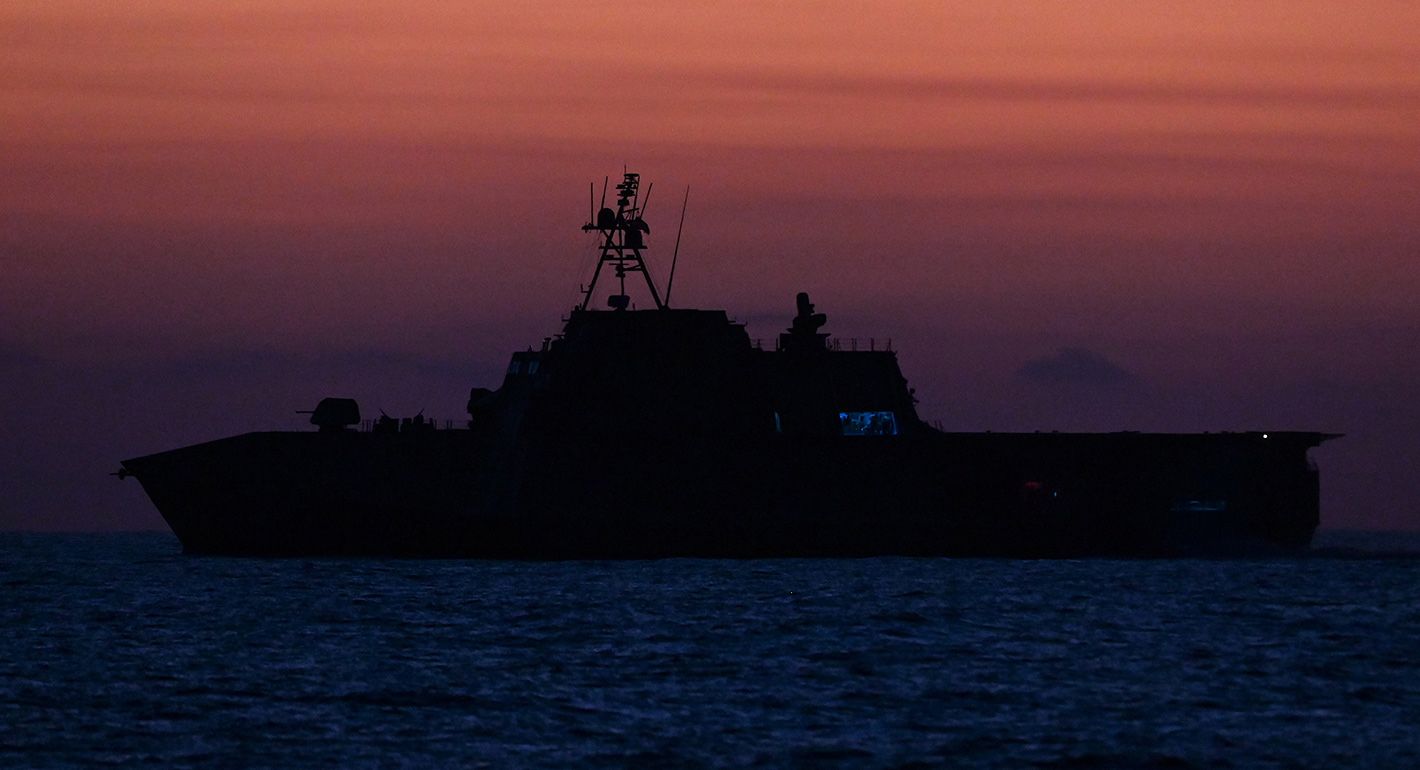
Deterring China from taking actions that risk catastrophic war will require a more disciplined consideration of concrete U.S. interests at stake in maritime East Asia.
Rather than directly confront the United States in East Asia, China has opted to undermine the American-led regional alliance system. This strategy sidelines American military power and erodes allied confidence in its commitments to mutual defense. China targets third parties in ways that could ignite U.S.-China crisis and conflict if American leaders do not attend to allies’ insecurities. This memorandum (1) analyzes the underlying logic and historical basis of this problem, (2) maps escalatory pathways and incentives, and (3) advises American decisionmakers to better coordinate within Washington and among allies. The underlying objective is to diminish China’s incentives to take actions that could escalate to regional or global conflict.
Red lines are ill-suited to the gray zone challenge China poses to the United States and its allies. Deterring China from taking actions that risk catastrophic war will require a more disciplined consideration of concrete U.S. interests at stake in maritime East Asia and a more strategic, less sentimental approach to alliance management.
The potential for crisis and conflict in maritime East Asia is growing in scope and scale. China’s capability to pursue its territorial objectives in the South and East China Seas (SCS and ECS, respectively) and across the Taiwan Strait is advancing in both absolute and relative terms. The United States has reoriented its national security outlook around great power competition and realigned its strategic priorities toward deterring China. Regional states are rapidly adjusting to this pressurized security environment, investing in maritime capabilities, coordinating with one another, and aligning with the United States to varying degrees.
Washington and Beijing are the locus of decisionmaking on questions of war and peace in the region, but neither determines all the factors that may precipitate a militarized crisis. Historically, third countries have often played consequential roles in setting the stakes, conditions, locations, and timing for great power conflicts. Their interests and incentives demand more serious and systematic consideration—especially those of U.S. allies facing Chinese challenges to their sovereignty and territorial integrity. Washington’s tendency to think and plan in terms of “red” (China) and “blue” (America) risks omitting the agency and interests of “green” (allies/friendlies), whose actions may generate the crisis itself, and whose reactions will affect red-blue escalation dynamics.
Under these conditions, apparently minor stakes may trigger major escalation. China’s increasingly coercive gray zone actions reflect Beijing’s assessment that the United States is unlikely to intervene decisively on its allies’ behalf and risk great power war over tiny islands, rocks, and reefs of the SCS and ECS.
This is only one of several asymmetries that make East Asian territorial and maritime disputes so crisis-prone. There is also the yawning gap in maritime power and operating capacity between China and the relatively smaller states whose claims it disputes; another disparity results from allied states’ acute interests in protecting their own sovereignty and the more general American interest in preventing war in the region; a final asymmetry results from varied levels of formal and practical U.S. commitment to disputed maritime features claimed by the Philippines and Japan. Each of these asymmetries contributes to mismatched expectations between the United States, China, and third parties, raising the risk of miscalculation and crisis.
U.S. defense obligations to its allies are the centerpiece of an enduring security architecture that has underpinned East Asia’s relative stability in the postwar era. Yet China’s rise is generating uncertainty about the nature of American treaty commitments, testing their credibility in myriad ways. U.S. allies are uncertain about how the United States will respond to a range of foreseeable scenarios involving China—in no small part because Washington has already balked at many provocative actions and appears uncertain about the thresholds at which it would intervene in mutual defense of its allies.
The Korean War and the Vietnam War are the only instances of direct combat engagements between Chinese and American armed forces. While Beijing and Washington ultimately chose to commit to these conflicts, their decisions were only conceivable in the context of prior third-party actions. These grave precedents should instruct U.S. leaders as they consider how to mitigate the risk of maritime crises with China.
America’s position and potential for conflict with China in maritime East Asia has been largely determined by its relationships with third parties—especially with its former treaty ally, Taiwan, and current allies, Japan and the Philippines. Although the United States takes no formal position in their territorial sovereignty disputes, American power and policy form China’s essential obstacles in those disputes. Truman’s fateful decision in June 1950 to interpose the U.S. Navy’s Seventh Fleet into the Taiwan Strait established a buffer against a mainland invasion that, in effect, remains in place today. Simultaneously, America’s action stifled Chiang Kai-Shek’s ambitions to take back the mainland.
The United States has been playing this dual role for seventy-five years, simultaneously checking sovereign ambitions on both sides of the Taiwan Strait. In this respect, the Taiwan case is not altogether unique. The islands of the SCS and ECS are scattered across the same littoral, and each island dispute shares the same historical provenance: undetermined sovereignty held over from World War II, the predicate for all the tensions that now threaten to destabilize the region. The United States pursues the same objective in each dispute: deterring both parties from taking actions that risk setting off a crisis that could quickly escalate to war.
China is clearly dissatisfied with this arrangement. Since the founding of the PRC in 1949, its leaders have rejected the postwar disposition of territory in the region. Beijing views America’s preservation of this regional order as an insult added to the injury of its “lost” sovereign territories and holds Washington responsible for creating and sustaining regional states’ rival claims. Indeed, the United States brokered the 1951 San Francisco Peace Treaty, which formalized Japan’s renunciation of its sovereignty over Taiwan (or rather, to “Formosa and the Pescadores”) and unenumerated islands in the SCS, but did not specify the sovereign to which they were to be returned. By contrast, Japan retained sovereign title to territories in the ECS south of 29 degrees north latitude (a group of islands that includes the Senkakus), which were placed under U.S. administration and later reverted to Japanese control.
In the twenty-first century, China has sought to renegotiate these territorial terms from a position of much-improved relative power. American decisions to intervene in Korea and Vietnam did not have to contend directly with another regional heavyweight. While the third-party triggers remain in place, China’s maritime posture and capabilities introduce several new dynamics. In particular, the PRC’s preference to operate in the gray zone between war and peace changes the nature of crises that are likely to emerge. This strategy allows Beijing to coerce U.S. allies while remaining beneath the threshold—the red line of lethal force—at which a forceful American response is appropriate.
Two episodes crystallize the third-party role in present U.S.-China maritime tensions surrounding contested features in the SCS and ECS. First, China’s seizure of the Scarborough Shoal in the summer of 2012 after a protracted standoff with the Philippines marks the last significant change to the territorial status quo. The proximate cause of this event was a Philippine Navy frigate’s interdiction of an illegal Chinese fishing operation. This action was interrupted by Chinese maritime law enforcement vessels and led to a months-long standoff. The United States tried to broker a diplomatic stand-down that required both parties to depart the shoal, but only the Philippines complied, sending its vessels home and leaving China in control of the feature.
Later that year, another near-crisis emerged when Japan disregarded American warnings and proceeded to purchase three of the eight Senkaku features from their private owner, a Japanese citizen. China’s subsequent rapid escalation of maritime law enforcement cruises near the islands placed severe strains on the Japan Coast Guard and sent bilateral relations into a tailspin. These events inspired the United States to positively affirm that its treaty commitments cover the disputed islands, but only after the PRC had established a new normal of routine coast guard operations in waters formerly under Japan’s exclusive jurisdiction.
These two episodes share a common narrative: allies took unilateral actions that China portrayed as provocative; then, China exploited poor coordination between the United States and its allies with measured escalation. The end result was greater PRC control and presence around disputed island territories. In one sense, these precedents might instill modest confidence that Chinese actions will remain below a kinetic threshold and only “slice the salami” to achieve marginal gains. From another perspective, however, these events initiated a sustained pattern of successful Chinese coercive actions over the ensuing years and undermined regional confidence that American power and treaty commitments are sufficient to check China’s gradual advances. Allies appear inclined toward the second interpretation and therefore incentivized to take independent action.
China’s repertoire of gray zone tactics has expanded considerably, as have the areas in which they are applied. Whereas in the early 2010s, these operations were confined largely to the northern parts of the SCS, China pressed into the southern tier during the latter part of the decade. Artificial island bases in the Spratly Islands are crucial enablers for these activities, allowing the China Coast Guard and maritime militia to sustain a permanent presence on station around remote features. By the 2020s, Chinese forces were also conducting similar activities around Taiwan and its offshore islands, increasing the frequency and tempo of operations around the Senkakus, and coordinating paramilitary and naval activities with greater sophistication throughout the region. U.S. and allied countermeasures to date have evidently not imposed sufficient costs for Beijing to change course.
This trend is worrisome. Having achieved effective control over much of the contested maritime space, there are few remaining courses of action for Chinese maritime forces that do not involve seizing control over new features and risking significant escalation. Extending the salami-slicing metaphor, there is only so much salami that can be sliced before you cut a finger. Indeed, machete-wielding Chinese paramilitary forces severed the thumb of a Philippines Navy sailor in June 2024. That operation came perilously close to an “armed attack” that could have been the basis for invoking the U.S.-Philippines Mutual Defense Treaty (MDT). China has not yet achieved its territorial ambitions, yet there is little headroom for further escalation that does not risk lethal effects.
Incentives to escalate are also in place for U.S. allies, compounding the risk of crisis. The asymmetry of interests between Washington and its allies with respect to disputed islands is a seam that China has routinely exploited. Beijing recognizes American reluctance to risk escalatory engagements over features with no intrinsic importance to its position in the region. This asymmetry enables China’s near-continuous encroachment into waters that were, until 2010, exclusively administered by Japan (and before then, the United States). Today, the China Coast Guard conducts routine patrols in the contiguous zones and territorial seas around the Senkakus. These operations place considerable strain on the maritime and air capacity of the Japan Coast Guard, while the United States remains a supportive onlooker of these small islands; it remains a step or more removed from the Sino-Japanese clash over core interests of territorial sovereignty.
U.S. interest is occupied primarily by the PLA forces that now operate regularly in the ECS and Sea of Japan, as well as in the northwest Pacific Ocean. Chinese submarines, aircraft, and surface vessels regularly transit the several straits dissecting the Japanese archipelago. While a succession of American presidents has affirmed unequivocally that the islands fall under the MDT, they are clearly not the purpose of the treaty. This robust and interoperable bilateral alliance is not well-adjusted to meet contingencies in and around the Senkakus. A Chinese landing on one or more of these uninhabited islands, for example, would precipitate a crisis in which leaders in Washington and Honolulu would likely exercise extreme caution to avoid a direct clash with Chinese forces. Tokyo would almost surely accept greater risk in defense of its territory.
For the Philippines, the pressure to take countermeasures is still greater due to China’s aggressive actions against its garrisoned forces in the SCS, especially at Second Thomas Shoal. Disagreements among Filipino leaders from defense and coast guard organizations, for example, have led to inconsistent actions at different features. Manila must also contend with another problematic asymmetry. The last three American presidents have affirmed that the MDT with Japan covers the Senkakus, whereas the Philippines’ MDT is limited to islands recognized to be under its jurisdiction, that is, those over which there is no sovereignty dispute. Even with growing permissions for U.S. forces to operate from Philippines territory and deploy more advanced military capabilities, Manila has less confidence that these assets will be used on their behalf—and more incentive to take independent action.
The relatively higher threshold for activating U.S. defense commitments on behalf of the Philippines creates opportunities for China. As America upgrades its posture in the Philippines, China has flaunted the implicit threat from Typhon and Navy-Marine Expeditionary Ship Interdiction Systems (NMESIS) missiles and enhanced joint combat forces. Chinese ships, aircraft, and bases may be more readily targeted using these assets, but the operating environment is no less permissive for the actions short of war that Chinese forces are actually conducting. Meanwhile, if these American capabilities are present, primarily to deter or deny an invasion of Taiwan, they will have the perverse effect of making Manila less confident in U.S. security guarantees and more resistant to allowing American forces to use its territory as a forward operating base for Taiwan contingencies.
With these evident asymmetries, the conditions are in place for allies to doubt U.S. defense commitments and pursue independent efforts to defend their own sovereignty. No amount of U.S. military capability in theater will assuage allies’ concerns that China will continue to operate with impunity—and perhaps even seize disputed territory—beneath the presumed thresholds that would elicit U.S. intervention on their behalf. U.S. policymakers must recognize that the deterrent effects of its current posture are not aligned with its regional defense objectives.
The dilemma facing U.S. decisionmakers in East Asia is thus one of dual deterrence. That is, they must simultaneously convince China not to use force against American allies and meanwhile convince those allies not to take actions that invite Chinese escalation. American commitments to mutual defense must be credible to China and calibrated to the interests and capabilities of its allies. Deterrence succeeds when Beijing sees intolerable risks at higher levels of coercion, while Manila and Tokyo see restraint and coordination with the United States as the surest path to protecting their sovereignty and security.
This dilemma is still more complex and consequential in the case of Taiwan. U.S. policy has long wrestled with the challenge of simultaneously deterring PRC aggression and restraining Taiwan from taking actions that could prompt a mainland use of force. Now that military contingencies involving the island are the “sole pacing scenario” for U.S. defense planning, posture, and force development, the problem has become more acute.
In preparing for high end warfighting over Taiwan, the United States neglects vulnerabilities at the low end of the conflict spectrum. Taiwan is struggling to counter the mainland’s intensifying gray zone activities, which could enable it to encircle or seize Taiwan’s outlying islands; law enforcement and militia assets alone could impose a quarantine or nonkinetic blockade that would deprive Taiwan of energy, food, or other vital imports. Without specific assurances that the United States would take decisive action to deny such operations, leaders in Taipei will have to weigh the risks of unilateral escalation against the gradual but existential effects of Chinese coercion.
Ultimately, deterrence occurs in the mind of the adversary. Its effectiveness is not a direct function of objective military capabilities, but subjective beliefs that those capabilities will be used under certain conditions. Crowding American forces into the theater may perversely embolden allies to take escalatory actions in the expectation that those forces will be employed in a crisis; the process of building up local capability may present a closing window of opportunity for China, and spur it to pursue defined territorial objectives before the United States has achieved escalation dominance. Any sound strategy entails serious reckoning with how the adversary will understand and react to it. In East Asia, that will require far greater attention to third-party agency and potential to catalyze a U.S.-China crisis.
Bottom line: U.S.-China conflict is not inevitable. Chinese coercion of third parties in the region, by contrast, is certain to continue and likely to escalate. This fundamental uncertainty underscores the wisdom of seeking to deter China and U.S. allies from generating crises that could devolve into great power war. Greater U.S. military capability in theater does not necessarily achieve this purpose—and may even undermine it by convincing allies that U.S. intervention is automatic, not conditional. Greater calibration of commitments to allies and disciplined signaling to China will introduce caution for all parties and reduce risk of conflict.

Senior Fellow, Asia Program
Isaac B. Kardon is a senior fellow for China studies in the Asia Program.
Recent Work


Sheena Chestnut Greitens, Isaac B. Kardon, Cameron Waltz
Sheena Chestnut Greitens, Isaac B. Kardon, Cameron Waltz
Carnegie does not take institutional positions on public policy issues; the views represented herein are those of the author(s) and do not necessarily reflect the views of Carnegie, its staff, or its trustees.
Policy discussion is ignoring that the Palestinian national project is hollowed out and apartheid is a present danger.

Nathan J. Brown
As negotiations with Iran and Lebanon continue, chaos is at the heart of the Netanyahu government’s calculations.

Michael Young
The party’s domestic and regional roles have changed, so Lebanon should devise a disarmament strategy that encompasses this.
Michael Young
In an interview, Marc Lynch discusses his new book decrying the post-1990 U.S.-dominated order in the Middle East.
Michael Young

Because perpetual conflict enhances control, offers economic benefits, and allows leaders to ignore popular preferences.

Angie Omar