

Commentary
Andrei Kolesnikov
{
  "authors": [
    "Andrei Kolesnikov"
  ],
  "type": "commentary",
  "blog": "Carnegie Politika",
  "centerAffiliationAll": "",
  "centers": [
    "Carnegie Endowment for International Peace",
    "Carnegie Russia Eurasia Center"
  ],
  "collections": [],
  "englishNewsletterAll": "",
  "nonEnglishNewsletterAll": "",
  "primaryCenter": "Carnegie Russia Eurasia Center",
  "programAffiliation": "",
  "programs": [],
  "projects": [],
  "regions": [
    "Russia"
  ],
  "topics": [
    "Political Reform",
    "Economy"
  ]
}
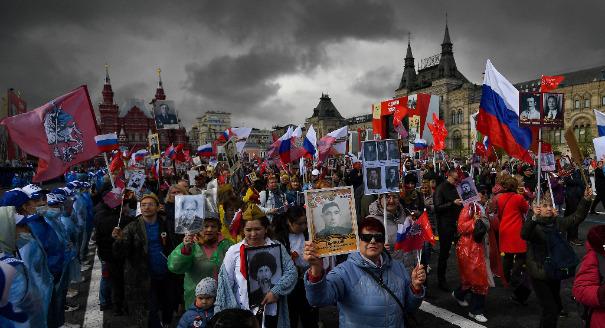
Source: Getty
Russia’s rulers build the future using blueprints from the past. Right now, Vladimir Putin’s Russia seems to have gone back in time to antiquity.
This article was originally published in Russian in the New Times.
Right now, several different groups of experts and activists, some still in Russia and some already abroad, are hard at work writing conceptual papers on the Russia of the future. That’s perfectly logical: the desire to understand exactly what Russia should be moving toward and what scenarios it will have to pass through to get there is always strongest during periods of crisis or—like now—the complete collapse of everything.
Brainstorming visions of the future is a form of psychotherapy and an attempt to pragmatize a state of total disaster, since people are keen to emerge from that state and to draw up scenarios that will make sure they never end up trapped in that same nightmare again.
It’s also an attempt to understand why any experiments involving modernization and visions of the future always end badly. Back in his 1994 book State and Evolution, the reformer Yegor Gaidar described this trait of Russian history as follows: “Movement from any given point, after any pirouettes, always ends the same way: at the foot of the throne of the same old political and economic dictatorship of an ‘eastern’ state.”
The last time the Russian authorities took a modernization plan seriously—and not even an overly authoritarian one at that—was under then president Dmitry Medvedev. The documents prepared by the Institute of Contemporary Development (INSOR) at the request of Medvedev included an “image of a desirable tomorrow,” as well as concrete plans and attractive brochures based on brainstorming sessions. Yet officially, not one of those plans was accepted by the authorities, even back in those relatively toothless times.
Looking back, several things are clear. Russia was and remains a country of constant crises and constant wars. First there were the Chechen wars, then, under Medvedev, the war with Georgia, while the primary motivation to think about the future stemmed from the economic crises of 1998 and 2008–2009. It seemed that these factors were being taken into account, and there was a strong impulse to build a future for Russia free of both war and crisis.
Toward the end of Medvedev’s presidency, at the start of 2011, the INSOR compiled—this time at its own initiative, without any impetus from the Kremlin—one more document that was intuitively seen as a bequest, a last-ditch attempt to provide Medvedev with a program for a second presidential term. Having worked on the document myself, I can say that even as the program was being written, there was a feeling that no second term, alas, would be forthcoming. In any case, judging by what the former president has been writing and saying lately, he didn’t read the INSOR materials very carefully.
The philosopher Alexander Rubtsov and I put our hearts and souls into compiling those materials. We argued that there were only two options: modernization, or the end of everything—and we were right. Chapters included “Modernization as National Salvation” and “The Humanitarian Aspect of Modernization as a Reassessment of Values,” in which we tried to protect Russia from the same ideology that led to the “special military operation” in Ukraine. Others were titled “Defense and Security: Getting the Army, Police, and Special Services on the Side of the People” and “Foreign Policy: Russia in a Circle of Friends.”
That may all sound utopian now, but it was the rejection of implementing that utopia that led to the current catastrophe.
Russia is unlucky with its future because it is unlucky with its past. Its rulers formulate whatever public image of Russia’s past happens to suit them. That means they are building the future using blueprints from the past. Right now, Vladimir Putin’s Russia seems to have gone back in time to antiquity.
The image of the future begins with the image of the past. If the country’s heroes are military commanders and state figures like the dictator Joseph Stalin and his secret police chief Lavrenty Beria, informants and loyalists, then such a past will result in a future Russia very close to today’s Putinism.
If the country’s heroes are those who took to Moscow’s Pushkin Square in 1965 to protest against the arrests of the dissident writers Andrei Sinyavsky and Yulii Daniel, and to Red Square in 1968 to protest the invasion of Czechoslovakia, then the country has a different future altogether.
Only one thing is certain. Any model of the future must be post-Putin. Under Putin, Russia’s future has been amputated. It’s now crystal clear that change and modernization can only begin after Putin. Russia’s history is heavily personified: that’s why we speak of the eras of Stalin, Nikita Khrushchev, Mikhail Gorbachev, Boris Yeltsin, and now Putin, who has lasted longer than any of the others—except Stalin.
Some might argue that the leader who comes after Putin could be even worse. But our country’s history shows that as a rule, following the departure of a harsh autocrat, their successors (from their own entourage) immediately start to compete among themselves to liberalize the regime, just as Georgy Malenkov, Beria, and Khrushchev did following the death of Stalin.
There was an idea in certain circles that anyone who wanted to see Russia modernize should actually back Putin, because truly free elections would bring to power unfettered ultranationalists. Needless to say, quite the opposite has happened. Democracy, the rotation of power, and accountability are the best defenses against this kind of scenario.
Sometimes, during the course of history, it’s helpful to let things develop naturally and not dabble in social engineering. Perhaps then, the nation will not slide headfirst into disaster. Right now, with the benefit of hindsight, it looks like it would have been a far better outcome for Russia if former prime minister Yevgeny Primakov, for example, had become president instead of Putin. Not because he was particularly good as a manager or thinker: far from it, in fact, his qualities are greatly overexaggerated. But under Primakov, and after him, Russia would not have been tipped into the national catastrophe referred to as the “special military operation.”
Authoritarian modernization in Russia is impossible. But in the post-Putin future, normal modernization will be possible, based on democratic development and the rotation of power.
Former Senior Fellow, Carnegie Russia Eurasia Center
Kolesnikov was a senior fellow at the Carnegie Russia Eurasia Center.
Recent Work
Andrei Kolesnikov
Andrei Kolesnikov
Carnegie does not take institutional positions on public policy issues; the views represented herein are those of the author(s) and do not necessarily reflect the views of Carnegie, its staff, or its trustees.

If the Russian-speaking community in Latvia cannot articulate their interests without being seen as disloyal, they could end up embracing a pro-Kremlin agenda.

Sergejs Potapkins

Russia’s ruling party would have benefited from Putin appearing as its distant patron, but as an active frontman imposing his views on the public, he has done nothing but harm both the party’s election campaign and the ruling system overall.

Andrey Pertsev

Depleted financial reserves and a shrinking tax base mean it is no longer possible to simultaneously deliver high defense spending, price stability, and economic growth.

Alexandra Prokopenko

Blurring the line between humans and animals is a long-standing tradition in social utopian prose. In his latest novel, Leonid Bershidsky reminds us that in social experiments, people are often treated no differently than animals.

Alexander Baunov

In the tenth year of his presidency, President Mirziyoyev’s system is becoming even more personalized than that of his predecessor Karimov.

Galiya Ibragimova