

Commentary
Temur Umarov
{
  "authors": [
    "Temur Umarov"
  ],
  "type": "commentary",
  "blog": "Carnegie Politika",
  "centerAffiliationAll": "dc",
  "centers": [
    "Carnegie Endowment for International Peace",
    "Carnegie Russia Eurasia Center"
  ],
  "collections": [],
  "englishNewsletterAll": "ctw",
  "nonEnglishNewsletterAll": "",
  "primaryCenter": "Carnegie Russia Eurasia Center",
  "programAffiliation": "russia",
  "programs": [
    "Russia and Eurasia"
  ],
  "projects": [],
  "regions": [
    "Central Asia",
    "Kazakhstan"
  ],
  "topics": [
    "Economy"
  ]
}
Source: Getty
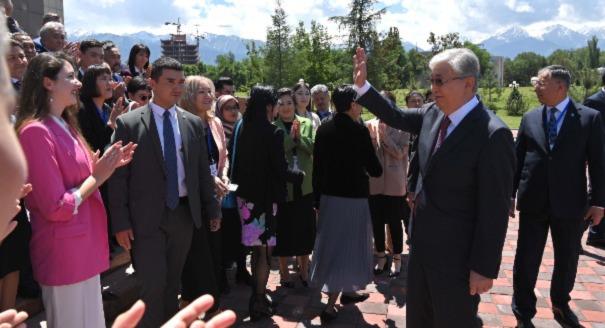
The war in Ukraine has enabled Kazakhstan’s Tokayev to reinvent himself as a truly independent figure, no longer reliant on either his predecessor Nazarbayev or Russia’s Putin. Now Tokayev hopes to cement this status by securing a popular mandate to rule.
At first glance, this fall’s snap presidential election in Kazakhstan may strike observers as just the latest attempt by an authoritarian leader to extend his grip on power. However, there may be grounds for optimism when it comes to President Kassym-Jomart Tokayev’s promise to transform the political system, even as concerns remain that Tokayev will ultimately prioritize his own interests—and those of other elites—over the cause of democratization.
Tokayev, the successor to the long-serving Nursultan Nazarbayev, took office in 2019. Now, two years before the end of his first term in power, he has called a snap presidential election. He could have waited until the end of his current term and then run again for another five-year term, but Tokayev has shocked Kazakhstan’s political world by proposing to limit its presidents to a single seven-year term. It’s not yet clear whether the proposed new rule would apply to the incumbent himself: if it is passed before the upcoming vote, Tokayev will run for one final seven-year term. If it is passed after the vote, he will have been elected for another five-year term with the option of then running again for a further seven-year term.
On the face of it, there is nothing novel about the election. All the presidential contests that preceded it, going back to the 1990s, were snap elections. The purpose is obvious: to hold an election at a time that suits the current regime. The opposition, or what remains of it after Nazarbayev’s reign, does not have enough time to prepare an adequate challenge to Tokayev.
More important, nor does the Nazarbayev family, whose allies are weaker and less popular than ever. Many in the ex-president’s circle are under investigation. Nazarbayev himself is out of politics and largely absent from the public eye. Meanwhile, Kazakhstan is ridding itself of his legacy. Most recently, Tokayev announced that the name of the capital—changed to Nur-Sultan in 2019—would be restored to its previous iteration, Astana.
Tokayev’s poll numbers, in contrast, are on the rise. His hand was initially strengthened early in the year, when he emerged victorious from the January unrest and set about marginalizing Nazarbayev and his family. At the same time, however, Tokayev’s appeal for intervention by the Russian-led Collective Security Treaty Organization convinced some Kazakhstanis that Nazarbayev’s man had become Vladimir Putin’s.
The war in Ukraine gave Tokayev the chance to shed that reputation. With his public refusal to support Russia’s invasion, he has reinvented himself as a truly independent figure. Tokayev hopes to cement this status by securing a popular mandate to rule, as distinct from a mandate from either Nazarbayev or Putin.
For Tokayev, holding the vote this fall, while there is a brief lull in the geopolitical turbulence on Kazakhstan’s borders, is a much safer bet than waiting until 2024, when it was originally scheduled. At present, Russia has its hands full with the war, while Xi Jinping is preparing for the Chinese Communist Party’s 20th National Congress, at which he is expected to consolidate his power.
In addition, it is crucial that Tokayev win reelection before the war’s economic consequences hit the pocketbooks of Kazakhstanis. The January riots, in which it is now estimated that more than a million people participated, revealed the extent of the pent-up socioeconomic discontent, and life is unlikely to get easier for people over the next few years.
In recent months, Russia has on four occasions stopped the flow of Kazakh oil through the Caspian Pipeline Consortium’s pipeline, threatening the Kazakh state’s main source of revenue. Since Russia is also Kazakhstan’s biggest trading partner, the Central Asian nation is also actively importing inflation: the cost of food items has increased by over 20 percent year on year. For now, Kazakhstan can count on high energy prices and the confiscation of assets from the Nazarbayev circle (nearly half a billion dollars’ worth since the start of the year). Still, the former are unpredictable, and the latter will not last forever, adding to the urgency of Tokayev getting reelected.
Tokayev’s commitment to democratization is not just rhetorical. His constitutional amendments bear little resemblance to those recently passed in Russia and Belarus and debated in Uzbekistan. Kazakhstan has abolished the death penalty, barred the president’s close relatives from entering politics or holding senior positions in state companies or regional administrations, and repealed a 2000 law granting legal immunity to Nazarbayev and his family. The constitutional amendments also envision the removal of the president every seven years.
Still, the fact remains that Kazakhstan’s political system has not changed yet. With the president remaining in control of all the branches of government, political transformation is for the time being just a promise from Tokayev. It is worth recalling that Kazakhstanis were frequently assured by Nazarbayev that he would not outstay his welcome, yet ultimately lived under his rule for three decades. For his part, Tokayev has already broken his promise not to “rewrite the laws, let alone the constitution.”
Tokayev may well be waiting for the right moment to launch substantial political reform, but what guarantees are there that such a time will ever come? After all, real democratization will inevitably harm the interests of various parts of the ruling elite, with whom Tokayev has not shown himself willing to come into conflict. It is, then, much more likely that reforms will be delayed again and again, ostensibly due to the crisis of the day, and that Tokayev will compromise on his plans and close his eyes to sabotage.
Critically, in Kazakhstan’s political system, there is no promise of a safe exit for the country’s leaders. Nazarbayev tried but largely failed to secure one, and his fate is not one that Tokayev is likely to want to meet. Yet Tokayev’s push for democratization risks weakening the presidency and in turn limiting his ability to fend off his enemies, of whom he already has his fair share: from Nazarbayev’s humiliated allies to Kazakhstan’s new generation of political elites, for whom Tokayev is no less a relic of the Soviet past than his predecessor.

Fellow, Carnegie Russia Eurasia Center
Temur Umarov is an expert on China and Central Asia, and a fellow at the Carnegie Russia Eurasia Center.
Recent Work
Temur Umarov
Temur Umarov
Carnegie does not take institutional positions on public policy issues; the views represented herein are those of the author(s) and do not necessarily reflect the views of Carnegie, its staff, or its trustees.

Russian strikes are weakening the economy sustaining Ukraine’s war effort. Closing the growing funding gap will require more European support and politically contentious reforms in Kyiv.

Balázs Jarábik

Ex-president Gurbanguly Berdimuhamedov remains interested in politics, but his son Serdar, Turkmenistan’s current president, is becoming increasingly independent and willing to break with his father’s legacy. If their covert rivalry goes too far, both risk losing power.

Galiya Ibragimova

For every ruble allocated to social policy, health, and education in 2027, double that amount is earmarked for the army, the police, and the security services.

Alexandra Prokopenko

Depleted financial reserves and a shrinking tax base mean it is no longer possible to simultaneously deliver high defense spending, price stability, and economic growth.
Alexandra Prokopenko

In the tenth year of his presidency, President Mirziyoyev’s system is becoming even more personalized than that of his predecessor Karimov.
Galiya Ibragimova