

Commentary
Tatiana Stanovaya
{
  "authors": [
    "Tatiana Stanovaya"
  ],
  "type": "commentary",
  "blog": "Carnegie Politika",
  "centerAffiliationAll": "dc",
  "centers": [
    "Carnegie Endowment for International Peace",
    "Carnegie Russia Eurasia Center"
  ],
  "collections": [],
  "englishNewsletterAll": "ctw",
  "nonEnglishNewsletterAll": "",
  "primaryCenter": "Carnegie Russia Eurasia Center",
  "programAffiliation": "russia",
  "programs": [
    "Russia and Eurasia"
  ],
  "projects": [],
  "regions": [
    "Russia",
    "Caucasus"
  ],
  "topics": [
    "Political Reform",
    "Economy",
    "Domestic Politics"
  ]
}
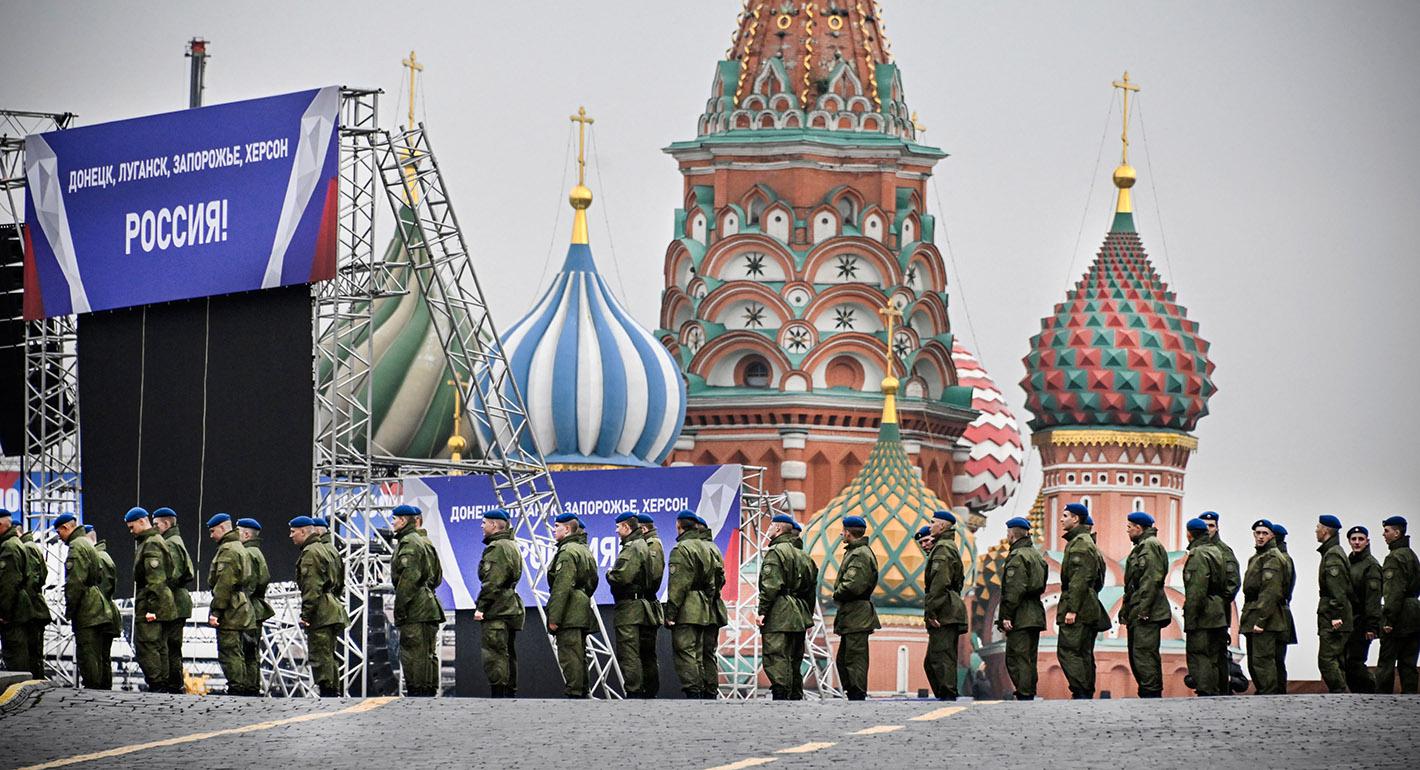
Source: Getty
Russia is heading toward a final battle between the radicals, for whom escalation is a way of life, and the realists, who understand that continuing to up the ante could lead to their country’s collapse.
There was already talk of a possible split within the Russian elite two months ago, after Russia’s hurried retreat from Ukraine’s Kharkiv region. Since then, Russian troops have also been forced to withdraw from the key city of Kherson, and the predicted schism is taking shape. Members of the elite are dividing into relative realists who are calling for a tactical pause in the fighting in order to rethink Russia’s goals, and those who advocate remorseless escalation at any price.
Never before have Putin’s strategic decisions—generally seen as the price of stability—pushed the Russian elites to the brink of a divide. They put up little resistance to the evisceration of the oligarchs, the rise of the siloviki (security services), and the 2008 Georgian war, while the annexation of Crimea from Ukraine in 2014 was positively welcomed by many.
From 2015, life in Russia started becoming rapidly Sovietized, culminating in changing the constitution to allow Putin to remain in power and the complete decimation of the genuinely anti-Putin (“non-system”) opposition. The elites grumbled, but carried on as if nothing had happened. Even the invasion of Ukraine didn’t divide the elites, though it came as a shock to them. Willingly or otherwise, they had to accept the war as a fait accompli. Anyone who was strongly opposed to it simply left the country. If they were unable to leave, they remained silent.
Until the September retreat from the Kharkiv region, the reasoning of most members of Russia’s elites—from the siloviki to big business—was simple: Russia would have to win somehow. It didn’t matter what that meant in practice, but defeat could well bring sociopolitical destabilization, and the elites certainly don’t want a revolution. The Kremlin, therefore, would have to achieve some kind of conquest that would enable the regime to evade collapse.
From September, however, everything started to change, and fast. For the first time in the twenty-three years for which Putin has been in power, there are grounds to talk of a gradual divide within the elites. People on both sides of that divide remain pro-Putin and part of the system, but they have different views on what Russia should do next and what its priorities should be. And since the divide is among Kremlin insiders—inside the apparatus of repression itself, tailored to fight the “non-system” opposition—not much can be done about it.
Putin himself is absent from this nascent debate. No one looks to him, if for no other reason than because his position isn’t clear to anyone. His functions as leader are becoming eroded because he is still waging this war as a “special operation” without clarifying its aims.
Up until September, it seemed to the elite that Putin knew what he was doing. But after the retreat from Kharkiv and Kherson, everything is being seen as a rapid descent into chaos and even the collapse of the country. After all, what was the point of holding referendums on annexing four new regions of Ukraine, only to promptly abandon them without a fight? More frightening than the war itself is the prospect of a freefall into the abyss. In this respect, Putin looks like a weak figure to both camps in the elite. Even the emergence of those camps is a reaction to his weakness as a leader.
The divide is forming around one key question: what to do if Russia loses this war. Practically all representatives of the elite are coming to the conclusion that that is what will happen if nothing changes. It may even be necessary to give up Crimea, and from there it’s a slippery slope to full capitulation, with international war tribunals, years of reparations, and the installation of a pro-Western government. This is why no party of peace has emerged in Russia: in the country’s current vulnerable position, it would instantly become the party of defeat, and no one is yet ready to join the ranks of the losers.
Even if there is no defeat, there will still be an increasingly distinct dividing line within the pro-war camp. On one side will be the realists, who believe that since Russia cannot win the war right now, it should pause the fighting to work on rebuilding its army and economy, as well as revamping the political system. For the realists, it was a mistake to start the war, stemming from a distorted understanding of the country’s capabilities. Nor should the referendums have been held, since there was no possibility of holding onto those territories. Still, the realists are opposed to giving up Russia’s positions: the front line must be defended.
The realists don’t just consist of technocrats. They also include siloviki, senior officials, and prominent businessmen. The heads of giant state corporations such as Rosneft CEO Igor Sechin and Rostec CEO Sergei Chemezov are pragmatists rather than supporters of victory at any cost, because they have everything to lose. The views of the pragmatists are represented in the media through sharp criticism of the army and warnings of the risks to the country from the unfolding war with NATO.
On the other side from the realists are those who favor escalation. These people are adamant that to avoid defeat, Russia must be prepared to embark on a full-scale mobilization, concentrate its resources, and rain bombs on Ukraine relentlessly until the bitter end. This section of the elite is far more disparate than the realists, but is united by one factor: the worse things are going at the front, the more political dividends these people are set to receive.
High-profile representatives of the party of escalation include the notorious businessman and mercenary boss Yevgeny Prigozhin and the reckless Chechen leader Ramzan Kadyrov. The wealthy Kovalchuk brothers are also more or less in this group. Although they, like Sechin and Chemezov, have everything to lose, the difference is that like Prigozhin, instead of controlling state assets, they provide their private assets to the state, such as media or Prigozhin’s private military company Wagner. The more the state needs their services, the more weight they carry within the system.
Despite the fact that many proponents of escalation remain on the sidelines of official decisionmaking processes, this is the party that is largely affecting Russia’s strategy in Ukraine right now, due to their ideological closeness to Putin and—for some of them—access to his ear. It’s because of them that Putin switched from “wait and see” tactics to launching massive strikes against Ukraine’s energy infrastructure. The president is convinced that these strikes will reduce the Ukrainian army’s combat capacity and damage the government’s popularity, paving the way for Moscow to dictate the terms of Kyiv’s capitulation.
If this plan doesn’t work (and there are serious doubts that it will), the party of escalation will grow even stronger and even more radical—not just with regard to Ukraine, but also toward those who believe Russia cannot win. At the same time, the party of realists will also gain political weight, especially since public opinion is gradually shifting in favor of de-escalation.
Russia is heading toward a final battle between the radicals, for whom escalation is a way of life, and the realists, who understand that continuing to up the ante could lead to their country’s collapse. It’s impossible to say right now who will win this battle, but it will determine not only the outcome of the war in Ukraine, but also the future of Russia.

Senior Fellow, Carnegie Russia Eurasia Center
Tatiana Stanovaya is a senior fellow at the Carnegie Russia Eurasia Center.
Recent Work
Tatiana Stanovaya
Tatiana Stanovaya
Carnegie does not take institutional positions on public policy issues; the views represented herein are those of the author(s) and do not necessarily reflect the views of Carnegie, its staff, or its trustees.
A leak of Russian gas price data helps establish that China is paying Russia far less than Central Asian countries and Gazprom’s former European customers.

Sergey Vakulenko

Japan’s long-term security policy is driven by concerns about China, and there is little appetite for (or interest in) pursuing a confrontation with Moscow.

James D.J. Brown

The truth of the strategic situation is that Europe and Russia are extremely unlikely to be able to “turn the page” on their confrontation within the next two decades.

Arkady Moshes
Russia spent years building a “sovereign internet,” concentrating web infrastructure exclusively within Russian territory. Ukrainian drone attacks have shown how vulnerable that approach has left the Russian internet.

Maria Kolomychenko

Putin’s conservative staffing policies and search for ever greater control have cemented parliament’s transformation into a bureaucratic appendage of the executive branch.

Andrey Pertsev