

Commentary
James D.J. Brown
{
  "authors": [
    "James D.J. Brown"
  ],
  "type": "commentary",
  "blog": "Carnegie Politika",
  "centerAffiliationAll": "dc",
  "centers": [
    "Carnegie Endowment for International Peace",
    "Carnegie Russia Eurasia Center"
  ],
  "collections": [],
  "englishNewsletterAll": "ctw",
  "nonEnglishNewsletterAll": "",
  "primaryCenter": "Carnegie Russia Eurasia Center",
  "programAffiliation": "russia",
  "programs": [
    "Russia and Eurasia"
  ],
  "projects": [],
  "regions": [
    "East Asia",
    "China",
    "Japan",
    "Russia",
    "Caucasus",
    "Eastern Europe",
    "Ukraine"
  ],
  "topics": [
    "Foreign Policy",
    "Economy"
  ]
}
Source: Getty
Tokyo’s tough response to Russia’s invasion of Ukraine stems at least partly from fear over what conclusions Japan’s other authoritarian and anti-Western neighbor—China—might draw from the war.
Russia’s annexation of Crimea in 2014 prompted largely symbolic sanctions from Japan, and did not divert Tokyo from its pursuit of better relations with Moscow. In 2022, however, the Japanese response to the invasion of Ukraine closely tracked that of the United States and the EU.
Since the war’s outbreak, Japan has sanctioned hundreds of Russian entities and individuals and promised to gradually end imports of Russian oil and coal. Tokyo has supplied Kyiv with military equipment including surveillance drones, and may even eventually lift its ban on providing lethal weapons to foreign nations.
There is more to this than mere displeasure with Moscow’s actions. In Tokyo, officials fear what conclusions China might draw from the war, and are seeking to signal to Beijing that any similar attempt to forcibly change the status quo in East Asia will be met with fierce resistance.
Since 1945, Japan has strived to avoid confrontation in its foreign policy, and to this end refrained from sanctioning transgressive states. Under the influence of the powerful Ministry of Economy, Trade, and Industry, successive prime ministers prioritized economic interests over geopolitical or humanitarian ones. Even after China’s Tiananmen Square protests of 1989 and the ensuing massacre, Japan—in its capacity as a G7 member—opposed sanctioning China.
Yet Russia’s invasion of Ukraine has forced it to change tack, prompting it to introduce a sanctions regime that differs little from those of the EU, the United States, and Canada. The latest package of sanctions, in effect since January 27, blacklisted three more companies and thirty-six individuals, who joined hundreds of designees from Russia including President Vladimir Putin himself. In addition, forty-nine Russian companies were banned from importing dual-use goods from Japan.
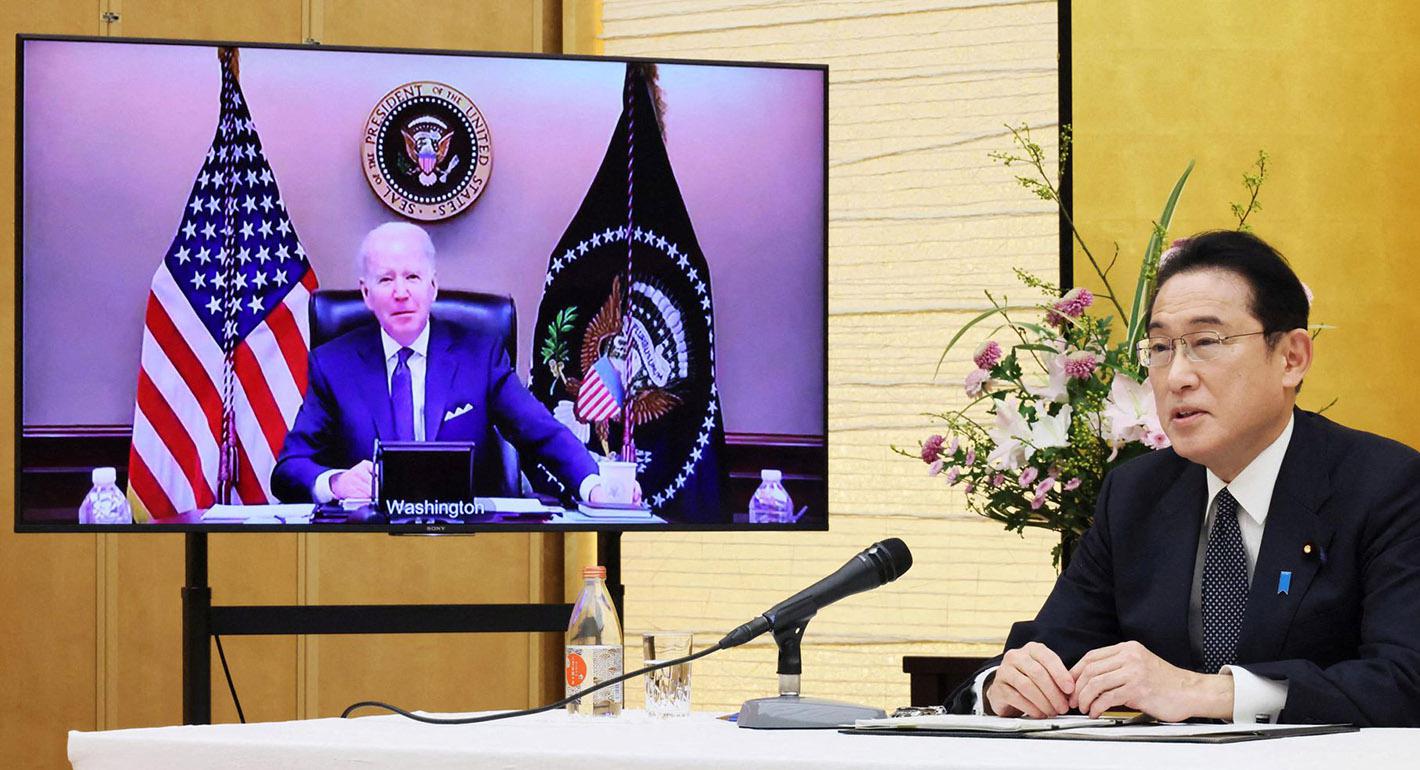
The Japanese have also actively supported Kyiv. On February 20, Prime Minister Fumio Kishida announced a financial package worth $5.5 billion, adding to the $600 million already committed. Despite a history of accepting few refugees, Japan has also taken in about 2,000 Ukrainians. In addition, Tokyo has supplied Ukraine with not only body armor and winter gear, but also surveillance drones and other defense hardware. This is the first instance of Japan assisting a country that is party to an armed conflict in this way, amid a long-standing ban on such transfers.
Japan’s government may go further still. There is talk of a proposal to allow the provision of lethal weapons and other equipment such as tanks and missiles to victims of acts of aggression that violate the principles of international law: in other words, to Ukraine.
These moves are surprising not only because they are unprecedented, but also because of Japan’s geographical distance from the war zone and the absence of any threat to it of a Russian invasion. Tokyo could, after all, have adopted the same “wait and see” reaction as countries like Turkey and Israel.
The Kremlin claims that Tokyo has simply succumbed to pressure from Washington, becoming a vassal of the United States at the expense of Japan’s national interest. Such accusations allow Russia to downplay how global the international coalition against Moscow is, but are not convincing.
While the United States does have the ability to influence Japanese policy, in this instance, there was no need to cajole or coerce. For one, Japanese society, which was genuinely shaken by the invasion of Ukraine, came out in support of the sanctions against Russia: support that only deepened following reports of atrocities by Russian soldiers in Bucha and other Ukrainian towns and cities.
Last spring, a poll by the Kyodo news agency showed that 86 percent of Japanese people were in favor of imposing sanctions on Russia. By October 2022, just 5 percent of respondents said they “felt amicable” toward Russia: the lowest level since polls started being held on this issue in 1978. If there was any pressure to take a hard line against Russia, then it came from the public, not Washington.
Japan’s policy on the war has also been developed with the threat from China in mind. From Tokyo’s point of view, Putin and Xi Jinping have a lot in common. Both leaders have grown more authoritarian and anti-Western in recent years, and both have served as head of state for many years now, and have potentially lost their grip on reality: all factors that increase the risk of a serious miscalculation.
Japanese leaders wonder whether Xi, like Putin, may be so far gone as to embark on a disastrous war with a neighbor. Indeed, Prime Minister Fumio Kishida regularly observes that “Ukraine today may be East Asia tomorrow.”
Were a major conflict centered on Taiwan to break out, Japan would almost certainly end up involved. The troops that Washington would task with defending Taiwan would deploy from bases on Japanese territory. Furthermore, Japan’s parliament legislated in 2015 that the country could use force to protect allies from attack, such as in the event of a Chinese assault on U.S. ships departing Japan for Taiwan.
Understandably unenthusiastic about such a scenario, Japan would prefer to deter China from attempting to forcibly change the status quo in East Asia. To this end, it is committed to increasing defense spending from 1 percent of GDP to 2 percent, and will acquire missiles that can reach targets inside China.
Japan’s tough response to the invasion of Ukraine is also part of this effort. It is designed to prevent Moscow from achieving a victory that could embolden Beijing, and also to signal to China that any aggression against Taiwan will be similarly punished by the international community.
Japan’s Russia policy has long been shaped by its relations with China, which Tokyo considers the main threat to its security. Following the annexation of Crimea in 2014, then prime minister Shinzo Abe resisted Western calls to seriously sanction Russia on the grounds that an isolated Moscow would draw even closer to Beijing. Now, on the contrary, the Japanese government believes a tough response is needed as a warning to others.
The Kremlin may believe that both the Japanese public and government actually oppose sanctions against Russia and have only joined them under pressure from the United States. Yet even discounting its concern for and investment in the rules-based order, Tokyo is extremely worried about the precedent Russia’s aggression may set for other authoritarian states, making this seemingly distant conflict nothing less than a matter of national security for Japan.

Professor of Political Science at Temple University
Recent Work
James D.J. Brown
James D.J. Brown
Carnegie does not take institutional positions on public policy issues; the views represented herein are those of the author(s) and do not necessarily reflect the views of Carnegie, its staff, or its trustees.

Russian strikes are weakening the economy sustaining Ukraine’s war effort. Closing the growing funding gap will require more European support and politically contentious reforms in Kyiv.

Balázs Jarábik

Despite a new textbook, an influx of Russian teachers and managers, and an end to the teaching of Ukrainian, the Kremlin is unlikely to have “reprogrammed” locals.

Konstantin Skorkin

For every ruble allocated to social policy, health, and education in 2027, double that amount is earmarked for the army, the police, and the security services.

Alexandra Prokopenko

Cargo traffic through Russia’s Northern Sea Route has increased because of the disruption caused by the conflict in the Middle East, the Ukraine war, and U.S.-China tensions.

Mikhail Korostikov
An analysis of traffic accident data suggests that Ukrainian drone attacks caused a material but not disastrous fall in Russian gasoline consumption over the summer.

Sergey Vakulenko