

Commentary
Alexandra Prokopenko
{
  "authors": [
    "Alexandra Prokopenko"
  ],
  "type": "commentary",
  "blog": "Carnegie Politika",
  "centerAffiliationAll": "dc",
  "centers": [
    "Carnegie Endowment for International Peace",
    "Carnegie Russia Eurasia Center"
  ],
  "collections": [],
  "englishNewsletterAll": "ctw",
  "nonEnglishNewsletterAll": "",
  "primaryCenter": "Carnegie Russia Eurasia Center",
  "programAffiliation": "russia",
  "programs": [
    "Russia and Eurasia"
  ],
  "projects": [],
  "regions": [
    "Russia",
    "Caucasus"
  ],
  "topics": [
    "Political Reform",
    "Economy",
    "Foreign Policy",
    "Domestic Politics"
  ]
}
Source: Getty
The excessive optimism of Putin and his ministers smacks of an attempt to convince not even mythical investors so much as themselves that business as usual is possible—and even compatible with their threats to unleash nuclear war.
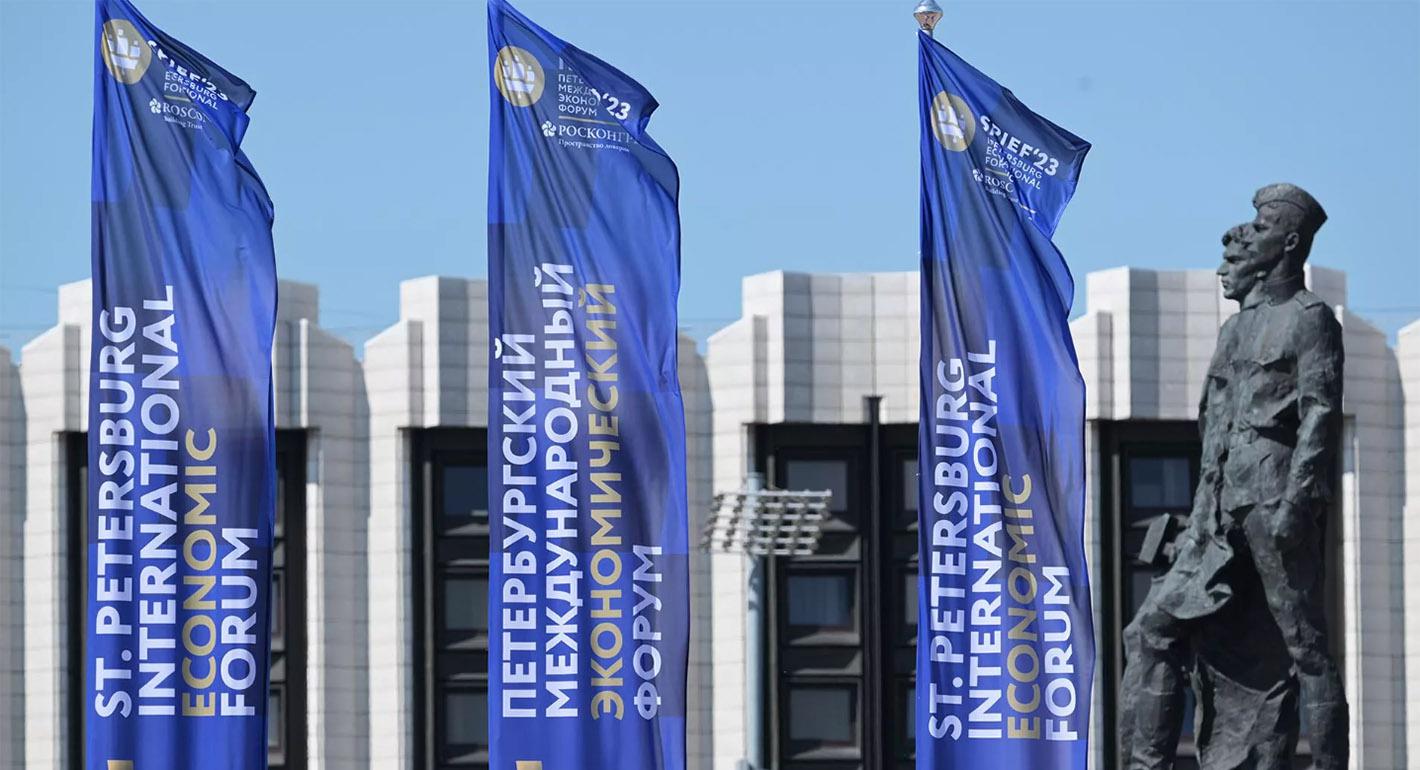
Once dubbed the “Russian Davos,” the annual St. Petersburg International Economic Forum (SPIEF) is less and less international every year. Investors and foreign media used to see Vladimir Putin’s keynote address as an economic road map and indication of the Russian president’s mood. This year, neither Western media nor investors were in attendance, and as the Ukrainian counteroffensive gets under way amid the shelling of Russia’s border regions, what matters most is not what Putin said, but what he didn’t.
SPIEF was conceived over twenty-five years ago as a showcase for the Russian economy aimed at foreign investors. To illustrate Russia’s place as part of the international community, much importance was placed on the attendance of foreign guests, and the forum’s content and infrastructure were assembled with them in mind.
Even after the annexation of Crimea in 2014, the forum remained an important international event attended by representatives of BP, Royal Dutch Shell, Philips, Total, Eni, Telenor Group, Glencore, and many others. The world’s leading powers continued to step up to the role of a guest country whose leader always spoke at the plenary session with Putin. In 2017, that leader was Indian Prime Minister Narendra Modi, followed by French President Emmanuel Macron in 2018 and China’s Xi Jinping in 2019.
With Russia’s full-scale invasion of Ukraine, however, the situation began to deteriorate rapidly. Last year, the guest country was Egypt, whose president, Abdel Fattah El-Sisi, spoke by video link rather than attending in person. Only Kazakh President Kassym-Jomart Tokayev shared the stage with Putin, while a delegation from Afghanistan’s Taliban regime attracted the most media attention.
This year, even some Russian CEOs quietly skipped the forum. Delegations were small, and the level of representation of foreign countries and companies—including from the Global South, to which Russia has supposedly turned its focus—was below ministerial.
Journalists from countries deemed “unfriendly” by the Kremlin were not accredited, while Western guests simply ignored invitations. The guest country was the United Arab Emirates, though it was the Algerian president who shared the stage during Putin’s plenary address.
The content of the Russian president’s speech was entirely predictable. Inevitably, he began by boasting of Russia’s growing GDP, despite the thousands of sanctions imposed on the country. He also took the chance to point out that inflation is “lower in Russia than in many Western countries,” and that unemployment is at a record low. Soon bored by economic routing, Putin also eagerly indulged in his usual talk about neo-Nazis running the Ukrainian state and thinly veiled nuclear threats to the West.
Far more important, however, is what went unspoken amid this show of bravado. For example, the facts that the main driver of economic growth in Russia this year is budget spending on defense, and that the military-industrial complex has been leading industrial growth for many months, towing the entire manufacturing industry behind it.
In the first four months of 2023, the Russian military-industrial complex grew by a full 25 percent, with some product groups showing explosive growth: navigation devices were up 60 percent year on year, while protective clothing was up 47 percent. But it is clear that as soon as budgetary spending on the military-industrial complex stops, economic growth will also grind to a halt.
The president was also predictably silent about the fact that Russia has not managed to overcome its dependence on imports. The government initially stated that the foreign trade surplus in April amounted to $6.8 billion, and then had to revise that figure to $2.3 billion. In other words, Russian imports are growing much faster than expected, while export earnings are falling.
In addition, the yuanization of Russia’s foreign trade continues. In April, the Chinese currency was used for a record 23 percent of exports and 31 percent of imports, while the ruble accounted for 38 percent and 28 percent, respectively. So Russia already pays more for imports in yuan than it does in rubles.
The record low unemployment of which the Russian government is so proud primarily indicates that Russia simply does not have enough workers. Among white-collar workers, the traditional personnel deficit has been exacerbated by two waves of emigration: one after the outbreak of war, and another after the partial mobilization was announced in September 2022.
As for blue-collar workers, civilian enterprises now have to compete with a round-the-clock defense industry, professional army contracts, and construction sites in occupied Ukrainian territory, where salaries reach 200,000 rubles (almost $2,500) a month: about three times the national average. The average civilian sector is simply not in a position to offer that kind of money, so the labor force is being eroded.
The result is paradoxical: the economy of a country at war is showing signs of overheating. Demand is growing, but the domestic supply of goods and services is not keeping up with it, so prices are rising, instead of production increasing. The central bank, which is responsible for inflation, is already reporting that there is no likelihood of seasonal deflation, and is preparing to raise interest rates.
One final thing the president failed to mention is that despite the apparent budgetary stability (the budget was balanced without a deficit in May), the government has already accumulated a deficit of 3.4 trillion rubles (more than $40 billion) since the beginning of the year, and is accordingly fighting desperately for every kopeck, sometimes to the detriment of long-term plans.
Finance Minister Anton Siluanov’s explanation that a retrospective windfall tax of 300 billion rubles on businesses will go to support families with children should be seen not as social responsibility, but as a sign of a possible budget crisis. Amid falling oil and gas revenues, the government will shake every last kopeck out of the economy.
The Russian government likes to talk about the sustainability and long-term growth of the economy, but over the past year, officials have reprogrammed themselves to think in the short term. Investors, meanwhile—regardless of where they are from—prefer long-term planning horizons.
The excessive optimism of Putin and his ministers smacks of attempts to convince not so much mythical investors as themselves that business as usual is possible—and even compatible with their threats to unleash nuclear war.
No sane investor could fail to see past the charade of this talk of a favorable economic climate to the devastating fighting in Ukraine, calls for nuclear strikes, and high-profile infighting between Russian mercenaries and the Defense Ministry. After a quarter of a century, SPIEF has been transformed from a prestigious investment forum to a platform for an aging autocrat who has somehow managed to convince himself that everything is going according to plan.

Senior Fellow, Carnegie Russia Eurasia Center
Alexandra Prokopenko is a senior fellow at the Carnegie Russia Eurasia Center.
Recent Work
Alexandra Prokopenko
Alexandra Prokopenko
Carnegie does not take institutional positions on public policy issues; the views represented herein are those of the author(s) and do not necessarily reflect the views of Carnegie, its staff, or its trustees.
Russia spent years building a “sovereign internet,” concentrating web infrastructure exclusively within Russian territory. Ukrainian drone attacks have shown how vulnerable that approach has left the Russian internet.

Maria Kolomychenko

Putin’s conservative staffing policies and search for ever greater control have cemented parliament’s transformation into a bureaucratic appendage of the executive branch.

Andrey Pertsev

Russia’s AI-driven propaganda campaigns operate in a fragmented, chaotic, and often illogical manner. That’s not necessarily a problem for the Kremlin, though: It’s much easier to mimic genuine public debate that way.

Ilya Klishin

Without a ceasefire with Ukraine on attacking each other’s energy infrastructure—to which the Kremlin is unlikely to agree—the diesel agreement between Putin and Trump is largely for show, rather than representing a genuine increase in the volumes of Russian diesel on the global market.

Sergey Vakulenko

Russian strikes are weakening the economy sustaining Ukraine’s war effort. Closing the growing funding gap will require more European support and politically contentious reforms in Kyiv.

Balázs Jarábik