

Commentary
Russia spent years building a “sovereign internet,” concentrating web infrastructure exclusively within Russian territory. Ukrainian drone attacks have shown how vulnerable that approach has left the Russian internet.
Maria Kolomychenko
{
  "authors": [
    "Kirill Krivosheev"
  ],
  "type": "commentary",
  "blog": "Carnegie Politika",
  "centerAffiliationAll": "dc",
  "centers": [
    "Carnegie Endowment for International Peace",
    "Carnegie Russia Eurasia Center"
  ],
  "collections": [
    "Aso Tavitian Initiative"
  ],
  "englishNewsletterAll": "ctw",
  "nonEnglishNewsletterAll": "",
  "primaryCenter": "Carnegie Russia Eurasia Center",
  "programAffiliation": "russia",
  "programs": [
    "Russia and Eurasia"
  ],
  "projects": [],
  "regions": [
    "Caucasus",
    "Russia",
    "Azerbaijan",
    "Armenia"
  ],
  "topics": [
    "Foreign Policy",
    "Economy"
  ]
}
Source: Getty
Any broader peace agreement between Armenia and Azerbaijan would signal the start of a new era in the South Caucasus. Russia’s influence would decline, and Turkey’s—grow.
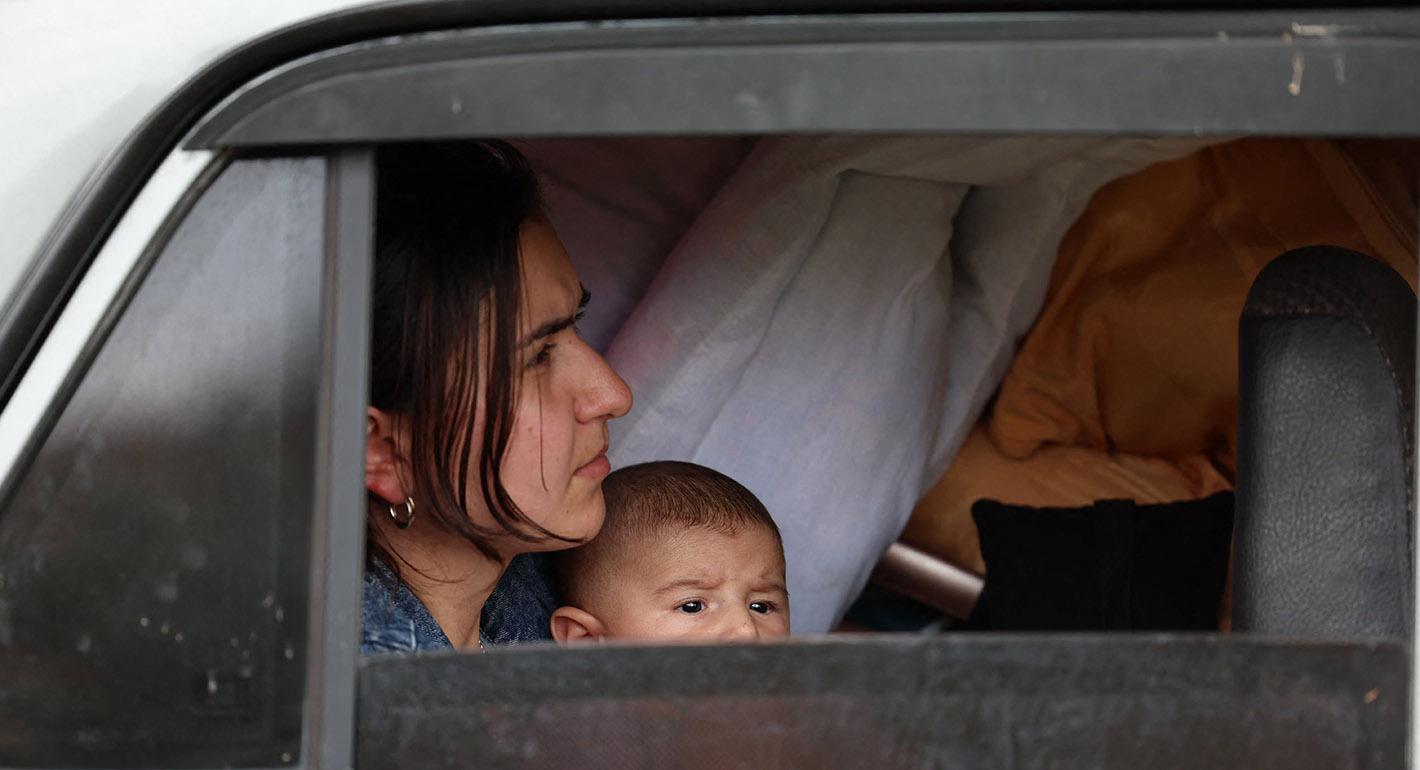
There is little doubt among Armenians that Azerbaijan’s September military operation in the disputed region of Nagorno-Karabakh led directly to ethnic cleansing. Tens of thousands of Karabakh Armenians have already fled, and the exodus shows no signs of slowing.
Nevertheless, Baku has seemed in no hurry since its 24-hour military assault delivered the long-standing goal of a clear pathway to taking full control of Nagorno-Karabakh. The Karabakh Armenians who remain have received some humanitarian aid from Azerbaijan, and their leaders—who announced the dissolution of the unrecognized Nagorno-Karabakh republic after thirty years of existence—are negotiating with representatives of Baku. All three major participants in this process—Armenia, Azerbaijan, and Russia—would prefer to see some Karabakh Armenians left in Nagorno-Karabakh.
The flight of Karabakh Armenians began when Azerbaijan opened the Lachin Corridor (the only road connecting Nagorno-Karabakh and Armenia) following the capitulation of local defense forces. The rate at which refugees are flooding into Armenia suggests that there could soon be no Armenians in Nagorno-Karabakh. But if some do stay, this will be politically significant. And it could create the conditions for a partial return of Karabakh Armenians once it becomes clear what sort of government Baku will impose.
The Azerbaijani military has been surprisingly restrained as refugees stream down the Lachin Corridor. It looks like Baku wants to avoid being accused of ethnic cleansing, so it avoids subjecting departees to interrogations or serious checks. Just a few weeks ago, it would have been impossible to imagine such a hands-off approach: in its ten-month blockade of Nagorno-Karabakh, Azerbaijan arrested a sixty-eight-year old man accused of crimes during the First Karabakh War who was attempting to travel to Armenia for medical treatment.
Even so, Azerbaijan has detained a couple of men attempting to flee Nagorno-Karabakh, including former Armenian field commander and local politician Vitaly Balasanyan and Russian-Armenian billionaire Ruben Vardanyan, a former state minister of Nagorno-Karabakh who called on Karabakh Armenians to fight to the last bullet. These detentions hint at Azerbaijan’s unofficial rule: only Nagorno-Karabakh’s political elite need fear prosecution.
Predictions of a partisan war led by Karabakh Armenians unwilling to give up their weapons have been proved false. The process of disarming local defense forces with the assistance of Russian peacekeepers has, to the surprise of many, taken place without any major incidents.
There have also been no attempts to use force to keep the Karabakh Armenians in place. However, it’s not in anyone’s interest to see the region totally devoid of people. Armenia will struggle to house 100,000 refugees, and, if many end up in Yerevan, they could join anti-government protests and exacerbate Armenia’s domestic political crisis.
Azerbaijan appears preoccupied with not being seen as a monster. And Russia needs Armenians in Nagorno-Karabakh to justify the presence of its peacekeepers: handing out humanitarian aid, organizing evacuations, and generally looking useful. If there is nothing for them to do, Russia’s peacekeeping mission could come to an end earlier than planned.
Finally, if there are no Armenians left in Nagorno-Karabakh, there is no point to negotiations between Baku and the Karabakh Armenians. These negotiations are ongoing, and have yielded some modest results.
In the meantime, it’s possible Aliyev could allow some sort of international monitoring mission into Nagorno-Karabakh to show himself in a positive light. While Yerevan has been hoping for Western sanctions against Baku, these look unlikely to materialize.
However painful, Armenia’s defeat in Nagorno-Karabakh has not prompted it to drop out of discussions about a broader peace treaty with Baku. On the contrary, this process has been given fresh impetus. The secretary of Armenia’s Security Council, Armen Grigoryan, met with Hikmat Hajiyev, an adviser to the Azerbaijani president, on September 26 in Brussels. Apart from the obvious humanitarian issues, they discussed a planned October 5 meeting between Armenian Prime Minister Nikol Pashinyan and Azerbaijani President Ilham Aliyev in the Spanish city of Granada.
If a peace agreement were signed, it would signal the start of a new era in the South Caucasus. Russia’s influence would be on the decline, and Turkey’s would grow.
The text of a peace agreement was more or less ready even before Azerbaijan’s recent capture of Nagorno-Karabakh. If Baku feels the process is dragging on unnecessarily, it could raise the stakes by not only demanding a land corridor through Armenia to the Nakhchivan Autonomous Republic, an Azerbaijani exclave bordering Turkey, but by laying claim to internationally recognized Armenian territory. Aliyev hinted at the latter in a recent meeting with Turkish President Recep Erdoğan, when he mused about Armenia’s post-Soviet borders in a similar way to which Russian President Vladimir Putin speaks about Ukraine.
If it were implemented, a corridor between Azerbaijan and Nakhchivan could provide a welcome toehold for Moscow in the region. The agreement that ended the 2020 Second Karabakh War envisaged Russian security forces policing the corridor, protecting Azerbaijani traffic and securing its entry and exit points.
As soon as Armenia and Azerbaijan sign a peace agreement, Turkey is likely to open its border with Armenia (which has been closed since 1993). Once this happens, economic factors will begin to come into play. Considering Erdogan’s talent for manipulating his partners, an open border could be a powerful tool of influence for Ankara.
Nevertheless, any document proclaimed as a “peace agreement” between Armenia and Azerbaijan will likely be little more than a framework. There will be a general recognition of each other’s territorial integrity and a commitment to refrain from infringing on it. This should be enough to protect Armenia from losing its southern region of Syunik to Azerbaijan.
But, as ever, many other issues should also be addressed. The international border between Armenia and Azerbaijan, which passes over remote mountains, needs to be permanently fixed, and there should be discussions about transport links. And that’s before you get to the issue of whether displaced Karabakh Armenians will be allowed to enter Azerbaijan. The devil will be in the details.

Kirill Krivosheev
Journalist
Carnegie does not take institutional positions on public policy issues; the views represented herein are those of the author(s) and do not necessarily reflect the views of Carnegie, its staff, or its trustees.

Russia spent years building a “sovereign internet,” concentrating web infrastructure exclusively within Russian territory. Ukrainian drone attacks have shown how vulnerable that approach has left the Russian internet.

Maria Kolomychenko

Putin’s conservative staffing policies and search for ever greater control have cemented parliament’s transformation into a bureaucratic appendage of the executive branch.

Andrey Pertsev

Russia’s AI-driven propaganda campaigns operate in a fragmented, chaotic, and often illogical manner. That’s not necessarily a problem for the Kremlin, though: It’s much easier to mimic genuine public debate that way.

Ilya Klishin

Without a ceasefire with Ukraine on attacking each other’s energy infrastructure—to which the Kremlin is unlikely to agree—the diesel agreement between Putin and Trump is largely for show, rather than representing a genuine increase in the volumes of Russian diesel on the global market.

Sergey Vakulenko

Russian strikes are weakening the economy sustaining Ukraine’s war effort. Closing the growing funding gap will require more European support and politically contentious reforms in Kyiv.

Balázs Jarábik