

Commentary
Nikita Smagin
{
  "authors": [
    "Nikita Smagin"
  ],
  "type": "commentary",
  "blog": "Carnegie Politika",
  "centerAffiliationAll": "dc",
  "centers": [
    "Carnegie Endowment for International Peace",
    "Carnegie Russia Eurasia Center"
  ],
  "collections": [],
  "englishNewsletterAll": "ctw",
  "nonEnglishNewsletterAll": "",
  "primaryCenter": "Carnegie Russia Eurasia Center",
  "programAffiliation": "russia",
  "programs": [
    "Russia and Eurasia"
  ],
  "projects": [],
  "regions": [
    "Middle East",
    "Syria",
    "Russia",
    "Caucasus"
  ],
  "topics": [
    "Security",
    "Military",
    "Foreign Policy",
    "Economy"
  ]
}
Source: Getty
Syria has not only failed to become a secure base for Russian forces in the Middle East, but is increasingly generating its own crises.
For several years, Russia has set itself the joint mission with Iran of pushing the United States out of Syria—and ideally out of the entire Middle East. Yet Russia’s full-scale invasion of Ukraine and subsequent growing alignment with Tehran have actually had the opposite effect: the U.S. presence in the region is growing.
Indeed, Washington finally has a clear justification for continuing its campaign in Syria. The more Russia gets entangled in the Middle East, the more challenging it becomes for Moscow to handle Ukraine.
In addition to Russia’s confrontation with the United States, the situation inside Syria itself is escalating, and Russia is also dealing with the problems of integrating the remaining Wagner mercenary troops into the Russian armed forces following the dismantling of Wagner and dramatic death of its leader, Yevgeny Prigozhin. These growing difficulties are turning the war-torn country into a headache for Moscow and undermining hopes that Syria would not distract the Russian leadership from the war in Ukraine.
Since this spring, Russia has intensified its activities in the skies over Syria. In addition to strikes against militants, this activity is directed against U.S. forces present in the country. Russian aircraft and drones fly over American military installations, contrary to agreements between the two powers on delineating areas of activity. The U.S. military has repeatedly reported dangerous maneuvers by Russian Air Force pilots with regard to American drones and fighter jets, while the Russian military in turn claims that incidents in the sky are caused by the Americans violating the agreements.
Containing the United States was already part of the job of Russian forces in Syria, but, previously, it was largely the navy’s responsibility. Now Moscow is being forced to shift the focus to aviation, since there are hardly any Russian ships left in the Mediterranean. It became very difficult to rotate naval forces following Russia’s invasion of Ukraine, when Turkey closed the Bosporus Strait to military vessels, cutting off Russia’s Black Sea Fleet from Syria.
The increase in incidents between Russian and U.S. warplanes coincided with a surge in clashes between the Americans and Iranian proxies in Syria. According to media leaks, Tehran and Moscow have been coordinating their actions as part of a joint effort to push Washington out of the region. While Russian aviation puts pressure on the United States in the air, Iranian proxy forces carry out missile strikes against American targets in both Syria and Iraq.
These attacks are intended more to scare than to inflict damage, and usually the rockets intentionally miss the target and explode somewhere nearby. This is not always the case, however, and some launches have killed and injured U.S. base personnel. It was after one such attack in 2020 that then U.S. president Donald Trump ordered the killing of Iranian general Qasem Soleimani.
The problem is that Russia and Iran’s efforts to squeeze the United States out of the Middle East are having precisely the opposite effect. The U.S. military presence in the region is only increasing.
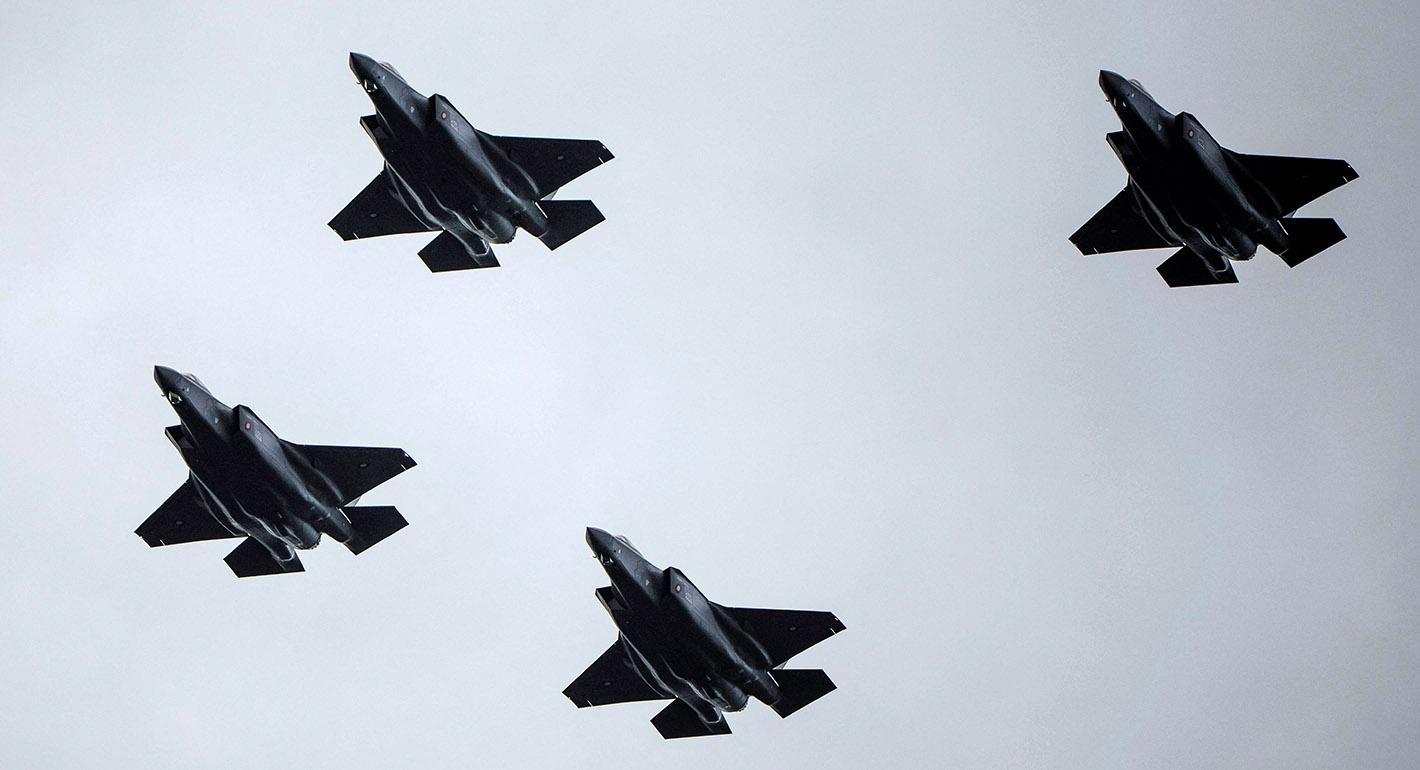
In July, Washington deployed the USS Thomas Hudner destroyer to the Persian Gulf, along with F-35 and F-16 fighter jets, in addition to the existing forces. Just a few days later, two more ships with marine landing forces were added with the stated aim of protecting commercial vessels from “Iranian destabilization activities in the region.” As a result, the number of American troops in the Gulf reached its highest level in recent years.
To counter the “unprofessional behavior” of Russian pilots over Syria, additional fifth-generation F-22 Raptor fighters were sent directly to Syria. The U.S. military claims that these additional aircraft help to deter such behavior.
U.S. actions go beyond deploying new units. In late summer, the Americans attempted to unite all the allied forces in Syria, including Arab tribal structures, into a single coalition around the American base at Al-Tanf and the Syrian Democratic Forces (SDF), whose backbone is made up of Kurdish units.
Judging by recent clashes between pro-American groups, the creation of a unified front is far from plain sailing. Still, the fact that the United States is making efforts to this end indicates that Washington has no intention of yielding to Russian-Iranian pressure in Syria—especially considering that any additional tension in Syria distracts Moscow from Ukraine.
Russia’s goal of maintaining a relatively low-key presence in Syria that would not require excessive financial resources or be a distraction from the Ukrainian fronts is becoming increasingly unrealistic, not least because of the greater U.S. presence prompted by Moscow’s own provocative actions there.
There are, however, other problems not directly related to Russia. Bashar al-Assad’s government has regained control over most of Syria, but that has not necessarily meant a return to normal life. Hunger and corruption have become integral parts of the local socioeconomic landscape, and by the end of summer, major protests had erupted in several areas under Damascus’s control, sometimes accompanied by large-scale clashes. The situation is so serious that the authorities have partially lost control over the Suwayda province.
Far from events in Syria settling down, therefore, instability is increasing, and there are no solutions to the country’s economic problems. This year, the vestiges of the Islamic State group have even reanimated in the country, seeking to exploit the new surge of dissatisfaction.
All of this comes at a time when Russia needs to figure out what to do with the remnants of the Wagner mercenary army. Initial attempts to replace Wagner in Syria with Russian military troops reportedly brought the two formations to the brink of an armed skirmish. The process will not be easy, and a weakening of Russia’s influence there seems inevitable.
The fact is that Wagner did the work in Syria that the Russian Defense Ministry handled poorly: developing oil deposits, establishing connections with local groups, shoring up Russia’s presence in new areas, and conducting civilian reconnaissance. The Russian military cannot transform overnight into an effective force to address such tasks. In any case, Wagner is a complex structure with its own economic bloc and political consultants. Many elements of this model simply have no place within the Defense Ministry.
The results of these difficulties can already be seen in attempts by pro-Iranian formations to take over areas previously dominated by Wagner. Syria’s oil fields are a particularly tempting prize.
Russia’s position in Syria is still far from critical, but certain challenges are unavoidable. Syria has not only failed to become a secure base for Russian troops, but is increasingly generating its own crises, albeit localized—for now.

Expert on Iranian foreign and domestic policies, Islamism, and Russia's policy in the Middle East
Recent Work
Nikita Smagin
Nikita Smagin
Carnegie does not take institutional positions on public policy issues; the views represented herein are those of the author(s) and do not necessarily reflect the views of Carnegie, its staff, or its trustees.

The truth of the strategic situation is that Europe and Russia are extremely unlikely to be able to “turn the page” on their confrontation within the next two decades.

Arkady Moshes

Russia spent years building a “sovereign internet,” concentrating web infrastructure exclusively within Russian territory. Ukrainian drone attacks have shown how vulnerable that approach has left the Russian internet.

Maria Kolomychenko

Putin’s conservative staffing policies and search for ever greater control have cemented parliament’s transformation into a bureaucratic appendage of the executive branch.

Andrey Pertsev

Russia’s AI-driven propaganda campaigns operate in a fragmented, chaotic, and often illogical manner. That’s not necessarily a problem for the Kremlin, though: It’s much easier to mimic genuine public debate that way.

Ilya Klishin

Without a ceasefire with Ukraine on attacking each other’s energy infrastructure—to which the Kremlin is unlikely to agree—the diesel agreement between Putin and Trump is largely for show, rather than representing a genuine increase in the volumes of Russian diesel on the global market.

Sergey Vakulenko