

Commentary
Nikita Smagin
{
  "authors": [
    "Nikita Smagin"
  ],
  "type": "commentary",
  "blog": "Carnegie Politika",
  "centerAffiliationAll": "dc",
  "centers": [
    "Carnegie Endowment for International Peace",
    "Carnegie Russia Eurasia Center"
  ],
  "collections": [],
  "englishNewsletterAll": "ctw",
  "nonEnglishNewsletterAll": "",
  "primaryCenter": "Carnegie Russia Eurasia Center",
  "programAffiliation": "russia",
  "programs": [
    "Russia and Eurasia"
  ],
  "projects": [],
  "regions": [
    "Middle East",
    "Russia",
    "Caucasus"
  ],
  "topics": [
    "Security",
    "Military",
    "Foreign Policy",
    "Economy"
  ]
}
Source: Getty
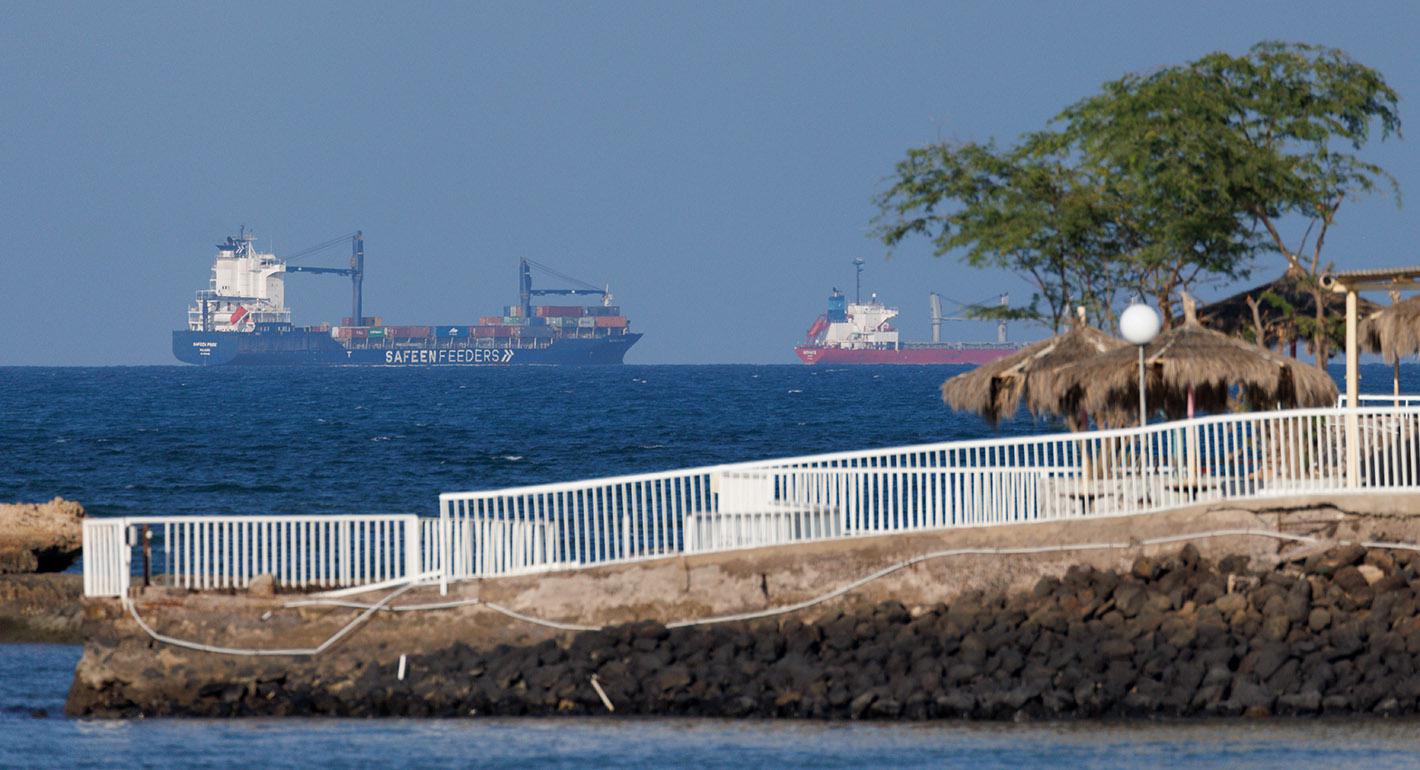
Moscow has little to gain from a major flare-up in the Red Sea, which means Washington’s efforts to stop Houthi attacks on shipping are likely to be quietly welcomed.
Predictably, Russia has been deeply critical of strikes by the United States and the United Kingdom against Yemen’s Houthi militia, which had been attacking ships passing through the Red Sea. In reality, however, Moscow is likely not at all opposed to Washington restoring order in the Red Sea and ensuring maritime traffic can continue to use the Suez Canal: an important transit route for Russian oil bound for India.
Russian officials responded angrily to the news of the U.S. and UK attacks on the Houthis. President Vladimir Putin’s spokesman Dmitry Peskov said they were “illegitimate”; State Duma speaker Vyacheslav Volodin called for U.S. President Joe Biden to face criminal proceedings; and the Foreign Ministry requested an urgent UN Security Council meeting.
Indeed, it’s difficult to imagine Moscow reacting in any other way. U.S.-Russian relations long ago became a zero sum game, which means every move by Washington is automatically condemned by Moscow. In addition, the Kremlin is using every opportunity to double down on its anti-colonial rhetoric, which it hopes will help it win the support of the Global South.
At least in public, Russian officials contend that the confrontation in the Red Sea is economically advantageous to it. Russia’s exports and imports largely pass through its Far East ports and railway links with China. No more than about 10 percent of its foreign trade goes through the Suez Canal and, in any case, that has not—so far—been affected.
Putin claimed that the Red Sea standoff could prompt shipping companies to switch to the Northern Sea Route that runs along Russia’s Arctic coast. Moscow has also used this moment to promote another alternative trade route: the North–South Transport Corridor connecting Russia to the Indian Ocean via Iran. According to nationalist politician Leonid Slutsky, this route could be “a new logistics infrastructure for Eurasia.”
In other words, Moscow’s rhetoric appears designed to frame events in the Red Sea as just another example of how it is benefitting from fracturing U.S. hegemony. Russia’s actions, however, are far more revealing. Moscow has done nothing to stop the United States from taking military action—despite having some power to do so. Washington set up a coalition against the Houthis on December 18 last year. Even before the strikes on Yemen itself, that coalition had sunk three Houthi ships and shot down dozens of drones and rockets.
On January 11, Washington put forward UN Resolution 2722 as a legal basis for attacks on Houthi infrastructure. Russia did not veto the resolution, which subsequently passed, and the United States and the UK carried out their first strikes on Yemen the following day.
Perhaps inevitably, Russia claimed the resolution was not a mandate for military action. Yet it’s hard to believe that Russia did not guess this might be the outcome. It was obvious from the discussions about the resolution that military action was very much on the cards.
Further light is shone on Russia’s position by statements made by its officials at the UN that were critical of the Houthis. They included condemnation of the Houthis and calls for “free and secure maritime transit in the region.” Putin’s spokesman Peskov said that Russia had “repeatedly called on the Houthis to refrain from such actions and considers them to be wrong.”
The reality is that Moscow is concerned about its economic interests in the Red Sea. Of course, there is some truth to the argument that the current crisis could stimulate interest in the Northern Sea Route and the North–South Transport Corridor, but that would only happen in the long term. There has been no immediate difference in the volume of freight being sent via those routes.
Russia would, however, suffer from the closure of the Suez Canal. Most of Russia’s oil exports to India—currently the biggest importer of Russian hydrocarbons—are sent via the canal. That’s up to 3 million barrels of oil a day: about a third of Russia’s crude exports.
If the Suez Canal were closed, Russia would be forced to send its tankers all the way around Africa to reach India. Its fleet of tankers is not big enough to maintain current export volumes if that were to happen, and sourcing more would be no mean feat: tanker demand would be sky-high in such a scenario, since Russia is not the only country transporting oil through the Suez Canal.
For now, the risks to Moscow’s oil exports from the Houthis are minimal. Indeed, Russia is the only country not to have reduced the amount of oil it sends through the Red Sea amid the ongoing military confrontation. It’s possible Houthi fighters are deliberately avoiding targeting Russian ships: perhaps Moscow is passing the Houthis—via Iran—information about their tankers. Yet even if that is the case, it’s hardly a foolproof system of protection from possible escalation. The Houthis did attack a tanker on January 14 that was carrying Russian oil.
It seems clear, then, that Russia has little to gain from a flare-up in the Red Sea. For that reason, Washington’s efforts to solve the problem of Houthi attacks are likely to be quietly welcomed in Moscow. Of course, U.S.-Russian tensions mean the Kremlin can’t officially come out and say it supports U.S. military action. But it’s very unlikely to get in the way.

Expert on Iranian foreign and domestic policies, Islamism, and Russia's policy in the Middle East
Recent Work
Nikita Smagin
Nikita Smagin
Carnegie does not take institutional positions on public policy issues; the views represented herein are those of the author(s) and do not necessarily reflect the views of Carnegie, its staff, or its trustees.

Russia spent years building a “sovereign internet,” concentrating web infrastructure exclusively within Russian territory. Ukrainian drone attacks have shown how vulnerable that approach has left the Russian internet.

Maria Kolomychenko

Putin’s conservative staffing policies and search for ever greater control have cemented parliament’s transformation into a bureaucratic appendage of the executive branch.

Andrey Pertsev

Russia’s AI-driven propaganda campaigns operate in a fragmented, chaotic, and often illogical manner. That’s not necessarily a problem for the Kremlin, though: It’s much easier to mimic genuine public debate that way.

Ilya Klishin

Without a ceasefire with Ukraine on attacking each other’s energy infrastructure—to which the Kremlin is unlikely to agree—the diesel agreement between Putin and Trump is largely for show, rather than representing a genuine increase in the volumes of Russian diesel on the global market.

Sergey Vakulenko

Russian strikes are weakening the economy sustaining Ukraine’s war effort. Closing the growing funding gap will require more European support and politically contentious reforms in Kyiv.

Balázs Jarábik