

Commentary
Zaur Shiriyev
{
  "authors": [
    "Zaur Shiriyev"
  ],
  "type": "commentary",
  "blog": "Carnegie Politika",
  "centerAffiliationAll": "",
  "centers": [
    "Carnegie Endowment for International Peace",
    "Carnegie Russia Eurasia Center"
  ],
  "collections": [
    "Aso Tavitian Initiative"
  ],
  "englishNewsletterAll": "",
  "nonEnglishNewsletterAll": "",
  "primaryCenter": "Carnegie Russia Eurasia Center",
  "programAffiliation": "",
  "programs": [],
  "projects": [],
  "regions": [
    "Caucasus",
    "Central Asia",
    "Russia and Eurasia"
  ],
  "topics": [
    "Climate Change"
  ]
}
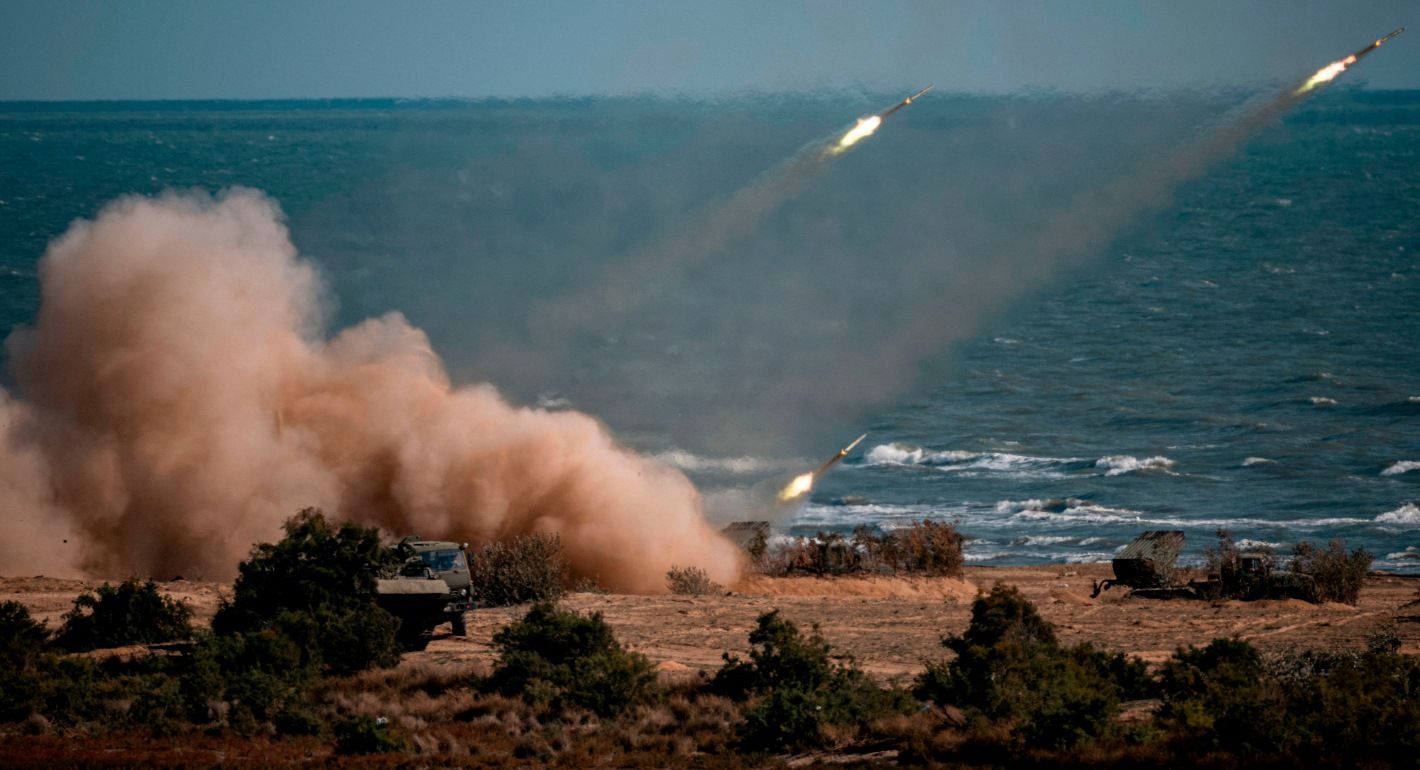
Source: DIMITAR DILKOFF/AFP via Getty Images
Russia’s use of the Caspian Sea for military purposes and its reduction of water flow from the Volga are damaging the sea’s already fragile ecosystem.
In early July, fish began dying en masse off Azerbaijan’s coast, sparking speculation that Russia’s increasingly frequent cruise missile strikes against Ukraine, launched from its Caspian Flotilla, could be to blame. The deaths coincided with a significant Russian missile attack on Ukraine, allegedly using Kalibr cruise missiles also launched from the Caspian Sea.
Governments in the region, wary of angering Moscow, are reluctant to investigate the veracity of speculation made on unofficial social media accounts. Azerbaijan’s biodiversity agency attributed the deaths to warmer water and lower oxygen levels. But military activity is known to cause pollution and disrupt marine life, and numerous earlier media reports had raised fears of damage to the marine ecosystem from Russia’s Caspian Sea military operations, which have multiplied since its full-scale invasion of Ukraine.
In March–May 2022, just after the invasion, dead seals were found on the coast of Kazakhstan’s Mangistau region on a scale not previously seen. That November, about 170 seal carcasses were found on Kazakhstan’s Caspian shores. Just one month later, thousands more seals died on Russia’s Dagestan coast—the largest die-off in years—while hundreds more dead seals washed up on the other side of the sea on Turkmenistan’s island of Gyzylsuw.
Various explanations were given for these mass deaths. Russia claimed the mammals in Dagestan had died of natural causes. However, Kazakhstan’s final investigation in February 2023 attributed its seal deaths to pneumonia following decreased immunity and burgeoning viral infections due to environmental pollution, and acknowledged that no studies had been conducted to determine whether that pollution was linked to rocket fuel.
Pollution has traditionally been blamed on oil and gas extracting and prospecting around the inland sea, but Russia’s extensive use of its Caspian Sea flotilla in a supporting role in the war in Ukraine has renewed claims that toxic substances from missile fuel could be adding to the problem.
Such fears date back to 2022, when a Russian journalist claimed that Caspian fauna were dying due to poisonous substances from Soviet-era Kh-55 and other missiles fired by Tu-160 and Tu-95 bombers flying over the Caspian Sea. Since old missiles are often used, some fail and crash into the sea. These defective missiles leak substances like detsilin, a toxic fuel whose ingredients suppress central nervous systems. Such substances can poison creatures, build up in the food chain, and disrupt crucial habitats.
The extent of any damage is difficult to verify in an area already suffering environmental degradation. The launch and detonation of missiles clearly introduces pollutants into the sea, including other chemicals and debris, as well as fuel. Additionally, the noise and shock from missile launches and military exercises can alter migration patterns, breeding, and feeding habits, further stressing already vulnerable marine populations.
Disquiet over Russia’s use of the Caspian Sea to wage war is growing, with concerns going beyond possible environmental problems. Some view it as a violation of the 2018 Caspian Convention, ratified by all littoral states except Iran, which states that the sea should be used for peaceful purposes only, though it lacks provisions on the demilitarization of the sea.
Caspian states are reluctant to press the issue or publicly express displeasure, fearing Russian ire. Some argue that the convention hasn’t been violated. Kamal Makili-Aliyev, a lawyer and senior lecturer at Sweden’s Gothenburg University, says that the “zone of peace” provision of the Caspian Convention can be interpreted either restrictively (to mean that the parties should not further militarize the Caspian Sea by increasing their armed forces there) or broadly (that the Caspian Sea can only be used for peace, regardless of the context). This latter interpretation is less convincing because it could also imply that countries should not have militaries based on the sea at all.
However, environmental harm would more likely violate the Framework Convention for the Protection of the Marine Environment of the Caspian Sea, also known as the Tehran Convention. Evidence would be needed that Russia’s military activities are causing significant damage. That would need to be formalized as a complaint by at least one party, leading initially to consultations with Russia, followed by arbitration by an international body if no settlement were reached.
It’s unlikely that any Caspian state will complain publicly about pollution, but they are more vocal about falling water levels. The sea gets four fifths of its water from Russia’s Volga River, an inflow that has been shrinking annually for some years now and has recently reached a critical stage.
Azerbaijan says this is not just due to climate change, but also to dams on the Volga diverting water. Here, too, the war may play a role. Western sanctions have led to intensified agricultural exploitation and water use in the region as Russia seeks to compensate for lost imports. Ali Salajegheh, head of Iran’s Environment Department, attributed the decline in Caspian Sea levels in 2023 to Russia intentionally reducing the Volga inflow. While that has not been denied, some link the decline to natural variation, worsened by climate change.
Lower river water levels would restrict inland water transport, which Russia relies on for trade—and increasingly for military purposes, another knock-on effect of the war in Ukraine. The Volga-Don Canal has allowed the Caspian Flotilla to travel to the Sea of Azov and Black Sea to reinforce the navy there, a crucial role since Türkiye closed the Black Sea straits to military vessels from countries involved in the conflict, invoking the Montreux Convention.
In the Caspian Sea, falling water levels and an advancing coastline significantly challenge shipping by reducing carrying capacity, increasing grounding risks, and necessitating more frequent dredging to keep channels navigable, thereby disrupting port operations.
This affects not only Russia but also routes from Central Asia to Europe through Azerbaijan. The Trans-Caspian International Transport Route, also known as the Middle Corridor, passes through Central Asia, the Caspian Sea, and the South Caucasus, and is crucial for trade between China and Europe. Officials in Kazakhstan and Azerbaijan, increasingly alarmed by the shrinking Caspian, say the issue is critical. Falling water levels impact every aspect of life, the maritime industry, and the region’s ecology, threatening the efficacy and economic potential of the Middle Corridor.
Russia’s use of the Caspian Sea for military purposes and its reduction of water flow from the Volga are damaging the sea’s ecology and maritime activities. The only viable solution appears to be multilateral cooperation among littoral states that have collaborated on environmental protocols and regulations under the Tehran Convention. That convention mandates regular meetings where they have received—and could continue to receive—financing for monitoring environmental issues, along with support from international environmental organizations.
Caspian state Azerbaijan will host the COP29 international climate change conference in November 2024, and could use it to bring attention to this issue and foster greater regional cooperation. The conference will attract global attention, providing an opportunity to highlight the region’s problems and mobilize international support for monitoring and mitigating the environmental impact on the Caspian Sea.
Still, while COP29 could highlight the Caspian issue globally, international actors are unlikely to reach agreement on establishing and funding steps to address the sea’s problems. Since Russia shows no intention of stopping its military use of the Caspian or of ending the war, and the West has halted any cooperation with Russia, geopolitics appears to stand in the way of implementing effective solutions.

Nonresident Scholar, Carnegie Russia Eurasia Center
Zaur Shiriyev is a nonresident scholar at the Carnegie Russia Eurasia Center.
Recent Work
Zaur Shiriyev
Zaur Shiriyev
Carnegie does not take institutional positions on public policy issues; the views represented herein are those of the author(s) and do not necessarily reflect the views of Carnegie, its staff, or its trustees.

Ex-president Gurbanguly Berdimuhamedov remains interested in politics, but his son Serdar, Turkmenistan’s current president, is becoming increasingly independent and willing to break with his father’s legacy. If their covert rivalry goes too far, both risk losing power.

Galiya Ibragimova

In the tenth year of his presidency, President Mirziyoyev’s system is becoming even more personalized than that of his predecessor Karimov.
Galiya Ibragimova

With the growth in points of friction between the great powers, organizations like the SCO will continue to play a role in the strategic adaptation of the smaller powers caught between them.

Temur Umarov

When faced with fuel shortages in the past, Central Asian governments could always count on additional supplies from Moscow. That safety net no longer exists.
Galiya Ibragimova
Tokayev’s predecessor, Nursultan Nazarbayev, outlined arrangements for a power transition too soon and in too much detail, ultimately losing control over the process. Tokayev is determined not to meet the same fate.
Temur Umarov