

Commentary
Ruslan Suleymanov
{
  "authors": [
    "Ruslan Suleymanov"
  ],
  "type": "commentary",
  "blog": "Carnegie Politika",
  "centerAffiliationAll": "",
  "centers": [
    "Carnegie Endowment for International Peace",
    "Carnegie Russia Eurasia Center"
  ],
  "englishNewsletterAll": "",
  "nonEnglishNewsletterAll": "",
  "primaryCenter": "Carnegie Russia Eurasia Center",
  "programAffiliation": "",
  "programs": [],
  "projects": [],
  "regions": [
    "Russia",
    "Middle East"
  ],
  "topics": [
    "Security",
    "Foreign Policy",
    "Global Governance"
  ]
}
Source: Getty
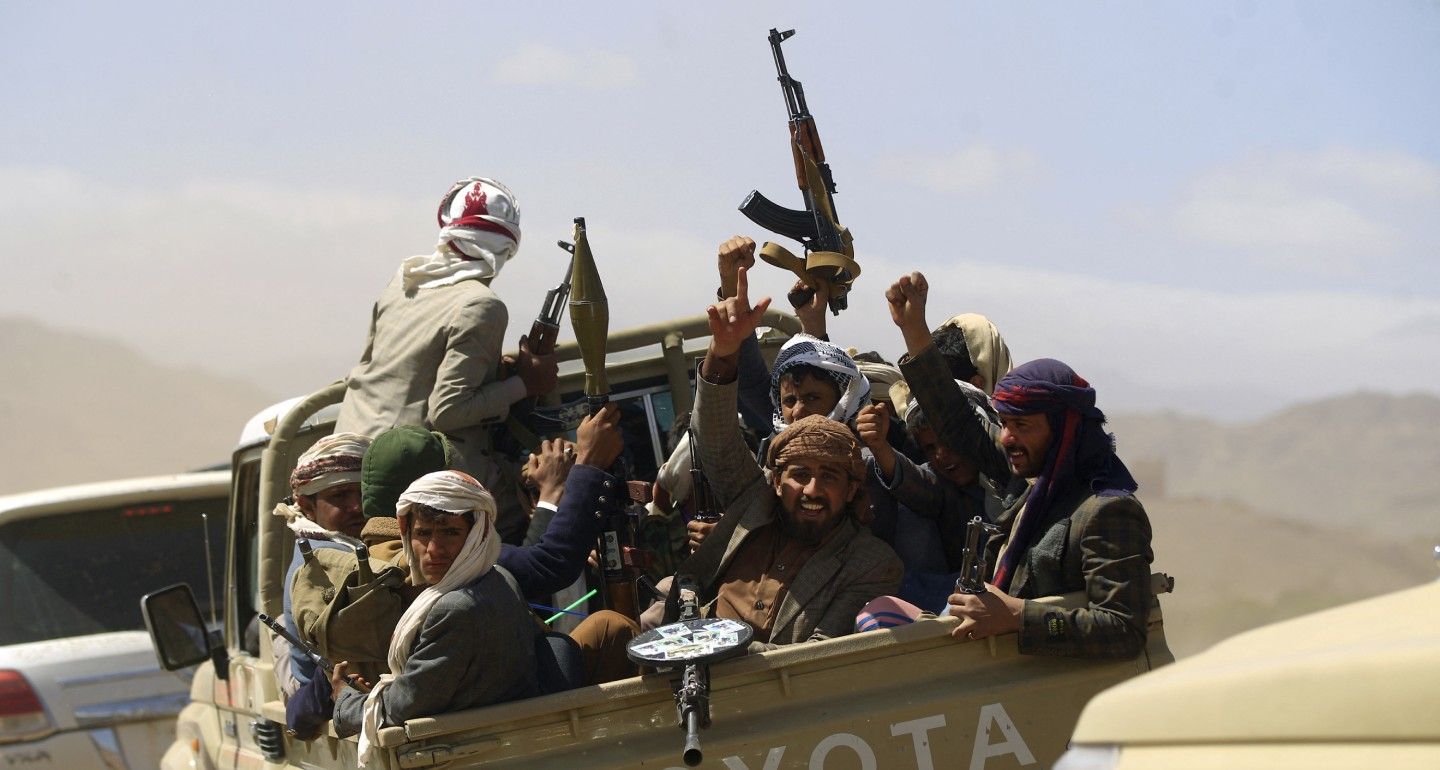
It’s becoming increasingly difficult for the Kremlin to maintain equidistance in the Yemen conflict: Moscow’s growing interaction with the Houthis, including at the military level, is making itself felt. We have seen this before in Syria, Libya, and Sudan.
The partnership between Russia and Iran, which is growing stronger as a result of military cooperation in Moscow’s war against Ukraine, is reverberating in various parts of the world. In war-torn Yemen, it is bringing about Moscow’s rapprochement with pro-Iranian Houthi rebels.
For a long time, Russia tried to maintain equal distance from all parties in the Yemen conflict. But now Russian military advisers are working in the Houthi-controlled capital Sanaa, and Moscow has not ruled out supplying weapons to the rebels. As a result, if there is a new escalation in Yemen—and that is very probable, given the Houthi attacks on vessels in the Red Sea—Moscow could find itself one of the parties to the conflict.
Since the collapse of the Soviet Union in 1991 and the unification of Yemen the previous year, Russia has not had any serious interest in Yemen, with trade turnover reaching just $250 million at best. Accordingly, after the start of Yemen’s civil war in 2011, the Kremlin took an equidistant position and did not actively interfere, unlike in the Libyan and Syrian crises.
Russian policy remained unchanged after Saudi Arabia and its allies launched a military operation against the Houthis in March 2015. Moscow limited itself to calling on all parties to “immediately cease any forms of warfare.”
At the same time, throughout the fighting, Russia has maintained dialogue with all the main participants in the Yemen conflict, and continues to do so. Russian diplomats regularly meet with representatives of the internationally recognized Presidential Leadership Council (PLC), the separatist Southern Transitional Council (STC), and the former ruling party, the General People’s Congress (GPC), which has now entered into a coalition with the Houthis. But recently, a clear bias has emerged in favor of the latter.
Of course, Russia is not the only external force taking an interest in what is happening in Yemen. Neighboring Saudi Arabia has always supported the PLC. The United Arab Emirates helps the STC, which allows Abu Dhabi to explore oil fields in southern Yemen. The Houthis, for their part, have for many years received weapons, money, and information support from Iran.
In the past two and a half years, Russian Deputy Foreign Minister Mikhail Bogdanov has met with Houthi representatives at least four times: more than with any other participant in the conflict in Yemen. Now quantity is gradually translating into quality.
Advisers from Russia’s foreign military intelligence agency, the GRU, are now working in Sanaa under the guise of humanitarian aid workers. This has been reported both by media citing U.S. intelligence, and by my own sources close to the Houthis. According to them, Iranian military instructors and other specialists have been operating in Yemen for many years under a similar scheme.
In addition, in the summer of 2024, several U.S. media outlets reported that the Kremlin had been preparing to supply the Houthis with weapons, but was forced to abandon the idea under pressure from the United States and Saudi Arabia. However, UN experts have repeatedly reported attempts to smuggle 9M133 Kornet anti-tank guided missiles, AKS-20U assault rifles, and other weapons to Yemen: i.e., weapons with the same technical specifications and markings as those produced in Russia. Iran also appears to have been involved in this scheme.
Indeed, it is cooperation with Iran that has pushed the Kremlin to become more actively involved in the Yemen conflict on the side of the Houthis. Having become dependent on Iranian arms supplies for its war against Ukraine, Moscow is being increasingly drawn into Tehran’s orbit in the Middle East, and is accordingly beginning to actively support Iran’s satellites in the region.
Moscow’s position on the Israeli-Palestinian conflict is indicative. The Russian authorities have never publicly condemned the aggression of Hamas militants against Israel on October 7 last year, despite the presence of Russian nationals among the hostages taken by Hamas. Having effectively adopted an anti-Israel position, the Kremlin is also trying to present itself as the leader of the Global South: of all those who are dissatisfied with the position of the West, which has thrown its support behind Israel.
What Moscow gets in exchange is the blessing for its policies from pro-Iranian forces in the Middle East. On February 21, 2022—three days before Russia’s full-scale invasion of Ukraine—the Houthis expressed support for the recognition of Donetsk and Luhansk, which are internationally recognized as Ukrainian territory, as independent republics. Hamas leaders have voiced hope that Russia’s “special military operation will lead to the formation of a multipolar world.” And Lebanon’s Hezbollah even supplies Russia with men to fight in Ukraine in exchange for Russian weapons.
As for the Israeli-Palestinian conflict, the Kremlin is reluctant to sever ties with Israel completely. In this respect, Russia’s reaction to Iran’s April attacks on Israeli territory was telling: Moscow did not side with Tehran, which was avenging attacks on its facilities in the region, but limited itself to expressing “extreme concern at yet another dangerous escalation.”
In the Yemen conflict, however, it will be increasingly difficult for the Kremlin to maintain equidistance. Its growing interaction with the Houthis, especially at the military level, will make itself felt. We have seen this before: in Syria in 2015, when Moscow launched a military operation to save Bashar al-Assad’s regime; in Libya, where Russia supports Field Marshal Khalifa Haftar, who controls the east of the country; and in Sudan, where Wagner mercenaries are active on two fronts at once, supporting both the Transitional Sovereignty Council and the rebel Rapid Support Forces.
For now, a ceasefire is holding in Yemen between the Houthis and the coalition assembled by Saudi Arabia. But the risk of hostilities breaking out again is high, especially given the Houthis’ activity in the Red Sea. Since November 2023, they have attacked more than seventy merchant ships that they say were connected in some way to Israel and its allies. The attacks have disrupted a route that had carried approximately 12 percent of all international trade, and have caused the cost of transporting goods from Asia to Europe to almost quadruple.
The United States and the UK (and, more recently, Israel) periodically strike Houthi positions. That inevitably leads to civilian casualties and increases the risk of a new escalation.
One of the most likely scenarios for further development is a new Houthi campaign in the south to seize the rest of the country’s territory. To do that, they will need the support of all their few foreign partners—including Russia.
Non-resident research fellow, the Institute for Development and Diplomacy (Azerbaijan)
Recent Work
Ruslan Suleymanov
Ruslan Suleymanov
Carnegie does not take institutional positions on public policy issues; the views represented herein are those of the author(s) and do not necessarily reflect the views of Carnegie, its staff, or its trustees.

Russia’s ruling party would have benefited from Putin appearing as its distant patron, but as an active frontman imposing his views on the public, he has done nothing but harm both the party’s election campaign and the ruling system overall.

Andrey Pertsev

Depleted financial reserves and a shrinking tax base mean it is no longer possible to simultaneously deliver high defense spending, price stability, and economic growth.

Alexandra Prokopenko

Blurring the line between humans and animals is a long-standing tradition in social utopian prose. In his latest novel, Leonid Bershidsky reminds us that in social experiments, people are often treated no differently than animals.

Alexander Baunov

While France and Australia are seeking to establish the legal obligations of messaging apps like Telegram, Russia wants total subordination.

Maria Kolomychenko
The recent uncovering of Dmitry Donskoy’s relics in the Cathedral of the Archangel is yet another attempt by the Russian Orthodox Church to help the state solve its problems. However, parroting the state’s version of Russian history leaves the Church with no message except “patriotism.”
Alexander Zanemonets