

Commentary
Alexander Baunov
{
  "authors": [
    "Alexander Baunov"
  ],
  "type": "commentary",
  "blog": "Carnegie Politika",
  "centerAffiliationAll": "",
  "centers": [
    "Carnegie Endowment for International Peace",
    "Carnegie Russia Eurasia Center"
  ],
  "englishNewsletterAll": "",
  "nonEnglishNewsletterAll": "",
  "primaryCenter": "Carnegie Russia Eurasia Center",
  "programAffiliation": "",
  "programs": [],
  "projects": [],
  "regions": [
    "Russia",
    "South America",
    "China",
    "Southern, Eastern, and Western Africa",
    "India"
  ],
  "topics": [
    "Foreign Policy",
    "Global Governance"
  ]
}
Source: Getty
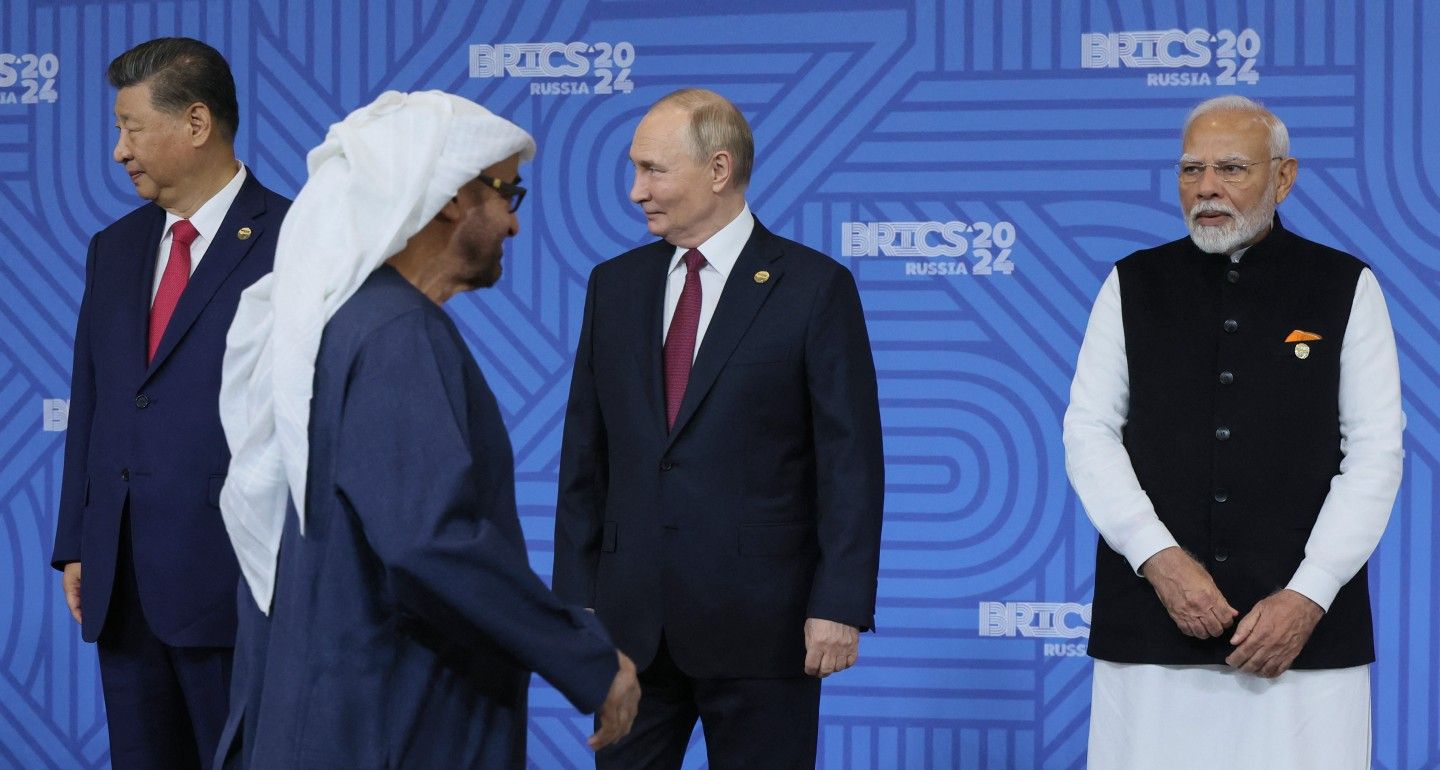
It might seem that within BRICS, Russia should be overshadowed by the giant economies of China and India, especially the former. Yet what is happening is almost the opposite, with Russia effectively taking over the leading role in the club.
Russia’s war against Ukraine has not only shattered lives and upended international relations. It is also changing the character and identity of organizations whose founding members include Russia—above all, BRICS, whose members and guests gathered in the Russian city of Kazan last week for the organization’s annual summit.
Russia has tried to present BRICS as a new nonaligned movement. But in reality, following Russia’s full-scale invasion of Ukraine, the organization increasingly resembles a club of Russia’s allies in opposing the West.
The fact that BRICS has added five new members since the start of Russia’s aggression against Ukraine allows Moscow to interpret this major expansion as a gesture of support for its own actions by the Global South. Although the recent expansion and its potential continuation blunt the club’s elitism—and the clarity of criteria for joining it—Russia now attaches more weight to the number of members and how the new composition alters the organization.
In its pre-expansion lineup of Brazil, Russia, India, China, and South Africa, BRICS was an alliance of several countries undergoing economic growth and democratic transformation—plus authoritarian China. India officially boasted the title of the most populous democracy in the world; Brazil held the same title for Latin America; and South Africa was lauded as the most stable democracy in Africa. Brazil, South Africa, and even Russia were touted as success stories of countries that had overcome dictatorships at the turn of the 1990s.
After Iran, Egypt, the UAE, and Ethiopia joined BRICS at the 2023 summit in South Africa, following which Saudi Arabia was also invited to join, the proportion of nondemocratic states in BRICS increased, making it more authoritarian and also more conservative, since the societies and legislation of the new member countries are far more traditional and anti-liberal, and their populations more anti-Western. In the meantime, two original members of the organization, China and Russia, have also moved toward personalistic dictatorships.
BRICS has started to transform from a club of the largest developing economies into a less exclusive group of non-Western states selected according to unclear criteria, but which are largely friends of the oldest members of the club, brought in by their lobbying efforts. And no one has shown more initiative than Russia in inviting new members. Amid such ill-defined criteria, the main condition for being invited to join is now that countries must be non-Western, even anti-Western.
The flip side of expansion is that the more members there are, the less control Russia has over ensuring BRICS follows an anti-Western and anti-liberal agenda. After all, not everyone is tempted by that new agenda. In August 2023, Argentina accepted an invitation to join, but in December, its new president Javier Milei sent a letter to the organization’s members declining to participate after all. And in contrast with the long list of those now wishing to join BRICS, Kazakh President Kassym-Jomart Tokayev’s statement ahead of the summit that his country would not be applying to join the group in the foreseeable future was also notable.
Another noticeable absence at the Kazan summit was that of Saudi Arabia’s Crown Prince Mohammed bin Salman. Nor is Saudi Arabia’s status in the organization entirely clear. The country received an official invitation to join BRICS at the same time as Argentina, but unlike Argentina has not experienced a change in political leadership. According to the Russian Foreign Ministry, Saudi Arabia is a full-fledged member of BRICS, and an invitation to the summit was personally conveyed to the Crown Prince by Foreign Minister Sergey Lavrov, and was not turned down. According to Saudi sources, however, the country participated in all events as an invitee, and not as a full member. Bin Salman did not go to Kazan, or even speak via video link. The Saudi foreign minister did not sign the joint Kazan Declaration. There could be several reasons for this, from unwillingness to share the organization’s anti-Western slant, coupled with pressure from the West, to differences between Russia and Saudi Arabia over the oil market.
It might seem that within BRICS, Russia should be overshadowed by the giant economies of China and India, especially the former. Yet what is happening is almost the opposite, with Russia effectively taking over the leading role in the club. China and India are not only the largest powers in Asia, they are also regional rivals. Inside BRICS, Russia finds itself in the role of their peacemaker and moderator. At last week’s summit in Kazan, Russia was clearly reveling in its role as mediator, calling on China and India to put their differences behind them for the sake of shared global goals.
And indeed, it would not be accurate to say that BRICS has no real substance beyond propaganda and anti-Western posturing. While it’s true that the member countries’ economic interaction has lagged behind their political interaction, they do share a genuine interest in making settlements in national currencies. After all, such settlements with Russia itself help other countries to save hard currency, and help China to promote its own currency as a regional reserve. Interest in alternatives to the SWIFT international payment system and the decentralization and diversification of the global financial system in general is just as real.
Still, the fact that warring Russia managed to host key ministerial meetings and a top-level summit on its territory, exposing the leaders of the Global South to Russian President Vladimir Putin’s aggressive rhetoric, could not help but at least partly transform BRICS into an anti-Western club. The authoritarian and conservative bent effected by the recent expansion, the growing list of candidates, and most importantly, Russia’s presidency of BRICS itself, have led the organization further away from the development agenda and closer toward Russia’s program of global confrontation.

Senior Fellow, Editor-in-Chief, Carnegie Russia Eurasia Center
Baunov is a senior fellow and editor-in-chief at the Carnegie Russia Eurasia Center.
Recent Work
Alexander Baunov
Alexander Baunov
Carnegie does not take institutional positions on public policy issues; the views represented herein are those of the author(s) and do not necessarily reflect the views of Carnegie, its staff, or its trustees.

Japan’s long-term security policy is driven by concerns about China, and there is little appetite for (or interest in) pursuing a confrontation with Moscow.

James D.J. Brown

The truth of the strategic situation is that Europe and Russia are extremely unlikely to be able to “turn the page” on their confrontation within the next two decades.

Arkady Moshes
Russia spent years building a “sovereign internet,” concentrating web infrastructure exclusively within Russian territory. Ukrainian drone attacks have shown how vulnerable that approach has left the Russian internet.

Maria Kolomychenko

Putin’s conservative staffing policies and search for ever greater control have cemented parliament’s transformation into a bureaucratic appendage of the executive branch.

Andrey Pertsev

Russia’s AI-driven propaganda campaigns operate in a fragmented, chaotic, and often illogical manner. That’s not necessarily a problem for the Kremlin, though: It’s much easier to mimic genuine public debate that way.

Ilya Klishin