

Commentary
Alexandra Prokopenko
{
  "authors": [
    "Alexandra Prokopenko"
  ],
  "type": "commentary",
  "blog": "Carnegie Politika",
  "centerAffiliationAll": "",
  "centers": [
    "Carnegie Endowment for International Peace",
    "Carnegie Russia Eurasia Center"
  ],
  "englishNewsletterAll": "",
  "nonEnglishNewsletterAll": "",
  "primaryCenter": "Carnegie Russia Eurasia Center",
  "programAffiliation": "",
  "programs": [],
  "projects": [],
  "regions": [
    "Russia",
    "United States"
  ],
  "topics": [
    "Economy",
    "Trade",
    "Foreign Policy",
    "Global Governance"
  ]
}
Source: Getty
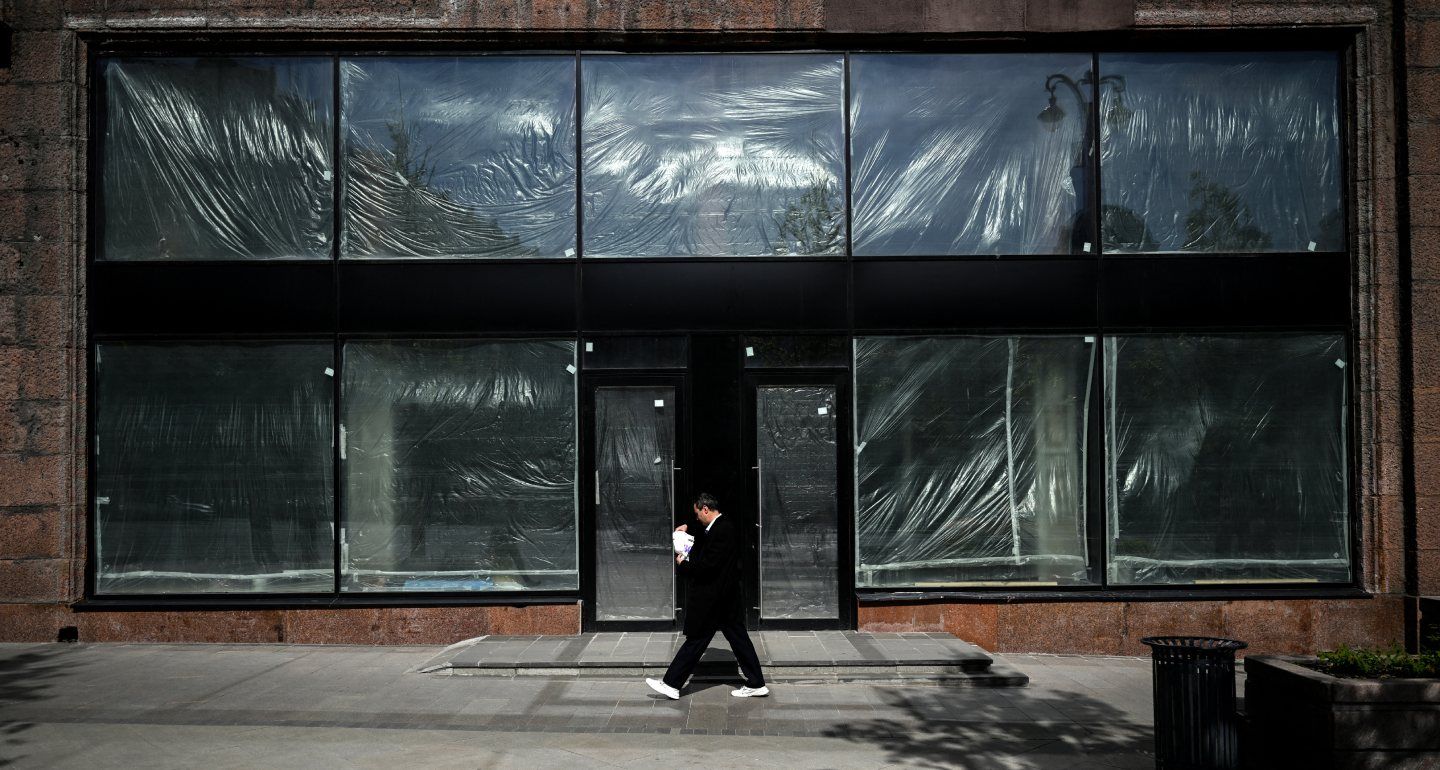
Talk of renewed U.S.-Russia business ties could mask exclusive deals aimed at enriching individual capitalists.
High-profile talks between Russia and the United States have ignited speculation about a potential revival of economic cooperation between the two countries and the return of American companies to the Russian market. Concrete discussions on lifting sanctions remain vague at best. Yet judging by Russian media coverage, foreign companies may as well be lining up at Russia’s borders, ready to overlook their recent losses and re-enter the market. Inside the Kremlin, officials are already rubbing their hands and preparing to regulate the re-entry of Western businesses.
The American corporate response, in contrast, remains cautious. Nevertheless, U.S. President Donald Trump continues to send favorable signals toward Moscow while sharply criticizing Ukrainian President Volodymyr Zelensky. Trump’s apparent affinity for Russia is not driven by a deep understanding of its history or any sentimental attachment to the country. His focus appears to be on ending the war to demonstrate that he is fulfilling his election campaign boast. Moscow, for its part, seeks to restore economic ties—not to return to business as usual, but to foster projects that would benefit a select few.
For a global capital, Russia remains distinctly uninvestable. Two primary factors underscore this reality. First, as long as the issue of Russia’s frozen foreign currency reserves remains unresolved, the Kremlin will continue to hold Western companies’ assets in special accounts, putting any new investments at risk of seizure or expropriation. Of the nearly $300 billion in frozen Russian reserves, only $5 billion is held in the United States, with over $210 billion trapped in the European Union, which redirects interest accrued from the reserves to Ukraine.
Second, over the past three years, Russia has enacted a series of laws that effectively repress foreign businesses. None of these legal barriers—from categorizing countries as “friendly” or “unfriendly,” which affects business regulations, to restrictions on repatriating profits and moving equipment—appear close to being lifted. Recent Russian court rulings, including the forced expropriation of assets from the owners of Domodedovo Airport and Raven Russia’s logistics centers due to their foreign citizenship, have only made the investment climate even chillier.
Russia’s interest lies not in restoring broad U.S. investment; it’s about crafting exclusive deals for a select group of businessmen. And the person facilitating these deals from the Russian side is telling.
Kirill Dmitriev, head of the Russian Direct Investment Fund (RDIF) and a prominent participant in the talks with the United States, boasts strong ties to Trump’s inner circle. A Kyiv-born graduate of both Stanford and Harvard, Dmitriev has frequently served as an intermediary between Russian President Vladimir Putin and foreign investors. Recently, he was appointed the Kremlin’s special envoy for investment and trade: a role tailored specifically for him that comes with no executive authority but does grant direct access to Putin.
Dmitriev is also known for his 2017 Seychelles meeting with Erik Prince, founder of the U.S. private military company Blackwater, and for his reported connections to figures like former White House communications director Anthony Scaramucci and Trump’s son-in-law Jared Kushner.
While the RDIF’s stated goal is to attract investment to Russia, the fund’s operations remain shrouded in secrecy. Little is known about its investment strategies, partnerships, returns, or investor exits—leading some to view it less as a private equity firm and more as an exclusive investment club for insiders.
Dmitriev’s network will likely serve as a parking lot for American capital, which will then be funneled into sectors dominated by Putin’s allies.
Which sectors could be on the table? Trump has a penchant for quick wins, high profits, and projects with headline-grabbing potential. Energy and artificial intelligence (AI) were reportedly on the agenda during his phone call with Putin. One particularly intriguing area could be projects tied to the Northern Sea Route—Russia’s ambitious alternative to the Suez Canal, offering the shortest passage between Europe and Asia. That could involve logistics, port construction, Arctic oil and gas development, and icebreaker fleets.
For Trump, investing in the Northern Sea Route isn’t just a huge infrastructure project—something he has long admired—but is also about limiting China’s influence in the Arctic and leaving his mark on the region’s exploration and development, especially if his plan to acquire Greenland doesn’t work out. Domestically, such investments could be sold to American voters as job-creating ventures in logistics, energy, and shipbuilding.
The Northern Sea Route is managed by Rosatom, Russia’s state nuclear monopoly, which also has other potentially lucrative offerings. Notably, small modular nuclear reactors (SMRs) have become increasingly vital as demand for computational power surges, especially for AI and cloud services. Despite sanctions against its leadership, Rosatom itself has avoided broader restrictions and aims to capture 20 percent of the global SMR market. The prospect of dominating the energy supply for the world’s most promising technology—artificial intelligence—is likely irresistible to both Trump and his tech-enthusiast allies.
The Kremlin’s motivations are equally clear. Beyond the obvious financial benefits, Moscow would gain access to technologies currently blocked by sanctions and potentially leverage U.S. partnerships to position itself as a global leader in AI. There may be other projects, too.
Even without any major steps to ease sanctions, the current negotiations could still give Russia a significant economic boost. Russian businesses have learned to live under Western sanctions, though they admit things would be far better without them. Moscow is much more worried about the ever-present risk of Washington introducing secondary sanctions again the key buyers of Russian exports. Accordingly, if no measures are taken to more closely enforce the current restrictions and the U.S. Office of Foreign Assets Control turns a blind eye to new tankers in Russia’s “shadow fleet” and their maintenance, that would already be a satisfactory state of affairs for the Russian leadership.
But Washington’s flirtation with Moscow cannot fail to have consequences. No economic project will make Putin see the West as anything but a rival, even with a friendly Trump in the White House. Putin’s paranoia, historical grievances, and unchecked authority at home will likely push him toward future conflicts. By pursuing potential short-term profits, the United States risks enabling a larger global threat—and investors risk facing the same devastating losses they endured in 2022. History shows that in dealings with the Kremlin, there are no easy wins—only costly lessons.
Fellow, Carnegie Russia Eurasia Center
Alexandra Prokopenko is a fellow at the Carnegie Russia Eurasia Center.
Recent Work
Alexandra Prokopenko


Eric Ciaramella, Aaron David Miller, Alexandra Prokopenko, …
Carnegie does not take institutional positions on public policy issues; the views represented herein are those of the author(s) and do not necessarily reflect the views of Carnegie, its staff, or its trustees.
Moldova’s reintegration plan was drawn up to demonstrate to Brussels that Chișinău is serious about the Transnistria issue—and to get the West to react.
Vladimir Solovyov
Lukashenko is willing to make big sacrifices for an invitation to Mar-a-Lago or the White House. He also knows that the clock is ticking: he must squeeze as much out of the Trump administration as he can before congressional elections in November leave Trump hamstrung or distracted.

Artyom Shraibman
The future trajectory of the U.S.-Iran war remains uncertain, but its impact on global energy trade flows and ties will be far-reaching. Moscow is likely to become a key beneficiary of these changes; the crisis in the Gulf also strengthens Russia’s hand in its relationships with China and India, where advantages might prove more durable.

Sergey Vakulenko
The Kremlin expects to not only profit from rising fertilizer prices but also exact revenge for the collapse of the 2023 grain deal.
Alexandra Prokopenko

Talankin and Borenstein’s documentary is a unique inside look at a regime that threatens the world and has killed thousands of people in its neighboring country. And many critics and general viewers alike draw parallels between the Putin regime and their own governments.

Ekaterina Barabash