

Commentary
Andrey Pertsev
{
  "authors": [
    "Andrey Pertsev"
  ],
  "type": "commentary",
  "blog": "Carnegie Politika",
  "centerAffiliationAll": "",
  "centers": [
    "Carnegie Endowment for International Peace",
    "Carnegie Russia Eurasia Center"
  ],
  "englishNewsletterAll": "",
  "nonEnglishNewsletterAll": "",
  "primaryCenter": "Carnegie Russia Eurasia Center",
  "programAffiliation": "",
  "programs": [],
  "projects": [],
  "regions": [
    "Russia"
  ],
  "topics": [
    "Domestic Politics",
    "Political Reform"
  ]
}
Source: Getty
While most candidates from United Russia ignored the conflict in Ukraine, those who did not were punished by voters—creating a conundrum for future elections.
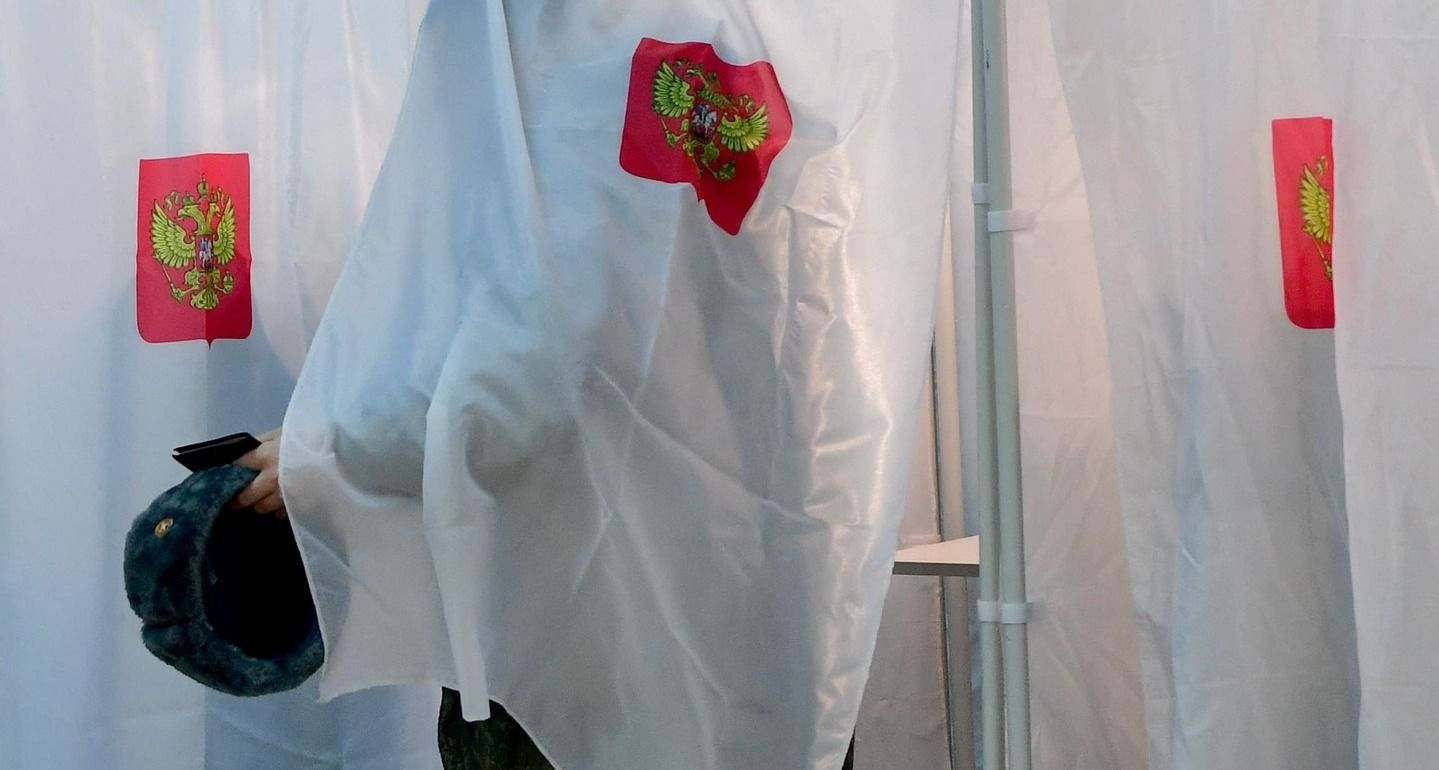
For the Kremlin’s political managers, the elections held in early September for governors and regional legislative assemblies were a dress rehearsal for the State Duma vote in 2026. During campaigning, the ruling United Russia party mainly used traditional slogans promising “development” and “stability.” There were a few experiments with pro-war messaging, but they were a failure.
At the same time, the Kremlin-controlled opposition parties in Russia’s tightly managed democracy were permitted to try out anti-migrant, nationalistic rhetoric. This shift to the right meant there was less risk of anyone trying to exploit genuine social issues—a tactic that could have badly damaged support for United Russia.
Despite United Russia’s involvement in Russia’s war effort, the party tried to avoid mentioning the conflict in Ukraine in campaigning. Party strategists were only too well aware this would alienate voters, who support messages of “stability,” but are tired of war. According to the latest survey by pollster Levada Center, two-thirds of Russians are keen to see peace talks.
The party strategists turned out to be correct, and when the war did feature in campaigning, it damaged pro-regime candidates. The acting governor of the Sverdlovsk region, Denis Pasler, for example, tried to present himself as one of Russia’s most pro-war and patriotic-minded regional leaders: he stressed his ties to military commander-turned-politician Artyom Zhoga, took part in pro-war events, talked about using regional funds to boost the salaries of soldiers, and adopted pro-war slogans.
It’s possible this approach won Pasler friends in the Kremlin, but it did not go down well in one of Russia’s more democratically inclined regions. Shortly before the vote, pollster VTsIOM predicted Pasler would win 54 percent: a terrible result for a regime candidate in Russia’s rigged system. Pasler’s campaign then pulled out all the stops, and on election day, he got a still very moderate 61.3 percent.
Another example of the negative electoral effect of highlighting the war came from the Tambov region. There, acting governor Yevgeny Pervyshov, a member of the so-called “new Putin elite” who had publicly signed up for a volunteer battalion in Ukraine (although there is no proof he actually took part in military action) ended up with 74 percent. While that was better than Pasler, the Tambov region is known for handing pro-government candidates big wins (Pervyshov’s predecessor, Maksim Yegorov, got 83 percent).
It was also indicative that Russia’s most pro-war in-system opposition party, A Just Russia, performed worse in most regions than it had in previous elections. In the Kostroma region, for example, its result fell 3 percentage points (to 6 percent), and in the Kurgan region by almost 5 percentage points (to 5 percent).
All told, United Russia’s experiments with pro-war messaging suggest it would be deeply unwise for the party to put forward a lot of military personnel as candidates in the 2026 parliamentary elections. In Russia’s last parliamentary elections in 2021, United Russia officially won 49.8 percent of the vote. Now even VTsIOM, which works closely with the Kremlin, puts the party at 34.1 percent.
If a lot of military figures do run, that will neither boost United Russia’s chances, nor increase turnout. However, Russian President Vladimir Putin’s personal obsession with the ongoing conflict with Ukraine means the Kremlin’s political managers will not be allowed to run a campaign entirely free of references to the war.
Another new development in these elections was the decision to permit Kremlin-controlled opposition parties—the nationalist Liberal Democratic Party of Russia (LDPR), the centrist New People party, and A Just Russia—to use anti-immigrant and nationalist rhetoric. The LDPR’s call for a ban on allowing immigrants to bring their families into Russia seemingly helped them come second in regional assembly elections (according to official results, the LDPR came second in seven of the eleven regions where votes took place).
Both the LDPR and the New People party were also permitted to use moderate nationalist slogans as part of their campaigns—and both parties were pleased with their results, which means those slogans will likely be deployed again in the run-up to the State Duma vote.
For many years, anti-immigrant rhetoric and nationalist slogans have been taboo for Russia’s “in-system” opposition parties. That no longer appears to hold. One of the reasons is that the Kremlin’s political managers want to try to pull voters away from the Communist Party—traditionally Russia’s second most popular party, and one of its less pliable. Allowing political parties to shift rightward is also a Kremlin tactic to try to stop them from exploiting some of the social issues that really concern voters.
Now that the dust has settled, the regional election campaign appears to have flagged a number of problems for the Kremlin. While Putin is clearly content with Russia’s electoral landscape and sees opposition party leaders as his comrades in arms, it’s difficult for Kremlin political managers to ensure all the political parties get exactly the right number of votes. A Just Russia’s poor showing, for example, means that the Kremlin will now have to pull administrative weight to get it seats in regional assemblies. Similar interventions (which are not always guaranteed to be successful) are required for the LDPR and New People.
Going forward, Putin’s position means United Russia will not be able to avoid mentioning the war in the 2026 State Duma elections. That will likely make a big win harder to achieve. Instead, the Kremlin will need to increase pressure on state companies to mobilize their employees to turn out and vote, and significantly increase falsification at the election committee level. However, such an approach risks making the official results seem absurd and divorced from reality. That will not necessarily lead to protests, but it will contribute to rising disillusionment and a growing sense of malaise in Russian society.

Andrey Pertsev is a journalist with Meduza website.
Recent Work
Andrey Pertsev
Andrey Pertsev
Carnegie does not take institutional positions on public policy issues; the views represented herein are those of the author(s) and do not necessarily reflect the views of Carnegie, its staff, or its trustees.

The European far right might fail to steer EU policy in the direction Russia wants, but they will create enough chaos inside Europe to benefit the Kremlin.

Dimitar Bechev

If the Russian-speaking community in Latvia cannot articulate their interests without being seen as disloyal, they could end up embracing a pro-Kremlin agenda.

Sergejs Potapkins

Russia’s ruling party would have benefited from Putin appearing as its distant patron, but as an active frontman imposing his views on the public, he has done nothing but harm both the party’s election campaign and the ruling system overall.
Andrey Pertsev

Depleted financial reserves and a shrinking tax base mean it is no longer possible to simultaneously deliver high defense spending, price stability, and economic growth.

Alexandra Prokopenko

Blurring the line between humans and animals is a long-standing tradition in social utopian prose. In his latest novel, Leonid Bershidsky reminds us that in social experiments, people are often treated no differently than animals.

Alexander Baunov