

Commentary
Balázs Jarábik
{
  "authors": [
    "Balázs Jarábik"
  ],
  "type": "commentary",
  "blog": "Carnegie Politika",
  "centerAffiliationAll": "",
  "centers": [
    "Carnegie Endowment for International Peace",
    "Carnegie Russia Eurasia Center"
  ],
  "englishNewsletterAll": "",
  "nonEnglishNewsletterAll": "",
  "primaryCenter": "Carnegie Russia Eurasia Center",
  "programAffiliation": "",
  "programs": [],
  "projects": [],
  "regions": [
    "Belarus",
    "Europe",
    "Russia",
    "Ukraine"
  ],
  "topics": [
    "Foreign Policy",
    "EU Foreign Policy",
    "Security",
    "Military"
  ]
}
Source: Getty Images
The future of the Belarus track will depend less on Minsk’s intentions than on whether the EU can move beyond symbolic unity and adopt a strategic approach toward a neighbor central to Europe’s security architecture. Without a more active EU role, these processes will unfold under conditions set entirely by Minsk and Moscow.
Belarus finds itself between isolation and cautious reengagement: caught between shifting U.S.–Russia relations under U.S. President Donald Trump’s push to end the war in Ukraine and a Europe that increasingly views the region through the lens of hybrid threats. Washington is speaking to Minsk while Brussels (formally) doubles down, reflecting an emerging asymmetry in Western approaches to Belarus.
After months of quiet U.S.–Belarus contacts, limited releases of political prisoners, narrowly calibrated sanctions adjustments, and border closures and reopenings, Minsk is now testing openings with select European neighbors while maintaining its asymmetric dependence on Russia. Border pressures (migration), balloon-related “hybrid war” alarms, and highly controlled prisoner releases have become tools in Belarus’s political repertoire, illustrating the regime’s effort to manage uncertainty without committing to any strategic realignment.
These maneuvers are unfolding against the backdrop of Minsk freezing its constitutional transition, launched after the highly contested 2020 elections, due to the war in Ukraine. For contested leader Alexander Lukashenko’s system, completing this transition represents its most significant unresolved challenge. To navigate it, the regime needs to widen its domestic and international political space—reviving, even if only partially, the balancing act that once defined Belarus’s foreign policy. The current situation is therefore less a moment of strategic drift than a deliberate attempt to create room for maneuver at a time of intensifying geopolitical constraints.
The fragile phase of dialogue between Minsk and the West is on hiatus after several rounds of prisoner releases and the first U.S. sanctions relief, giving way to selective reengagement. The recent correction of U.S. sanctions relief on state airline Belavia—introduced after Minsk expressed dissatisfaction with the narrow scope of the original measure—was the first clear signal that Washington intends to keep the Belarus track open.
The latest large-scale release of political prisoners—156 individuals, including all formal leaders of the 2020 opposition movement and 2022 Nobel Peace Prize laureate Ales Bialiatski—fits the established pattern of incremental humanitarian gestures linked to sanctions flexibility (following the latest release, the United States lifted sanctions against Belarusian potash, one of the country’s biggest exports). Securing prisoner releases remains Washington’s primary objective: to date, more than 200 detainees, including all prominent opposition figures, have been freed, although well over a thousand political prisoners remain incarcerated.
For Minsk, economic considerations have been central to these decisions. After Belavia, Belaruskali—one of the world’s biggest potash fertilizer producers—emerged as a top priority in discussions with the United States, helping explain the regime’s willingness to release high-profile political figures.
Broader sanctions relief, however, remains difficult. This reflects not only the cautious approach of U.S. agencies—particularly the Treasury—but also resistance within the European Commission and from several EU member states, most notably Belarus’s neighbor Lithuania, which continue to oppose any relaxation of pressure absent more far-reaching political change. Washington also plays a discreet role in the tentative Belarus–Ukraine thaw, visible most recently in Minsk’s release of thirty-one Ukrainian prisoners.
Overall, the White House increasingly views Belarus as a potential model: a case of calibrated engagement producing tangible results where pressure alone previously failed, and of reengagement demonstrating that the United States is not ceding Eastern Europe to Russian influence. This development fits within Washington’s broader effort to recalibrate policy toward Russia while maintaining controlled channels with its closest ally.
For Washington, Belarus offers tactical utility. It provides a discreet channel for communicating difficult messages to Moscow—including on issues like Venezuela—and serves as a testing ground for limited de-escalation measures. For Minsk, engagement with the United States offers political balance and a degree of legitimacy that neither Moscow nor Brussels can provide. The U.S. track has also become a reference point for the exiled opposition and even for Vilnius—both of which now see it as the only approach capable of generating meaningful outcomes in dialogue with Minsk.
While Washington keeps talking, Europe has demonstratively moved in the opposite direction. Belarus’s Zapad-2025 military exercise became a pretext for renewed confrontation. Minsk took visible steps to demonstrate restraint: relocating drills away from the Polish border, reducing participation to about 7,000 troops (a significant decrease from the 12,800 troops that participated in Zapad-2021 in Belarus), removing offensive scenarios, and inviting all OSCE members to observe—despite the exercise falling below the 13,000-troop threshold.
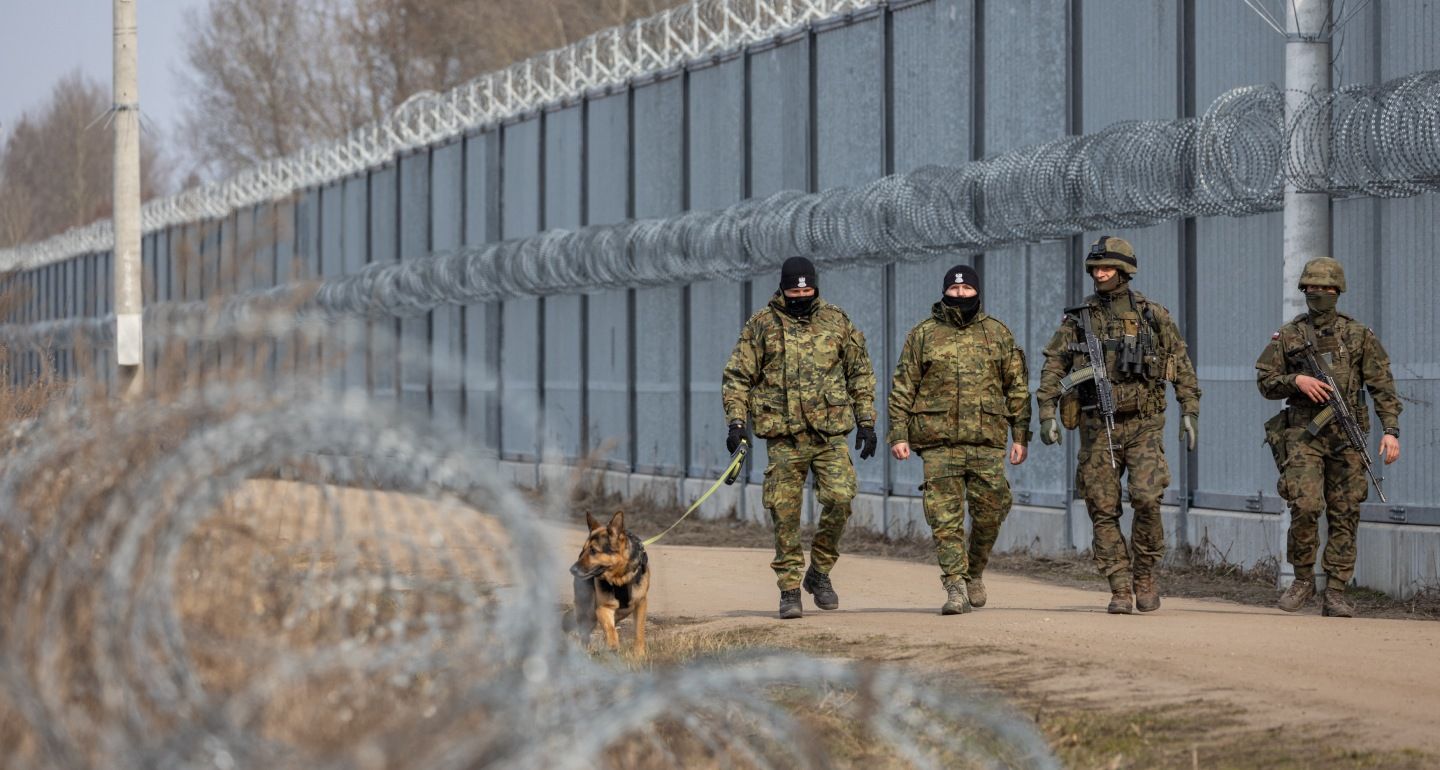
Warsaw nevertheless responded by completely closing its border on the eve of the exercise. That decision preceded an incident in which multiple Russian drones entered Polish airspace, with Minsk warning Warsaw of the incoming incursion. Polish officials have informally asserted that six of the drones were launched from Belarusian territory by Russian units, whereas Minsk maintains that it has kept its airspace tightly controlled since 2022 and that no unauthorized Russian strike activity has occurred without notification. Despite the warning, Warsaw proceeded with the closure, while 50,000 NATO troops held parallel drills around Belarus.
Relations with Vilnius deteriorated further when Lithuania also closed its border—just one day before the Minsk Eurasian Security Conference—disrupting travel for many Western participants. Belarusian officials admitted that helium balloons used to smuggle contraband over the border had caused interruptions at Vilnius Airport, but questioned the logic of closing a state border over such incidents. Minsk proposed restoring direct communication between border guards; Vilnius refused.
The closures had asymmetric effects. Around 1,800 Lithuanian trucks were left stranded in Belarus, with no facilitation from Minsk—a show of political rigidity. By contrast, when 1,500 Polish trucks were trapped during Warsaw’s earlier closure, Belarus extended visas and permits, signaling controlled pragmatism. The softer response reflected both the existence of a diplomatic and security service back channel and China’s stake in keeping the Polish transit route open.
In the same week that Lithuania sealed its border, Poland announced plans to reopen two additional crossings: a signal that practical coordination would ultimately resume, despite political hostility.
The so-called “balloon incidents” illustrate the intersection between security, economics, and politics on Belarus’s western frontier. The cross-border cigarette trade remains one of the region’s most lucrative informal economies, linking elite business interests in Minsk with criminal networks in neighboring EU states.
Large-scale smuggling takes place at several levels, from local villagers carrying small quantities daily to organized groups moving thousands of cartons in modified trucks or rail containers. A recent Polish seizure revealed 10,000 packs of Belarusian-stamped cigarettes disguised as sound-proofing material, worth about $47,000.
After Belarus criminalized the use of drones—a key tool for smugglers—balloons became a new delivery method. Dozens entered Lithuanian airspace in October, disrupting flights at Vilnius Airport. Lithuanian statistics show 966 balloon incidents in 2024 and 544 in 2025: an overall decline, but with some spikes after Belarus’s new drone law entered into force on October 20, 2025.
Official statistics have not confirmed the immediate claims of a major increase. Still, Vilnius Airport’s operations have been disrupted over ten times already, causing headaches for the authorities. While Vilnius viewed this as hybrid pressure, Minsk saw it as criminal opportunism politicized for domestic gain.
Belarusian insiders admit that the trade is tolerated because it channels off-budget revenues to networks close to the presidency. This phenomenon is essentially “instrumentalized smuggling”: tolerated or even staged by elements within the security apparatus to serve broader political purposes. Whether miscalculation or sabotage—since much depends on wind direction—the incidents derailed emerging efforts to reopen dialogue with Lithuania and reinforced Minsk’s dependence on Moscow.
Within the European Union, Belarus is now viewed almost exclusively through the prism of hybrid warfare. Every border incident—whether migrants or now balloons—is interpreted as a deliberate act of state pressure, or in some European capitals, as Russian hybrid attacks via Minsk.
Despite internal interest in reviving technical cooperation with Minsk, the EU’s official stance remains unchanged: no engagement until all political prisoners are freed. Brussels continues to emphasize accountability and humanitarian standards over tactical diplomacy. The U.S.–Belarus dialogue, though yielding limited prisoner releases, is dismissed as insufficient grounds for policy change.
For Brussels, maintaining consensus outweighs exploring relevance. Under the pressure of supporting Ukraine’s war effort, the EU’s posture toward Russia—and by extension Belarus—has hardened. In this climate, the political cost of flexibility exceeds its potential benefits.
Poland and Lithuania remain the EU’s frontline actors toward Belarus, but their domestic calculations diverge. Poland maintains selective working channels—through its foreign ministry, border service, and intelligence agencies—but has avoided military contacts since the 2024 killing of a Polish soldier by a migrant, which Warsaw attributes to Belarusian facilitation. Dialogue continues under clear preconditions for progress: Poland wants to see the release of journalist Andrzej Poczobut and a measurable reduction in migration flows viewed as part of Russia’s hybrid campaign.
Warsaw portrays its border closure as a success, citing Belarus’s restrained response as a proof of deterrence. Officials publicly downplay the visit of the Chinese delegation to Warsaw the same week, calling it coincidental. Yet Beijing retains leverage: Poland’s ambition to become a European “drone hub” depends on Chinese components and supply chains that still run through Belarus.
Lithuania, by contrast, continues to treat any normalization with Minsk as politically toxic. The new government briefly explored limited reengagement through the U.S. channel but quickly encountered resistance from its own security and foreign policy establishment. While parts of the ruling coalition appear cautiously open to dialogue, the foreign ministry and opposition remain firmly committed to isolation and sanctions, and the president aligns with this prevailing consensus.
In Vilnius, even raising the prospect of dialogue still risks being framed as disloyal or “anti-Lithuanian,” yet the political space for debate is gradually widening. The recent U.S. sanctions relief on Belarusian potash—whose transit was previously a lucrative business for Lithuania—has underscored the economic costs of isolation and could reopen discussion about whether the current policy remains sustainable.
Minsk’s selective release of political prisoners follows a clear internal logic. The KGB tends to release those individuals who, once free, are likely to fragment the exiled opposition and discredit its leadership abroad. The case of Siarhei Tsikhanouski, freed despite being one of Lukashenko’s main rivals in 2020, fits this pattern: his post-release statements have damaged the credibility of the opposition office and reinforced state narratives.
For Minsk, such releases are not merely tactical gestures designed to extract limited political dividends without altering the regime’s strategic course; they also reflect a deeper domestic challenge. The root cause of the large-scale protests that followed the 2020 elections—the widening desynchronization between state and society—remains unresolved. Criminal cases linked to the 2020 protests continue, and there is no indication of movement toward political reconciliation. Belarus’s external orientation also remains firmly anchored to Russia, as no alternative power center could guarantee regime survival were Lukashenko to distance himself from Moscow.
Yet Minsk understands that any return to its traditional balancing act requires creating greater political space at home while at the same time trying to limit it as far as possible. This is especially relevant as the regime prepares for the already drafted constitutional transition, which it froze in response to the war in Ukraine. Reopening limited channels with the West, including through selective prisoner releases, is therefore not only a foreign policy maneuver but also a way to manage the domestic political environment ahead of a sensitive institutional transformation.
Belarus continues to practice differentiation among its neighbors. Toward Lithuania, rigidity and retaliation prevail. Toward Poland, limited cooperation continues through security service channels. Toward the EU, a charm offensive is under way. In recent months, the Belarusian Foreign Ministry has tried to reach out to several EU member states—France, Italy, Germany, Hungary, and Slovakia—and supported a series of Track Two consultations in Minsk. These informal dialogues, supported locally by European embassies, have created modest openings for technical contacts.
Yury Ambrazevich, the Belarusian ambassador to the Vatican, has since met officials in Paris and Berlin focusing on humanitarian and environmental cooperation as low-risk entry points. A technical visit by European Commission officials in June, followed by informal consultations with the European External Action Service and the Working Party on Eastern Europe and Central Asia in October and November, reflected a tentative effort to assess whether member states might support policy recalibration.
Poland, though not part of the pro-engagement group, has begun coordinating more closely with the United States on prisoner releases and border reopening. The two November 17 border crossing reopenings coincided with Belarus releasing two imprisoned Catholic priests to the Vatican, signaling transactional pragmatism.
The post-2020 Western policy framework in Belarus is visibly eroding. The shift is driven less by Minsk than by U.S. recalibration toward Russia as Washington searches for a pathway to end the war in Ukraine. That process has inevitably elevated Belarus’s relevance—politically, diplomatically, and geographically.
For Minsk, this coincides with a critical internal challenge: completing the stalled constitutional transition and stabilizing a system that has relied heavily on coercion since 2020. In principle, navigating this transition would require reviving elements of Belarus’s traditional balancing act, which historically depended on maintaining a degree of political pluralism and societal accommodation.
Any sustainable transition would therefore demand a cautious but real widening of political space to reduce internal tensions and prevent another cycle of repression and backlash. Yet Minsk learned the opposite lesson from the 2020 protests: that political openings carry existential risks. As a result, it is seeking to manage the transition while keeping society tightly contained and while remaining structurally dependent on Moscow, making this perhaps the most delicate and paradoxical undertaking of the coming period.
The United States continues to actively pursue tactical engagement, as seen in the correction of the Belavia sanctions relief and further sanctions relief on potash following the latest prisoner release. Europe, by contrast, remains reluctant to adjust course. A small coalition of member states is exploring engagement, but institutional inertia and resistance from the Baltic states keep EU policy frozen.
This leaves the EU facing a broader strategic question: whether it can meaningfully manage a political and security challenge on its own border that is increasingly inseparable from its future relationship with Russia. Poland’s cautious reopening, Lithuania’s entrenched hard line, and Belarus’s calibrated diplomatic outreach all highlight how divergent national approaches are already testing EU cohesion and limiting its capacity to influence developments.
Belarus, for its part, is pursuing differentiated tactics—probing Poland, confronting Lithuania, and quietly courting several Western European capitals—while signaling its readiness to take further steps if the West responds. The long-standing “Balcony Doctrine,” which casts Belarus as both buffer and observer, still shapes Minsk’s behavior, though the balcony is narrowing as the war in Ukraine grinds on and Russia’s own capabilities remain under strain.
In this environment, the future of the Belarus track will depend less on Minsk’s intentions than on whether the EU can move beyond symbolic unity and adopt a strategic approach toward a neighbor central to Europe’s security architecture. Engagement is not an endorsement of the regime, but a prerequisite for achieving what isolation has failed to deliver: the release of political prisoners, steps toward political reconciliation, and a more transparent constitutional transition.
Without a more active EU role, these processes will unfold under conditions set entirely by Minsk and Moscow. With calibrated engagement, the EU can help shape outcomes that reduce regional instability, strengthen its leverage in future dealings with Russia, and ensure that developments in Belarus do not further erode Europe’s own security environment.

Political analyst, former Slovak diplomat, and consultant specializing in Eastern Europe
Recent Work
Balázs Jarábik
Balázs Jarábik
Carnegie does not take institutional positions on public policy issues; the views represented herein are those of the author(s) and do not necessarily reflect the views of Carnegie, its staff, or its trustees.

Trump has promised Belarus a massive potash deal. But Minsk is seeking something greater: restored Western transit and greater room for maneuver from Russia.
Balázs Jarábik

The European far right might fail to steer EU policy in the direction Russia wants, but they will create enough chaos inside Europe to benefit the Kremlin.

Dimitar Bechev

Minsk clearly expected the dialogue with Washington to yield more results, in particular the lifting of EU sanctions and permission to export potash.

Artyom Shraibman

If the Russian-speaking community in Latvia cannot articulate their interests without being seen as disloyal, they could end up embracing a pro-Kremlin agenda.

Sergejs Potapkins

Russia’s ruling party would have benefited from Putin appearing as its distant patron, but as an active frontman imposing his views on the public, he has done nothing but harm both the party’s election campaign and the ruling system overall.

Andrey Pertsev