

In The Media
Michele Dunne, Robert Kagan
{
  "authors": [
    "Robert Kagan"
  ],
  "type": "legacyinthemedia",
  "centerAffiliationAll": "dc",
  "centers": [
    "Carnegie Endowment for International Peace"
  ],
  "collections": [],
  "englishNewsletterAll": "menaTransitions",
  "nonEnglishNewsletterAll": "",
  "primaryCenter": "Carnegie Endowment for International Peace",
  "programAffiliation": "MEP",
  "programs": [
    "Middle East"
  ],
  "projects": [],
  "regions": [
    "North America",
    "United States",
    "Middle East",
    "Iran"
  ],
  "topics": [
    "Political Reform",
    "Foreign Policy"
  ]
}
Source: Getty
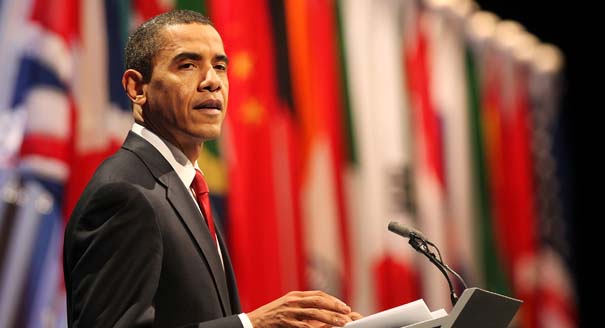
The political turmoil in Iran is not good news for the president but, rather, an unwelcome complication in his strategy of engaging and seeking rapprochement with the Iranian government on nuclear issues.
Source: Washington Post

If so, this will be one of those great ironies of history. For, in fact, Obama never meant to spark political upheaval in Iran, much less encourage the Iranian people to take to the streets. That they are doing so is not good news for the president but, rather, an unwelcome complication in his strategy of engaging and seeking rapprochement with the Iranian government on nuclear issues.
One of the great innovations in the Obama administration's approach to Iran, after all, was supposed to be its deliberate embrace of the Tehran rulers' legitimacy. In his opening diplomatic gambit, his statement to Iran on the Persian new year in March, Obama went out of his way to speak directly to Iran's rulers, a notable departure from George W. Bush's habit of speaking to the Iranian people over their leaders' heads. As former Clinton official Martin Indyk put it at the time, the wording was carefully designed "to demonstrate acceptance of the government of Iran."
This approach had always been a key element of a "grand bargain" with Iran. The United States had to provide some guarantee to the regime that it would no longer support opposition forces or in any way seek its removal. The idea was that the United States could hardly expect the Iranian regime to negotiate on core issues of national security, such as its nuclear program, so long as Washington gave any encouragement to the government's opponents. Obama had to make a choice, and he made it. This was widely applauded as a "realist" departure from the Bush administration's quixotic and counterproductive idealism.
It would be surprising if Obama departed from this realist strategy now, and he hasn't. His extremely guarded response to the outburst of popular anger at the regime has been widely misinterpreted as reflecting concern that too overt an American embrace of the opposition will hurt it, or that he wants to avoid American "moralizing." (Obama himself claimed yesterday that he didn't want the United States to appear to be "meddling.")
But Obama's calculations are quite different. Whatever his personal sympathies may be, if he is intent on sticking to his original strategy, then he can have no interest in helping the opposition. His strategy toward Iran places him objectively on the side of the government's efforts to return to normalcy as quickly as possible, not in league with the opposition's efforts to prolong the crisis.
It's not that Obama preferred a victory by Mahmoud Ahmadinejad. He probably would have been happy to do business with Mir Hossein Mousavi, even if there was little reason to believe Mousavi would have pursued a different approach to the nuclear issue. But once Mousavi lost, however fairly or unfairly, Obama objectively had no use for him or his followers. If Obama appears to lend support to the Iranian opposition in any way, he will appear hostile to the regime, which is precisely what he hoped to avoid.
Obama's policy now requires getting past the election controversies quickly so that he can soon begin negotiations with the reelected Ahmadinejad government. This will be difficult as long as opposition protests continue and the government appears to be either unsettled or too brutal to do business with. What Obama needs is a rapid return to peace and quiet in Iran, not continued ferment. His goal must be to deflate the opposition, not to encourage it. And that, by and large, is what he has been doing.
If you find all this disturbing, you should. The worst thing is that this approach will probably not prevent the Iranians from getting a nuclear weapon. But this is what "realism" is all about. It is what sent Brent Scowcroft to raise a champagne toast to China's leaders in the wake of Tiananmen Square. It is what convinced Gerald Ford not to meet with Alexander Solzhenitsyn at the height of detente. Republicans have traditionally been better at it than Democrats -- though they have rarely been rewarded by the American people at the ballot box, as Ford and George H.W. Bush can attest. We'll see whether President Obama can be just as cold-blooded in pursuit of better relations with an ugly regime, without suffering the same political fate.
This article originally appeared in the Washington Post.
Former Senior Associate
Kagan, author of the recent book, The Return of History and the End of Dreams (Knopf 2008), writes a monthly column on world affairs for the Washington Post and is a contributing editor at both the Weekly Standard and the New Republic.
Recent Work

Michele Dunne, Robert Kagan
Robert Kagan, Michele Dunne
Carnegie does not take institutional positions on public policy issues; the views represented herein are those of the author(s) and do not necessarily reflect the views of Carnegie, its staff, or its trustees.

Despite a new textbook, an influx of Russian teachers and managers, and an end to the teaching of Ukrainian, the Kremlin is unlikely to have “reprogrammed” locals.

Konstantin Skorkin

Cargo traffic through Russia’s Northern Sea Route has increased because of the disruption caused by the conflict in the Middle East, the Ukraine war, and U.S.-China tensions.

Mikhail Korostikov

Sergei Kiriyenko used Russia’s parliamentary vote to further hone his strategy of corporate mobilization that is designed to maximize votes for United Russia.

Andrey Pertsev

Trump has promised Belarus a massive potash deal. But Minsk is seeking something greater: restored Western transit and greater room for maneuver from Russia.

Balázs Jarábik

The European far right might fail to steer EU policy in the direction Russia wants, but they will create enough chaos inside Europe to benefit the Kremlin.

Dimitar Bechev