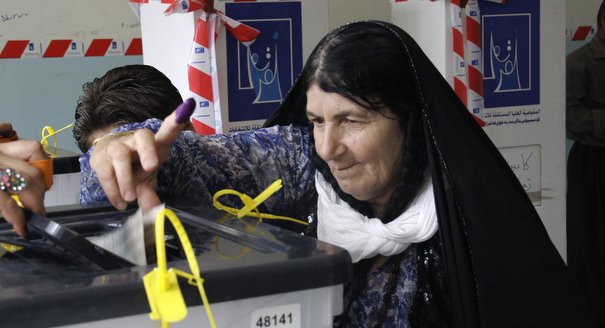
But Gorran’s success is not necessarily a bad outcome for either the KRG or Iraq. With national elections planned for January 2010, everything depends on how the KRG leadership deals with the upset.
The KRG is composed of the PUK, led by the current Iraqi president Jalal Talabani, and the Kurdistan Democratic Party (KDP) which is run by Massoud Barzani, the current president of the KRG and the son of the founder of modern Iraqi Kurdish nationalism, Molla Mustafa Barzani. The elections were to decide the composition of the KRG parliament and the presidency, although Mr Barzani ran against no opposition to speak of.
In the 1990s, when northern Iraq was under the watchful eye of a US-led air defence umbrella, the two parties bickered over territory and the distribution of revenues. Realising that the toppling of the Saddam regime in 2003 was their best chance at achieving a robust autonomous existence within the boundaries of a federal Iraq, the parties decided to integrate their administrations. Though far from perfect, the arrangement has worked.
Although Iraqi Kurdistan became an island of stability compared to the rest of Iraq, the public resented the two parties’ complete dominance of the Kurdish region and the corruption that went along with it. Ironically the Iraqi Kurds who had forged the model for democracy in Iraq saw the national parliament become more vocal and feisty in challenging the executive, whereas their own regional parliament was transformed into a rubber stamp.
The second irony is that it was the PUK that paid the price for the people’s anger, although the KDP is the one that really dominates the northern region. The PUK had sent both Mr Talabani and Barham Salih, a senior PUK official currently serving as Iraq’s deputy prime minister, to Baghdad. While the KDP’s leadership stayed closer to home, strains in the PUK began to show as Mr Talabani and Mr Salih focused their attention on Baghdad.
In 2006, the PUK-controlled region was shocked as the population made a display of its discontent by destroying the monument to the victims of Saddam’s infamous Anfal campaign and gassing of civilians in Halabja. Last year senior PUK officials, close supporters of Mr Talabani, resigned from the party in protest, although they later returned.
This is perhaps why Mr Salih, who is known to be not just squeaky clean but also as a very competent administrator, was selected to return to northern Iraq to lead the unified Kurdistan list. The assumption was that Mr Salih would assume the premiership of the KRG from his KDP counterpart and begin reforms. The success of the Gorran movement has cast this in doubt.
In some ways it is not surprising that the Gorran movement was successful in Sulaymaniyah. The PUK has always been a more middle-class movement compared with the KDP’s rural roots. Sulaymaniyah, the most important city in PUK territory, is also in a more modern and globalised region of Iraqi Kurdistan.
Gorran’s success could still be a blessing in disguise if the KDP-PUK list manages to eke out a majority of seats and Mr Salih assumes the premiership of the KRG. Although politically bruised, Mr Salih could use the post to speed up reforms, fight corruption, family dominance and cronyism, and in the process consolidate a more democratic system in Iraqi Kurdistan. Gorran’s success, the fact that so many people stood up to the dominant party, is proof that democratic politics is taking root in parts of Iraq.
On the other hand, if the KDP ditches its alliance with the PUK or tries to take advantage of its partner’s weakness, then Iraqi Kurdistan could be in for a period of uncertainty and instability. First of all, the opposition’s success is not going to make Iraqi Kurds more willing to compromise on the question of Kirkuk. Mr Barzani made statements as he cast his ballot that indicate the exact opposite is probably true. This will set Irbil on a collision course with Baghdad where prime minister Nouri al Maliki, anxious to add to his nationalist credentials ahead of national elections, is likely to harden his own position regarding the Kurds. In addition to the disputed city and province of Kirkuk, there is also the problem of the unresolved hydrocarbon law.
Increasing tensions between Baghdad and the KRG are also bound to affect KRG-Turkish relations, which had taken an unexpected turn for the better of late. The Turks dropped many of their objections to the KRG and began to actively collaborate with the Kurds on a number of points, including the export of oil and gas from Iraqi Kurdistan. It is too early to ascertain how the Iranians may choose to enter this high-stakes game, but there is no question that it provides them another opening for mischief should they decide to employ it.
Finally, this kind of instability, especially considering that the Kurdish region is strong militarily, would be the last thing Washington would like to see develop as it gets ready to extract itself from Iraq. The question of Iraqi Kurdistan has always been a gnawing problem for the Americans; after all, it is the Americans who have let the Kurds down in the past. Exiting as tensions between Baghdad and the KRG come to a boiling point would not be a happy outcome.