

Q&A
Christopher Boucek
{
  "authors": [
    "Christopher Boucek"
  ],
  "type": "legacyinthemedia",
  "centerAffiliationAll": "dc",
  "centers": [
    "Carnegie Endowment for International Peace"
  ],
  "collections": [],
  "englishNewsletterAll": "menaTransitions",
  "nonEnglishNewsletterAll": "",
  "primaryCenter": "Carnegie Endowment for International Peace",
  "programAffiliation": "MEP",
  "programs": [
    "Middle East"
  ],
  "projects": [],
  "regions": [
    "Yemen"
  ],
  "topics": [
    "Political Reform",
    "Security"
  ]
}
Source: Getty
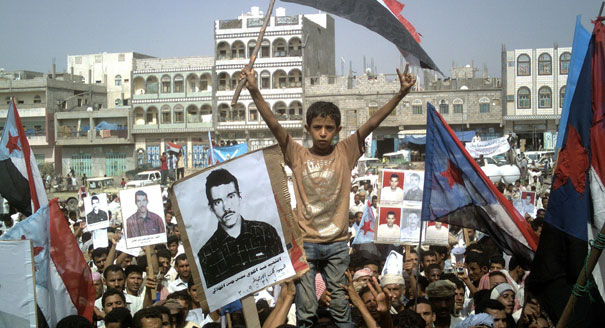
Yemen has always been on the verge of crisis. Throughout its history the country has never known complete stability, and governance has always bordered on chaotic. However, the situation is now rapidly deteriorating, with potentially devastating results.
Source: Jane's Intelligence Review

Yemen is facing a confluence of interconnected security challenges that threatens to swamp the central government. A looming economic crisis, renewed civil war in the north, a mounting southern secessionist movement and a resurgent Al-Qaeda organisation threaten to overwhelm Sanaa's capacity to manage multiple crises.
Unlike earlier individual challenges, such as unification in 1990 or the 1994 civil war, the problems now facing the country are multiple and interconnected, each one posing serious threats to Yemen's future. Any single event could lead to a further erosion of central government authority in Yemen and destabilisation of the region. For example, a major humanitarian crisis, perhaps triggered by severe famine or crop failure, could result in a large refugee emergency in which the government would be unable to provide even rudimentary relief services.
Former Associate, Middle East Program
Boucek was an associate in the Carnegie Middle East Program where his research focused on security challenges in the Arabian Peninsula and Northern Africa.
Recent Work
Christopher Boucek

Christopher Boucek, Karim Sadjadpour
Carnegie does not take institutional positions on public policy issues; the views represented herein are those of the author(s) and do not necessarily reflect the views of Carnegie, its staff, or its trustees.

The European far right might fail to steer EU policy in the direction Russia wants, but they will create enough chaos inside Europe to benefit the Kremlin.

Dimitar Bechev

If the Russian-speaking community in Latvia cannot articulate their interests without being seen as disloyal, they could end up embracing a pro-Kremlin agenda.

Sergejs Potapkins

Russia’s ruling party would have benefited from Putin appearing as its distant patron, but as an active frontman imposing his views on the public, he has done nothing but harm both the party’s election campaign and the ruling system overall.

Andrey Pertsev

In the tenth year of his presidency, President Mirziyoyev’s system is becoming even more personalized than that of his predecessor Karimov.

Galiya Ibragimova

With the growth in points of friction between the great powers, organizations like the SCO will continue to play a role in the strategic adaptation of the smaller powers caught between them.

Temur Umarov