

Commentary
Dmitri Trenin
{
  "authors": [
    "Dmitri Trenin"
  ],
  "type": "legacyinthemedia",
  "centerAffiliationAll": "",
  "centers": [
    "Carnegie Endowment for International Peace",
    "Carnegie Russia Eurasia Center"
  ],
  "collections": [],
  "englishNewsletterAll": "",
  "nonEnglishNewsletterAll": "",
  "primaryCenter": "Carnegie Russia Eurasia Center",
  "programAffiliation": "",
  "programs": [],
  "projects": [],
  "regions": [
    "Caucasus",
    "Russia"
  ],
  "topics": [
    "Political Reform",
    "Economy"
  ]
}
Source: Getty
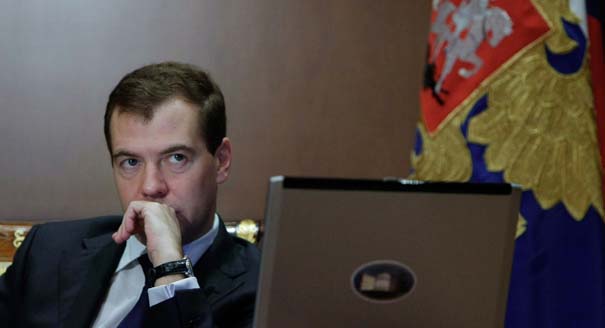
At some point Putin and Medvedev will have to decide between giving priority to the survival of the current system and accepting Russia's steady marginalization, or supporting modernization by opening up the system and putting its survival at risk.
Source: Gulf News

Both methods were used to describe the Putin-Medvedev relationship to understand its nature and dynamic, and what it portends for Russia. But observers remain puzzled.
To dismiss Dmitry Medvedev as a mere Putin puppet, a constitutional bridge between Putin's second and third presidential terms, would be both unfair and wrong. Russia's third president has a broader role and a distinct function. Conversely, portraying Putin as "a man from the past," and Medvedev as "a hope for the future," exaggerates the differences between them and omits the more important factors that unite them. A better analytical model is needed.
For all the apparent freshness of Medvedev's recent pronouncements, including his now famous article ‘Go Russia!' which sounded a clarion call for modernisation and liberalism he is borrowing massively from Putin's vocabulary of 2000. This suggests that the issue of modernisation, which lay dormant throughout the fat years of high oil prices, is back on the Kremlin agenda.
In 2008, Medvedev was installed in the Kremlin as part of "Putin's plan," the substantive part of which was known as "Strategy 2020," a blueprint for continued economic growth and diversification. The intervening crisis only made the Kremlin modify and sharpen its plan. And Medvedev is a key agent in its execution.
Putin chose Medvedev carefully, and not only for his unquestionable loyalty, vitally important as that is. Putin, among other things, is a combative nationalist, and he wants Russia to succeed in a world of competing powers. He is certainly conservative, but he is also a self-described moderniser.
As such, he might be compared to Pyotr Stolypin, another conservative prime minister who famously asked for 20 years of peace and quiet mostly from liberals and revolutionaries to transform Russia. Stolypin never got the chance a revolutionary assassinated him in 1911 and neither did Russia, which stumbled into the First World War, leading directly to the collapse of the monarchy and the Bolshevik revolution.
Former Director, Carnegie Moscow Center
Trenin was director of the Carnegie Moscow Center from 2008 to early 2022.
Recent Work
Dmitri Trenin
Dmitri Trenin
Carnegie does not take institutional positions on public policy issues; the views represented herein are those of the author(s) and do not necessarily reflect the views of Carnegie, its staff, or its trustees.

For every ruble allocated to social policy, health, and education in 2027, double that amount is earmarked for the army, the police, and the security services.

Alexandra Prokopenko

Cargo traffic through Russia’s Northern Sea Route has increased because of the disruption caused by the conflict in the Middle East, the Ukraine war, and U.S.-China tensions.

Mikhail Korostikov
An analysis of traffic accident data suggests that Ukrainian drone attacks caused a material but not disastrous fall in Russian gasoline consumption over the summer.

Sergey Vakulenko

Sergei Kiriyenko used Russia’s parliamentary vote to further hone his strategy of corporate mobilization that is designed to maximize votes for United Russia.

Andrey Pertsev

The European far right might fail to steer EU policy in the direction Russia wants, but they will create enough chaos inside Europe to benefit the Kremlin.

Dimitar Bechev