• Research
  • Politika
  • About
Carnegie Russia Eurasia center logoCarnegie lettermark logo
  • Donate
{
  "authors": [
    "Michael Pettis"
  ],
  "type": "legacyinthemedia",
  "centerAffiliationAll": "dc",
  "centers": [
    "Carnegie Endowment for International Peace",
    "Carnegie Europe"
  ],
  "collections": [],
  "englishNewsletterAll": "asia",
  "nonEnglishNewsletterAll": "",
  "primaryCenter": "Carnegie Endowment for International Peace",
  "programAffiliation": "AP",
  "programs": [
    "Asia"
  ],
  "projects": [],
  "regions": [
    "East Asia",
    "China",
    "Western Europe",
    "Asia",
    "Europe",
    "North America"
  ],
  "topics": [
    "Economy",
    "Trade"
  ]
}
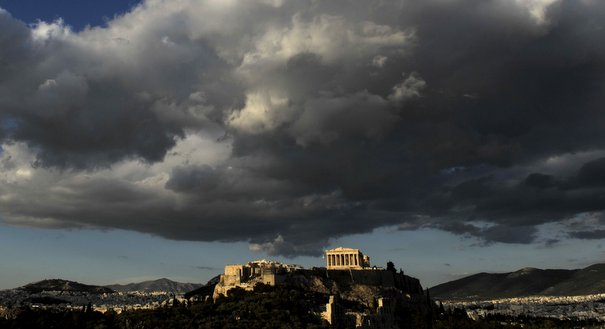
Source: Getty

In The Media

China Falls Victim to Greek Deficit Contagion

China’s steps to limit the damage from the Greek crisis will necessarily shift the brunt of the economic adjustment to other countries, unless the major trading powers can reach a burden-sharing agreement.

Link Copied
By Michael Pettis
Published on May 25, 2010

Source: Bloomberg

China Falls Victim to Greek Deficit ContagionChina is under growing pressure from Asia, Europe and the U.S. to revalue its currency. Until recently, it even looked like we were about to embark on a sustained process of yuan revaluation fairly soon.

The Greek crisis may have changed that. The 15 percent slide in the euro’s value against the yuan over the past six months has eroded Chinese competitiveness in the market of its largest trading partner: the European Union. More importantly, many trade-deficit countries in Europe -- such as Greece, Portugal and Spain -- are having difficulty financing themselves. Without net capital inflows, these countries can no longer run current-account shortfalls.

Not surprisingly, concerns in China about euro weakness have fueled calls for caution in any decision to realign the currency. The yuan has already strengthened significantly in trade-weighted terms and the potential contraction in demand from China’s main trading partner could put serious pressure on Chinese exporters even before a yuan revaluation.
 
One school of thought says to allow more yuan appreciation might create a drag on the economy, just as the Chinese government is trying to wean itself off a massive, and perhaps toxic, dose of investment. China will probably be hurt by the impact of the Greek crisis, and it should try to limit the pain.
 
The reasoning sounds plausible and even responsible, but it might only exacerbate the problem for China over a longer horizon by increasing trade tensions, which historically have been especially damaging to surplus countries.

Shift Burden

China plays a huge role in the global balance of payments. The Greek crisis and the larger European response will adversely affect existing trade. Limiting the damage for China necessarily means shifting the brunt of the adjustment to other countries.
 
Something similar happened in 1930 when the U.S., the leading trade-surplus nation at the time, foolishly used the Smoot-Hawley Tariff Act in an attempt to protect itself from the trade consequences of a collapse in the ability of European trade-deficit countries to finance themselves. U.S. protective measures implicitly required other deficit countries to absorb the full brunt of the impact, and this caused them to retaliate with tariffs, currency depreciations and import quotas.
 
What does all this have to do with Greece? For the foreseeable future, the major trade-deficit countries in Europe are going to find it very difficult to attract net new financing. At best they will be able, with official help, to refinance part of their existing liabilities.

New Capital Inflows

If they can’t attract net new capital inflows, they can’t run current-account deficits. There must be an equal, obverse reaction in the global balance of trade if there is a contraction in these large trade gaps, now equal to two-thirds that of the U.S. Either the trade surpluses of Germany and other European surplus countries must shrink by the same amount, or Europe’s overall surplus must expand by the same amount.
 
We will probably see a combination of the two, but a weaker euro -- as well as credit contraction, rising unemployment and a German reluctance to reverse policies that constrain domestic consumption -- will push most of the adjustment abroad via an expanding European current-account surplus.
 
If Europe’s current-account surplus grows, there must be a trade adjustment elsewhere. Either the current-account surplus of countries such as China and Japan must contract by the same amount, or the current-account deficits of countries such as the U.S. must grow (or some combination of both).

Trade Wars

Should China resist a contraction of the current-account surplus by postponing a yuan revaluation, lowering real interest rates (which have already declined this year), slowing credit contraction, and otherwise trying to maintain exports -- let alone grow them -- most of the adjustment will be shifted to countries that don’t intervene in trade directly. The most obvious are current-account-deficit countries.
 
This would cause a sharp increase in their current-account deficits, but these countries are likely to resist by intervening in trade themselves. Unlike many other countries, the U.S. has limited ability to use interest rates or currency intervention to affect trade, so it must use tariffs. As happened in the 1930s, this would probably set off higher tariffs in other countries that couldn’t regain export competitiveness through currency intervention.
 
The Greek crisis is forcing a much more rapid adjustment in trade than the world is easily able to absorb. As in the 1930s, each country seems eager to pursue policies to avoid adverse trade effects, but these policies can only work by pushing the burden of adjustment onto other, equally unwilling, entities.
 
The only way to overcome a beggar-thy-neighbor crisis is if the major trading powers -- the U.S., China, Japan, Germany and the EU -- work out a plan in which the adjustment process is slowed as much as possible and the burden is shared. Is it possible for them to come up with something fair and equitable? Perhaps not, but unless they try, the world will adjust much more painfully.

About the Author

Michael Pettis

Nonresident Senior Fellow, Carnegie China

Michael Pettis is a nonresident senior fellow at the Carnegie Endowment for International Peace. An expert on China’s economy, Pettis is professor of finance at Peking University’s Guanghua School of Management, where he specializes in Chinese financial markets. 

    Recent Work

  • Commentary
    What GDP Means in a Soft Budget Economy Like China

      Michael Pettis

  • Commentary
    What’s New about Involution?

      Michael Pettis

Michael Pettis
Nonresident Senior Fellow, Carnegie China
Michael Pettis
EconomyTradeEast AsiaChinaWestern EuropeAsiaEuropeNorth America

Carnegie does not take institutional positions on public policy issues; the views represented herein are those of the author(s) and do not necessarily reflect the views of Carnegie, its staff, or its trustees.
More Work from Carnegie Russia Eurasia Center

  • Commentary
    Carnegie Politika
    Russia’s Coal Industry Is Running on Borrowed Time

    Powerful lobbyists and inertia led to Russia’s coal-mining sector missing an excellent opportunity to solve its structural problems.

      Alexey Gusev

  • Commentary
    Carnegie Politika
    What’s Having More Impact on Russian Oil Export Revenues: Ukrainian Strikes or Rising Prices?

    Although Ukrainian strikes have led to a noticeable decline in the physical volume of Russian oil exports, the rise in prices has more than made up for it.

      • Sergey Vakulenko

      Sergey Vakulenko

  • Commentary
    Carnegie Politika
    Will Hungary’s New Leader Really Change EU Policy on Russia and Ukraine?

    Orbán created an image for himself as virtually the only opponent of aid to Ukraine in the entire EU. But in reality, he was simply willing to use his veto to absorb all the backlash, allowing other opponents to remain in the shadows.

      Maksim Samorukov

  • Commentary
    Carnegie Politika
    What the Russian Energy Sector Stands to Gain From War in the Middle East

    The future trajectory of the U.S.-Iran war remains uncertain, but its impact on global energy trade flows and ties will be far-reaching. Moscow is likely to become a key beneficiary of these changes; the crisis in the Gulf also strengthens Russia’s hand in its relationships with China and India, where advantages might prove more durable.

      • Sergey Vakulenko

      Sergey Vakulenko

  • Commentary
    Carnegie Politika
    Beyond Oil: Hormuz Closure Puts Russia in the Lead in the Fertilizer Market

    The Kremlin expects to not only profit from rising fertilizer prices but also exact revenge for the collapse of the 2023 grain deal.

      Alexandra Prokopenko

Get more news and analysis from
Carnegie Russia Eurasia Center
Carnegie Russia Eurasia logo, white
  • Research
  • Politika
  • About
  • Experts
  • Events
  • Contact
  • Privacy
  • For Media
Get more news and analysis from
Carnegie Russia Eurasia Center
© 2026 Carnegie Endowment for International Peace. All rights reserved.







