

Commentary
Japan’s long-term security policy is driven by concerns about China, and there is little appetite for (or interest in) pursuing a confrontation with Moscow.
James D.J. Brown
{
  "authors": [
    "James F. Collins",
    "Matthew Rojansky"
  ],
  "type": "legacyinthemedia",
  "centerAffiliationAll": "dc",
  "centers": [
    "Carnegie Endowment for International Peace",
    "Carnegie Europe",
    "Carnegie Russia Eurasia Center"
  ],
  "collections": [],
  "englishNewsletterAll": "ctw",
  "nonEnglishNewsletterAll": "",
  "primaryCenter": "Carnegie Endowment for International Peace",
  "programAffiliation": "russia",
  "programs": [
    "Russia and Eurasia"
  ],
  "projects": [
    "Eurasia in Transition"
  ],
  "regions": [
    "Central Asia",
    "Kyrgyz Republic",
    "Asia"
  ],
  "topics": [
    "Security",
    "Foreign Policy"
  ]
}
Source: Getty
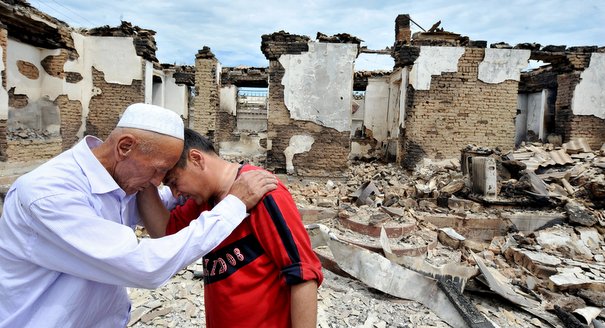
The crisis in Kyrgyzstan presents an opportunity for the three multilateral groups working in the area to do real, immediate good while building trust and demonstrating that cooperation is possible in the increasingly interconnected and fragile Eurasian security space.
Source: The International Herald Tribune

It is an ominous sign that a society which had undertaken impressive reforms aimed at creating the region's first parliamentary democracy is now teetering on the brink of outright civil war and state failure.
With the violence around Osh continuing and a very real possibility that the conflict could expand to engulf parts of neighboring Tajikistan and Uzbekistan, NATO and the United States must immediately engage with regional partners to help restore security.
For two decades, NATO has played the role of policeman in conflicts in Bosnia and Kosovo, while Russia has done so separately in Georgia and Moldova. Not surprisingly, what one side has viewed as peacekeeping, the other has labeled bullying occupation.
The crisis in Kyrgyzstan presents an opportunity for three multilateral groups working in the area — NATO, the Collective Security Treaty Organization (C.S.T.O., an alliance of seven former Soviet states currently chaired by Armenia), and the Organization for Security and Co-operation in Europe (O.S.C.E.) — to do real, immediate good while building trust and demonstrating that cooperation is possible in the increasingly interconnected and fragile Eurasian security space.
Both Russia and NATO maintain military presences in Kyrgyzstan — the only country in the world where this is true — and neither can afford to allow the violence there to destroy the vulnerable Kyrgyz state or plunge the region into a wider ethnic war.
Moreover, responding to this crisis and restoring stability is a responsibility NATO must share with the C.S.T.O. and the O.S.C.E. Where these institutions failed in 2008 to prevent or defuse the Russia-Georgia war, they must now succeed in preventing localized violence in southern Kyrgyzstan from deepening or spreading.
To do so will require the United States and Russia, as leading security partners in these groups, to put aside outdated stereotypes and focus on their fundamentally shared interests in Eurasian security.
Although the Kyrgyz provisional government has called for Russian troops to help maintain order, Moscow has referred the problem to the C.S.T.O., which resolved on Monday to provide “comprehensive assistance.”
In recent years, Russia has sought to expand C.S.T.O. capabilities through a partnership agreement with the Shanghai Cooperation Organization, a security forum which includes Russia, China and four of the Central Asian republics, and creation of a standing rapid reaction force, which remains a work in progress. Some in the West have regarded the C.S.T.O. as a tool of Russian expansionism, and are reluctant to see NATO or the O.S.C.E. engage with it directly.
However, the C.S.T.O. does serve Russia's legitimate interests in collective security and stability in the post-Soviet space, which is focused in Central Asia on securing energy supply lines and stemming the flow of narcotics, weapons and human trafficking across Russia's vast porous border. To work around the C.S.T.O. during the present crisis would suggest wrongly that the U.S. and NATO are more interested in rolling back Russia’s influence than in regional security.
But the C.S.T.O. is not the only multilateral security organization that has a mandate to prevent political and ethnic violence in Central Asia from spiraling into wider war.
The O.S.C.E., with 56 member states from Europe, Asia, and North America, binds NATO, Russia and the C.S.T.O. member states to a mission of conflict prevention, border protection and peace implementation.
While the organization has a mixed record since its origin in the 1970s, it has occasionally played a pivotal conflict-prevention and peace-implementation role, such as in the mid-1990s when it took over for the U.N. administration in Bosnia.
With the O.S.C.E.’s rotating chairmanship currently held by Kyrgyzstan’s large northern neighbor, Kazakhstan, there is a clear opportunity for the organization to step up to the challenge of defusing this regional threat.
Now is the time for the United States and NATO — whose presence in the region is part of an ongoing counterinsurgency mission in Afghanistan — to look beyond old stereotypes and offer any and all assistance to the Kyrgyz government, in full cooperation and partnership with both the C.S.T.O. and the O.S.C.E.
The point of such assistance must be, first and foremost, to help quell the violence around Osh before more innocent people are killed, so that Kyrgyzstan’s fragile provisional government has the chance to regain its footing on the road to rebuilding self-government.
By holding out a hand not only to the Kyrgyz authorities, but to natural regional partners, including the C.S.T.O., and the O.S.C.E., the United States and NATO can demonstrate the sincerity of their interest in regional security.
The killing in Osh must be stopped, innocent civilians and their property must be protected from further attacks, and tensions must be calmed so that Kyrgyzstan’s provisional authorities can get back on track to self-government.
The tragic events of recent days in Kyrgyzstan are not merely a matter of that country’s political future; they pose a defining challenge for mutual security in the Eurasian region as a whole.

Nonresident Senior Fellow, Russia and Eurasia Program; Diplomat in Residence
Ambassador Collins was the U.S. ambassador to the Russian Federation from 1997 to 2001 and is an expert on the former Soviet Union, its successor states, and the Middle East.

Former Deputy Director, Russia and Eurasia Program
Rojansky, formerly executive director of the Partnership for a Secure America, is an expert on U.S. and Russian national security and nuclear-weapon policies.
Carnegie does not take institutional positions on public policy issues; the views represented herein are those of the author(s) and do not necessarily reflect the views of Carnegie, its staff, or its trustees.

Japan’s long-term security policy is driven by concerns about China, and there is little appetite for (or interest in) pursuing a confrontation with Moscow.

James D.J. Brown

The truth of the strategic situation is that Europe and Russia are extremely unlikely to be able to “turn the page” on their confrontation within the next two decades.

Arkady Moshes

Russia’s AI-driven propaganda campaigns operate in a fragmented, chaotic, and often illogical manner. That’s not necessarily a problem for the Kremlin, though: It’s much easier to mimic genuine public debate that way.

Ilya Klishin

Without a ceasefire with Ukraine on attacking each other’s energy infrastructure—to which the Kremlin is unlikely to agree—the diesel agreement between Putin and Trump is largely for show, rather than representing a genuine increase in the volumes of Russian diesel on the global market.

Sergey Vakulenko

Russian strikes are weakening the economy sustaining Ukraine’s war effort. Closing the growing funding gap will require more European support and politically contentious reforms in Kyiv.

Balázs Jarábik