

In The Media
Lahcen Achy
{
  "authors": [
    "Lahcen Achy"
  ],
  "type": "legacyinthemedia",
  "centerAffiliationAll": "",
  "centers": [
    "Carnegie Endowment for International Peace",
    "Malcolm H. Kerr Carnegie Middle East Center"
  ],
  "collections": [],
  "englishNewsletterAll": "",
  "nonEnglishNewsletterAll": "",
  "primaryCenter": "Malcolm H. Kerr Carnegie Middle East Center",
  "programAffiliation": "",
  "programs": [],
  "projects": [],
  "regions": [
    "Gulf"
  ],
  "topics": [
    "Economy"
  ]
}
Source: Getty
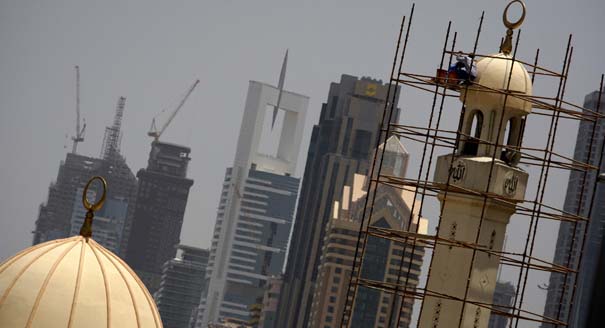
While Gulf countries already have high quality infrastructure, to ensure their global competitiveness they now need to develop a strategic plan to build the knowledge and professional capacities of their human resources.
Source: Al-Qabs

Competitiveness is one of the key factors that stimulates investment and spurs entrepreneurship within the local and foreign private sector, especially amid economic globalization and cut-throat competition for markets. Contrarily to what some may believe, competitiveness is not only gauged by low-cost corporate productivity regardless of the economic, financial, security, institutional and legal milieu. Competitiveness does not thrive either on the efforts of the private sector regardless of the latter’s degree of sophistication and level of maturity. Competitiveness necessitates a good infrastructure, competent public institutions, an adequate legislative environment and an honest judiciary for dispute settlement and rights protection. It also requires an advanced educational and training system that keeps pace with the educational and technological progress and injects the needed competences and skills into the labour markets. Obviously, these factors necessitate effective state intervention and strategic planning.
Global Index
Adopted by the World Economic Forum, the Global Competitiveness Index (GCI) is the most important benchmark that measures the global competitiveness of countries. It rests on 12 pillars, namely institutions, infrastructure, macroeconomic environment, health and primary education, higher education and training, goods market efficiency, labour market efficiency, financial market sophistication, technological readiness, market size, business sophistication and innovation.
According to this year’s GCI report released in the aftermath of the global economic crisis, 7 Arab countries out of 139 covered by the report prevailed in the top 40. With the exception of Tunisia that ranked 32nd, the GCC countries outperformed their counterparts in the Arab world, rounding out the six other positions. With a per capita income of around USD70,000, Qatar topped the rankings within the GCC country group at 17th, followed by Saudi Arabia in the 21st place and the United Arab Emirates in the 25th. Oman ranked 34th, having a narrow lead over Kuwait by one rank and Bahrain by 3. Interestingly, the Gulf countries improved their competitive positions compared to last year. Except for the United Arab Emirates which fell by two places, the remaining countries posted improvements with Saudi Arabia and Oman advancing by seven positions and Bahrain by one. Kuwait and Qatar improved by four and two respectively.
The ranking that each country occupies is the outcome of a thorough assessment of the World Economic Forum’s 12 pillars of competitiveness. For this reason, it is useful to examine, even if briefly, the pillars that have largely contributed to or hindered the competitive progress of Gulf countries. Identifying the weaknesses and strengths of competitiveness in the GCC countries is crucial to drawing the decision makers’ attention to the pillars where they need to make improvements, then elaborate policies and allocate resources to enhance their countries’ competitiveness.
Economic Environment
Featuring government accounts, current external accounts, public debt and inflation, the macroeconomic environment is the cornerstone of competitiveness in the Gulf countries. Four Gulf countries, i.e. Kuwait, Oman, Qatar and Bahrain respectively, prevailed in the top ten worldwide.
The second most important pillar is the infrastructure quality. Except for Kuwait, which fell to the 60th place overall, the other Gulf countries prevailed in the top 30, led by the UAE (3rd overall).
In parallel, the Gulf countries clearly lagged behind in other competitive pillars despite their economic and financial resources. Only Qatar occupied an advanced position (15th overall) in the health and primary education pillar. Bahrain came in the 36th place and Oman in the 99th followed by Kuwait in the 68th and Saudi Arabia in the 74th. Weakness is also noted in the higher education and training pillar, with the rankings of the Gulf countries ranging from 32nd to 83rd, the former occupied by Qatar and the latter by Kuwait. In addition, the Gulf countries posted a relative weakness in the technological readiness pillar. Except for the UAE that ranked 14th overall and Bahrain 27th, the other countries occupied median positions ranging from 42nd for Saudi Arabia and 77th for Kuwait.
Strengths and Weaknesses
The competitiveness of Gulf countries is somehow vulnerable and disconcerting. The macroeconomic environment basically depends on the oil and gas resources that maintain internal and external balances and rein in high levels of public debt. But the macroeconomic framework is prone to a sudden collapse if oil prices slump as happened at the outbreak of the global economic crisis. Crucial as it is for a competitive economy, good infrastructure remains insufficient in the absence of highly-skilled workers or if it fails to absorb advanced technologies or sophisticated production processes. A proof of this is the mounting unemployment rates among the highly-educated youth in most Gulf countries.

Former Nonresident Senior Associate, Middle East Center
Achy is an economist with expertise in development, institutional economics, trade, and labor and a focus on the Middle East and North Africa.
Recent Work
Lahcen Achy
Lahcen Achy

For every ruble allocated to social policy, health, and education in 2027, double that amount is earmarked for the army, the police, and the security services.

Alexandra Prokopenko

Depleted financial reserves and a shrinking tax base mean it is no longer possible to simultaneously deliver high defense spending, price stability, and economic growth.
Alexandra Prokopenko

A much-discussed disagreement over internet restrictions in Russia was never an existential threat for Putin: It was about elite groups protecting their interests.
Alexandra Prokopenko

The demands of the Kremlin’s war in Ukraine, demographic problems, and public hostility toward Central Asians mean Russia does not have enough workers.

Salavat Abylkalikov

Minsk’s faith in the future of its larger neighbor’s economy is fading as Belarusian firms in Russia see record losses.

Olga Loiko