

Q&A
Christopher Boucek
{
  "authors": [
    "Christopher Boucek"
  ],
  "type": "legacyinthemedia",
  "centerAffiliationAll": "dc",
  "centers": [
    "Carnegie Endowment for International Peace",
    "Malcolm H. Kerr Carnegie Middle East Center"
  ],
  "collections": [],
  "englishNewsletterAll": "menaTransitions",
  "nonEnglishNewsletterAll": "",
  "primaryCenter": "Carnegie Endowment for International Peace",
  "programAffiliation": "MEP",
  "programs": [
    "Middle East"
  ],
  "projects": [],
  "regions": [
    "Middle East",
    "Yemen",
    "Gulf"
  ],
  "topics": [
    "Security",
    "Military"
  ]
}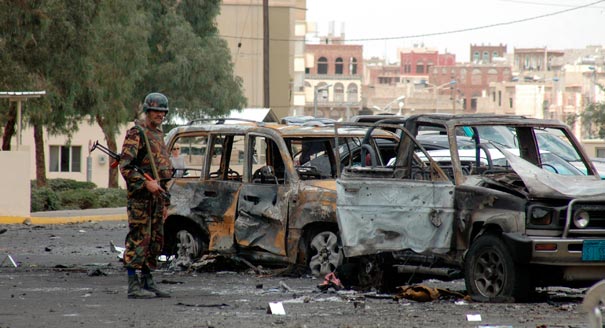
Source: Getty
If U.S. counterterrorism assistance to Yemen only takes the form of military and security cooperation, the result is likely to be an increase in the popular grievances that fuel militant groups like al-Qaeda in the Arabian Peninsula.
Source: CTC Sentinel

AQAP has evolved into an increasingly lethal and agile organization, with a proven track record of mounting operations within Yemen, regionally, and internationally. AQAP has been clear in stating its planned objectives, and it has repeatedly delivered on its threats. These concerns have been heightened by the presence of Yemeni-American cleric Anwar al-`Awlaqi in Yemen and his alleged role in inciting English-speaking foreigners to engage in violence and militancy. There are also increasing worries about the involvement of Western, and especially American, nationals in alleged domestic terrorist plots related to or connected with Yemen, AQAP, and Anwar al-`Awlaqi. Moreover, Yemen itself is being transformed from a rest and training arena into an actual theater of jihad.
This article originally appeared in the CTC Sentinel
Former Associate, Middle East Program
Boucek was an associate in the Carnegie Middle East Program where his research focused on security challenges in the Arabian Peninsula and Northern Africa.
Recent Work
Christopher Boucek

Christopher Boucek, Karim Sadjadpour
Carnegie does not take institutional positions on public policy issues; the views represented herein are those of the author(s) and do not necessarily reflect the views of Carnegie, its staff, or its trustees.

Two divergent trends—Putin’s hardline vision of how to prosecute the war in Ukraine, and a growing desire for change in Russia—could tear the regime apart.

Tatiana Stanovaya

Andrey Melnichenko’s essay offers no answer to the fundamental question of how, under any kind of negotiated settlement, Europe can protect itself from the Russian ressentiment that is inevitable in all scenarios except for an outright victory for Putin.

Leonid Bershidsky
The recent damage inflicted by Ukrainian drones and missiles on Russia has made Belarus aware of its own vulnerabilities—and surprisingly amenable to Kyiv’s demands.

Artyom Shraibman
It is not a phenomenon unique to Russia that the public of a country at war (even the aggressor) enduring airstrikes will not overturn its government but rather show solidarity with it and blame its woes on the enemy.
Vladislav Gorin
Ongoing uncertainty in the Middle East allows Moscow to both increase its influence in Tehran and continue to enjoy the financial windfall of higher oil prices.

Nikita Smagin