

Commentary
Vladislav Gorin
{
  "authors": [
    "Vladislav Gorin"
  ],
  "type": "commentary",
  "blog": "Carnegie Politika",
  "centerAffiliationAll": "",
  "centers": [
    "Carnegie Endowment for International Peace",
    "Carnegie Russia Eurasia Center"
  ],
  "englishNewsletterAll": "",
  "nonEnglishNewsletterAll": "",
  "primaryCenter": "Carnegie Russia Eurasia Center",
  "programAffiliation": "",
  "regions": [
    "Russia"
  ],
  "topics": [
    "Domestic Politics",
    "Security",
    "Civil Society"
  ]
}
Source: Getty
It is not a phenomenon unique to Russia that the public of a country at war (even the aggressor) enduring airstrikes will not overturn its government but rather show solidarity with it and blame its woes on the enemy.
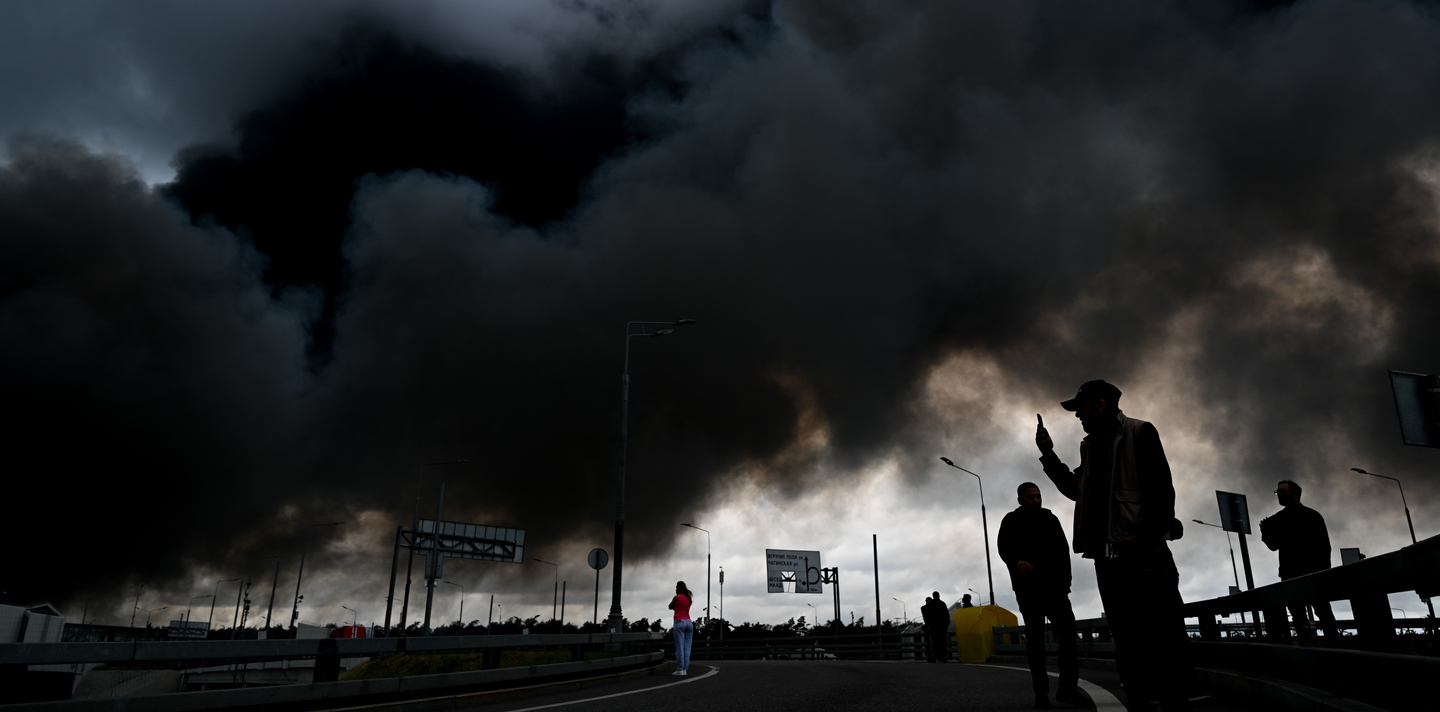
In recent weeks, Ukraine has dramatically ramped up its attacks against Russia. As a result, Russia’s oil refining output has fallen by more than 25 percent; the St. Petersburg International Economic Forum opened under a cloud of smoke; and on June 18, drones penetrated Moscow’s air defenses. Comments made by the Ukrainian leadership that same day made it clear that Kyiv believes that moving the war to deep inside Russia will destabilize the Putin regime.
On the day of the attack on Moscow, Ukrainian President Volodymyr Zelensky said that the images of the Moscow Refinery burning would force Russians to “sober up” and realize that “if Ukraine is going to burn, your Moscow will burn too.” He called on Russians to start putting pressure on President Vladimir Putin to reach a ceasefire agreement with Kyiv.
Previously, Kyiv’s aims in attacking Russian targets were economic (to reduce Russia’s ability to finance the war), external (to demonstrate Ukraine’s capabilities to Western donors), and domestic (to raise morale among the Ukrainian armed forces and public). Now it is trying to impact Russian domestic politics.
On June 14, Zelensky cited Russian sociological data obtained by Ukrainian intelligence services as saying that the ratings of Putin and the ruling United Russia party were falling and would continue to do so ahead of September elections for the State Duma. Falling ratings are a sore point for Putinism, the Ukrainian president argued.
Indeed, there is considerable evidence that the Russian leader pays close attention to his approval ratings. In a September 2000 conversation with U.S. President Bill Clinton, for example, in which the latter expressed his condolences to the newly elected Putin over the deaths of all the crew members in the recent Kursk submarine disaster, Putin’s response turned immediately to the effect it had had (or not had) on his ratings.
In the Putin system, regular assessments of attitudes toward the president (and the government in general) play the role of a substitute for elections and communication with the public. They are also a way of demonstrating to the public the ruling authorities’ absolute dominance and the pointlessness of any alternatives. Finally, Putin’s ratings are supposed to convince the ruling class—including the state apparatus—of the autocrat’s personal exceptionalism.
The ratings are hardly infallible, however. The Kremlin is not above manipulating them when it sees fit. In 2019, Putin’s trust rating soared overnight from 30 percent to 72 percent when sociologists changed the wording of a poll question following the intervention of the presidential administration.
Similarly, when one of the country’s main pollsters, VTsIOM, started paying home visits as well as calling people to survey them in May 2026, the decline in Putin’s trust and approval ratings suddenly stopped. The most likely outcome of falling ratings, therefore, is that officials will change polling methods to produce the required results.
The theory that ramping up the Ukrainian attacks will erode public support for Putin in Russia is also doubtful. After all, the war came home to many Russians in areas bordering Ukraine just a few months after their country’s full-scale invasion of it. Then, in August 2024, Ukrainian troops entered and briefly occupied part of Russia’s Kursk region. And since 2024, Ukraine has been systematically attacking sites belonging to Russia’s energy industry across the entire country, including oil refineries located thousands of kilometers from the front line, such as in Perm and Tyumen.
None of that, however, led to increased anti-Kremlin sentiment in the affected regions. Researchers from the independent sociological project Khroniki who studied precisely that issue three years ago found that many residents of the Belgorod, Bryansk, and Kursk regions close to Ukraine had not only failed to become more critical of the Russian authorities following Ukrainian attacks on their regions, but actually started to show increased loyalty.
A study carried out by the Public Sociology Lab in 2025 found that “in the perception of people living in the Kursk region, the incursion and occupation by Ukrainian armed forces were not a predictable consequence of the Russia-Ukraine war, but a separate and unexpected event. Kursk residents bore their encounter with the reality of war as they would have done a natural disaster.”
The fact that the public of a country at war (even if it is the aggressor) enduring air strikes will not overturn its government but rather show solidarity with it and blame its woes on the enemy is not a phenomenon unique to Russia. The recent bombings against Iran by the United States and Israel had a similar effect on Iranian society, and before that, the same pattern was seen in Ukraine itself. Not one of the sub-zero winters during which the Russian armed forces has deliberately destroyed the country’s energy infrastructure has managed to freeze the Ukrainian public into demanding that its leadership make concessions to the aggressor. Nor did they dent Zelensky’s approval rating.
This effect has long been documented by political scientists. In his 1996 book Bombing to Win: Air Power and Coercion in War, Robert Pape concluded that the wartime bombardment of a country’s cities did not lead to an uprising behind the front lines. On the contrary, it generally had the effect of consolidating civilians around their leader and resulted in increased hatred of the enemy.
In 2022, Pape published an article in Foreign Affairs magazine in which he argued that airstrikes against Ukrainian infrastructure would not only fail to inspire Ukrainians to demand concessions from their own government, but would have the opposite effect. Subsequent events have shown that Pape was right.
That’s not to say that the war in general and the attacks on Russia’s energy industry, which have already prompted shortages of gasoline, are not contributing to the worsening mood among the Russian public. Both state-controlled and independent pollsters working in Russia have recorded a rise in anger with the authorities, worries about the future, and a mounting desire to see an end to the conflict.
Growing lines at gas stations and restrictions on the purchase of gasoline will very likely have no less effect on Russians than the internet blackouts. But it’s important to remember that when war becomes visible, most people are not inclined to blame their own state—even if their country was the one that started the war.
Furthermore, at a time of war, demonstrating loyalty is a very rational decision. Expressing unhappiness with the state of affairs is punishable, while showing loyalty might result in help from the state—in the form of compensation for destroyed or damaged property, for example.
No less important is the fact that Russians, like many people with Soviet and post-Soviet experience, have gotten used to overcoming difficulties not through collective action, but through individual survival strategy. Now the atomization and apathy of society is playing into the hands of the Russian regime.
There is no doubt that Russia’s political and repressive apparatus is equipped to crush any localized discontent. Accordingly, no matter how much damage Ukrainian strikes manage to inflict this summer, it would be pointless to expect that, in combination with the Duma elections, they will lead to protests on the scale of those seen in Moscow and other major Russian cities in 2011–2012.
Journalist, host of "What Happened?" podcast from Russian independent media Meduza
Recent Work
Vladislav Gorin
Vladislav Gorin
Carnegie does not take institutional positions on public policy issues; the views represented herein are those of the author(s) and do not necessarily reflect the views of Carnegie, its staff, or its trustees.

Russian strikes are weakening the economy sustaining Ukraine’s war effort. Closing the growing funding gap will require more European support and politically contentious reforms in Kyiv.

Balázs Jarábik

Ex-president Gurbanguly Berdimuhamedov remains interested in politics, but his son Serdar, Turkmenistan’s current president, is becoming increasingly independent and willing to break with his father’s legacy. If their covert rivalry goes too far, both risk losing power.

Galiya Ibragimova

Despite a new textbook, an influx of Russian teachers and managers, and an end to the teaching of Ukrainian, the Kremlin is unlikely to have “reprogrammed” locals.

Konstantin Skorkin

For every ruble allocated to social policy, health, and education in 2027, double that amount is earmarked for the army, the police, and the security services.

Alexandra Prokopenko

Cargo traffic through Russia’s Northern Sea Route has increased because of the disruption caused by the conflict in the Middle East, the Ukraine war, and U.S.-China tensions.

Mikhail Korostikov