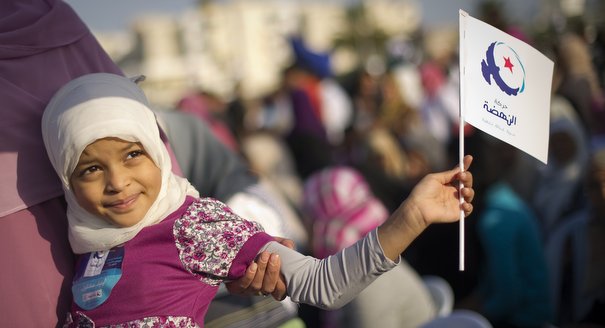
The current unrest in the Arab world caught most people by surprise—both inside and outside the region—and has fundamentally upended several conventional beliefs about the Arab world.
Arab Myths and RealitiesWith Hosni Mubarak’s ouster in Egypt – widely considered to have one of the region’s most stable regimes until only recently – and Colonel Muammar Qaddafi clinging to power in Libya, there is no clear end in sight to the turmoil sweeping across the Arab world. Protests have already toppled governments in Tunisia and Egypt, leaving other Arab countries faced with widespread discontent.
The unrest caught most people by surprise – both inside and outside the region – and has fundamentally upended at least five conventional beliefs about the Arab world.
Arabs don’t go into the street. Before the protests began in Egypt and Tunisia, many people argued that there was no real urgency to political reform, and that those who were calling for change did not understand the public mood – things weren’t as bad as the dissidents made them out to be. This line of thinking led governments to believe that Arabs would not demonstrate in large numbers and demand change. In each country, rapid reform was seen as detrimental to national interests.
This argument clearly is no longer tenable. No one predicted what happened in Egypt and Tunisia, which means that no Arab country is immune. Governments don’t have the luxury of waiting forever, and they can no longer use the myth of popular quiescence to avoid initiating the necessary reforms that will address the public’s underlying grievances.
Economic liberalization should precede political reform. Arab governments – and many Westerners – claimed that privatization and other economic reforms should be given priority over political change. But, while it is easy to argue that citizens want bread before freedom, economic liberalization came without a system of checks and balances, and thus largely resulted in neither bread nor freedom.
Instead, the benefits of privatization and other initiatives went largely to political and business elites. As a result, Arabs have come to view liberalization and globalization negatively. It is clear by now that economic reform must be coupled with political reform, so that institutional mechanisms of accountability are developed to monitor any excesses and ensure that benefits are made available to all. Governments have been quick to believe that the protests are fundamentally about high prices and unemployment, but the issue that unites Arab discontent is inadequate governance.
Closed systems are necessary to prevent Islamists from taking power. The West is often afraid that democracy will give Islamists the opening they need to gain control – a fear that Arab regimes exploit to justify maintaining closed political systems. But Islamists did not play a big role in Egypt or Tunisia, and they are not expected to lead any of the new governments that are formed – though they are an important part of Arab societies and should play a role in their emerging regimes.
So it is untrue that the only viable alternative to unrelenting absolutist rule must be Islamist. The protests are clearly the result of ordinary citizens becoming fed up with corruption, the lack of any semblance of rule of law, and arbitrary treatment. There is an opportunity here to start developing pluralistic systems where not only Islamists, but also other parties and discourses can play a role.
Elections equal democracy. No one is fooled by this claim anymore. In order to maintain their dominance, Arab governments have relied on flawed laws and elections that don’t produce strong parliaments or lead to real change. Indeed, in countries like Egypt and Tunisia, government and parliament alike were unpopular. Throughout the region, elections have been used to create a façade of democracy aimed at impressing citizens and the outside world while insulating the regimes from pressure for genuine reform.
The Arab public, however, will no longer accept the status quo. People will not be satisfied with economic handouts or cosmetic changes in governance; they are demanding real change that puts their country on a clear path toward democracy.
The international community has no role to play. While the reform process should certainly be homegrown, the United States and the rest of the international community can encourage democratic development without imposing it from afar. President Barack Obama rejected many of the policies of the George W. Bush administration that were seen as trying to force democracy on Arab countries. But the subsequent silence on democratization aggravated – though it certainly did not cause – the unraveling of the Arab reform process in the last few years.
The US and the West can discuss with Arab countries how political reform should be carried out in a way that would contribute to greater openness and opportunities for power-sharing. The West should not sacrifice these objectives for others; if allies ultimately lose power in popular revolts, such a tradeoff would not have furthered the West’s interests, to say the least.
The unfolding events grabbing headlines around the world have shattered key myths about the Arab world. These countries’ people need to start gradual, sustained, and serious political reform now. At the dawn of a new Arab era, it is up to them to build new, open political systems that can head off the looming threat of escalating crises.
Marwan Muasher is vice president for studies at Carnegie, where he oversees research in Washington and Beirut on the Middle East. Muasher served as foreign minister (2002–2004) and deputy prime minister (2004–2005) of Jordan, and his career has spanned the areas of diplomacy, development, civil society, and communications.
Carnegie does not take institutional positions on public policy issues; the views represented herein are those of the author(s) and do not necessarily reflect the views of Carnegie, its staff, or its trustees.
Sergei Kiriyenko used Russia’s parliamentary vote to further hone his strategy of corporate mobilization that is designed to maximize votes for United Russia.
The European far right might fail to steer EU policy in the direction Russia wants, but they will create enough chaos inside Europe to benefit the Kremlin.
If the Russian-speaking community in Latvia cannot articulate their interests without being seen as disloyal, they could end up embracing a pro-Kremlin agenda.
Russia’s ruling party would have benefited from Putin appearing as its distant patron, but as an active frontman imposing his views on the public, he has done nothing but harm both the party’s election campaign and the ruling system overall.