

Q&A
- +1
Amr Hamzawy, Andrew Leber, Eric Lob, …
{
  "authors": [
    "Marwan Muasher"
  ],
  "type": "commentary",
  "blog": "Emissary",
  "centerAffiliationAll": "dc",
  "centers": [
    "Carnegie Endowment for International Peace"
  ],
  "collections": [
    "The Iran War’s Global Reach"
  ],
  "englishNewsletterAll": "menaTransitions",
  "nonEnglishNewsletterAll": "",
  "programAffiliation": "MEP",
  "programs": [
    "Middle East"
  ],
  "regions": [
    "Gulf",
    "United States"
  ],
  "topics": [
    "Foreign Policy",
    "Security"
  ]
}
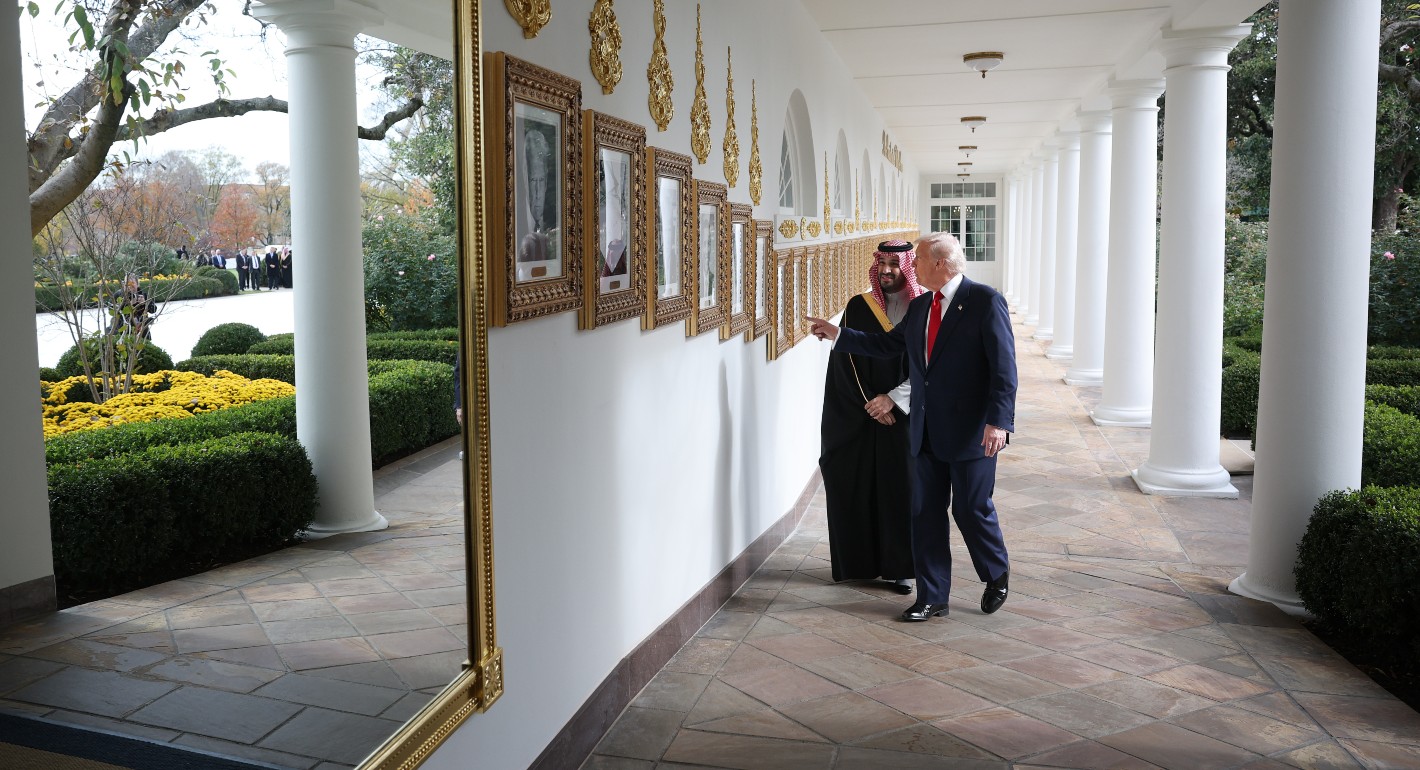
U.S. President Donald Trump (R) speaks to Crown Prince and Prime Minister Mohammed bin Salman of Saudi Arabia. (Photo by Win McNamee/Getty Images)
Neither the Abraham Accords nor the presence of large U.S. bases are enough to protect Arab Gulf states.
Rarely has there been a monolithic Arab Gulf position on any issue, but the war on Iran has managed to do just that: forge a collective Gulf anger directed toward Iran and the Unites States—and, at least at the popular level, against Israel as well. In the past month, the war between the three countries has spilled into the Gulf, killing civilians, damaging critical infrastructure, and rupturing key economic lifelines. Many of these countries have apparently been targeted as a result of their ties with the United States, particularly in their allowing U.S. bases to operate on their soil.
However, the current agreement among the Arab Gulf states may not last. These countries’ approaches and choices moving forward will likely move them in different directions, making it even less likely that negotiations to end the war will meet regional security needs. The divergence is best seen in the likely paths of Saudi Arabia and the UAE, particularly over the issue of ties with Israel.
A few years ago, Saudi Arabia—much like other Gulf states—viewed Iran as a major threat to the Gulf region, because of both its military action and its support for proxies in Iraq, Yemen, and Lebanon. Saudi leaders wanted U.S. protection against this threat in the form of advanced U.S. weaponry, a peaceful nuclear program, and a defense treaty that would commit Washington to protecting Saudi Arabia from external threats—mainly an Iranian one. But the American leadership demurred.
The Joe Biden administration wanted Saudi officials to sign a peace treaty with Israel as a condition for accommodating these requests. When Tehran hit Saudi oil installations in 2019 without Washington coming to its rescue, Riyadh decided it was time to indirectly poke Washington by seeking closer ties with China. That got Washington to change its position and eventually commit to working with Saudi leaders on a peaceful nuclear program and selling them advanced U.S. weaponry.
Riyadh also decided that if Washington was not going to come to its rescue, its best option was to try to reach some form of accommodation with Tehran. The past few years witnessed a serious thaw in the relationship between Saudi Arabia and Iran. Whatever goodwill had been built up is now out of the window.
The public mood now is such that any rapprochement attempts after the war between Iran and its Gulf neighbors will be extremely difficult. Iran now is seen not only as a potential threat but also as an actual one that needs to be dealt with through further buttressing the military defense capabilities of the Gulf and through the political and economic isolation of Tehran.
Saudi leaders can choose to once again threaten the diversification of their military and economic relations—particularly expanding ties with China. But they cannot keep trying to use that tool without losing credibility, unless they actually exercise it. It is also not easy to replace U.S. military equipment with Chinese or Russian options. So despite Riyadh’s anger with Washington, it most likely will still seek stronger military ties with the United States, probably including more guarantees that the United States will play a more active role in protecting Saudi Arabia in return for allowing U.S. bases there.
Despite U.S. diplomatic pressure, the Saudi position on the relationship with Israel before the Iran war was that it cannot proceed with normalization with Israel until the latter agrees to a credible path toward establishing a Palestinian state—a position now further complicated by Israel’s involvement in the war.
If Israel opens another front by occupying southern Lebanon, Riyadh is likely to take a very cautious position. It won’t want to appear too close to the Israeli or the American missions in a postwar situation—at least publicly. Public opinion in Saudi Arabia against Israel has been very hostile, according to several polls conducted in the past few years. The Saudi leaders are well aware of this. A position close to Washington and against Iran is supported by the majority of Saudis, but being close to Washington while it is supporting Israel’s expansionist policy is a different ball game. Riyadh is also angry at Israel for another reason: It needs regional stability as a way to achieve peace and attract investments to its Vision 2030 economic development plan. Israel is not helping achieve that regional peace with its current expansionist policies.
The United Arab Emirates has a different position, and this is where the unity may crumble. As a 2020 signatory to the Abraham Accords, the UAE has adopted a policy of decoupling the Palestinian issue from closer economic and security ties with Israel. That strategic official policy has not changed because of the October 7, 2023, Hamas attacks, and is not likely to do so because of the Iran war. On the other hand, the Emirates also adopted a policy of appeasement with Iran before the war, hoping to thaw relations and avoid any military tensions. But the Iranian missiles and drones targeting the UAE—the largest in number after those targeting Israel—has resulted in a very tough UAE stand, calling publicly on the Trump administration to finish the job.
The Iran war has made weakness and exposure of the Gulf states very apparent. They have not been protected by the Abraham Accords, economic deals, or the presence of large U.S. bases. When the war ends, these states will find themselves at a crossroads, and which path each takes is an open question. Already, a loose coalition appears to be forming to create a clear Gulf position on policies regarding the Arab-Israeli conflict. Saudi Arabia and Qatar, who had a recent rift between them, are now coordinating with Egypt, Jordan, and several non-Arab countries such as Turkey, Pakistan, and Indonesia.
So far, this coalition appears to be an attempt by countries with like-minded views on the Arab-Israeli conflict, namely support for a two-state solution, to coordinate their positions. But it is not clear what policies they might adopt to effectively counter what appears to be a very aggressive Israeli expansionist policy. It also does not include countries such as the UAE, which holds different views on how to deal with Israel. Whether the common Iranian threat is enough to help bridge the gap between Saudi Arabia and the UAE on other issues is doubtful. What is becoming clear, however, is that the lack of a serious Arab or Gulf common response to the region’s security, one that replaces the old, failed policy of simply relying on the United States, does not bode well for the future. Whether the Gulf countries can forge their anger into something better—or whether they’ll once again fragment—is well worth watching.

Vice President for Studies
Marwan Muasher is vice president for studies at Carnegie, where he oversees research in Washington and Beirut on the Middle East. Muasher served as foreign minister (2002–2004) and deputy prime minister (2004–2005) of Jordan, and his career has spanned the areas of diplomacy, development, civil society, and communications.
Recent Work



Amr Hamzawy, Andrew Leber, Eric Lob, …
Marwan Muasher
Carnegie does not take institutional positions on public policy issues; the views represented herein are those of the author(s) and do not necessarily reflect the views of Carnegie, its staff, or its trustees.
The conflict is exposing the flaws and fissures of their domestic governance and social cohesion.

Frederic Wehrey, Charles H. Johnson
Tehran’s attacks are reshaping the security situation in the Middle East—and forcing the region’s clock to tick backward once again.
Amr Hamzawy

Despite its flop at the box office, the film raises important questions for the climate community to answer.
Leonardo Martinez-Diaz
The acknowledgment has sparked fears of a new arms race with China and Russia.

Chris O’Meara
The summit may be remembered as a fatal blunder, when Washington, Beijing, and the AI industry collectively chose ceremony over action.

Jeffrey Prescott