

Commentary
Nathan J. Brown
{
  "authors": [
    "Nathan J. Brown"
  ],
  "type": "legacyinthemedia",
  "centerAffiliationAll": "dc",
  "centers": [
    "Carnegie Endowment for International Peace",
    "Malcolm H. Kerr Carnegie Middle East Center"
  ],
  "collections": [
    "Arab Awakening"
  ],
  "englishNewsletterAll": "menaTransitions",
  "nonEnglishNewsletterAll": "",
  "primaryCenter": "Carnegie Endowment for International Peace",
  "programAffiliation": "MEP",
  "programs": [
    "Middle East"
  ],
  "projects": [],
  "regions": [
    "North Africa",
    "Egypt"
  ],
  "topics": [
    "Political Reform"
  ]
}
Source: Getty
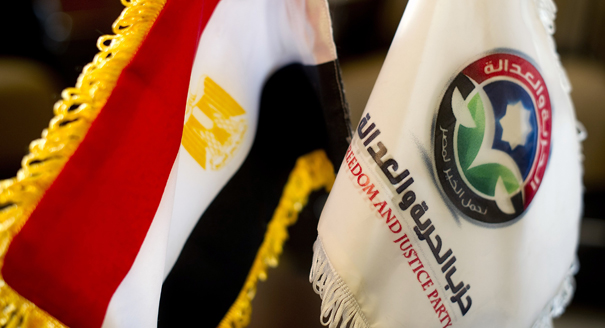
With scant governing experience, Egypt’s Muslim Brotherhood must face the challenges and pressures of power in a complicated political transition.
Source: Jewish Daily Forward

This is a heady moment for the Brotherhood, and it is one for which nothing in the group’s history prepares it. On one occasion in the early 1950s, the Brotherhood was offered a Cabinet ministry. That was as close as it came to political power. But the Brotherhood prides itself on thinking of generations, not electoral cycles. Can the Brothers sustain their sudden success?
In the country at large, the problems of Egypt’s transition are almost too numerous to mention: the crumbling economy, the cascade of conflicting statements from military rulers, an idiosyncratic electoral process and strangely drafted constitutional framework all continue to cause confusion. Most eyes are currently — and will remain for the next few months — on the big political questions: How will Egypt’s parliamentary blocs work together (if at all)? Will the military really surrender power, and if so, on what terms? How will the country’s constitution be written — and who will write it?All these questions do occupy the attention of Brotherhood leaders. But in conversations with them over the past few months, I am convinced that three longer-term issues loom just as large for them as the day-to-day maneuverings that make all the headlines.
First, they know that other Islamist movements have come close to power in the region before, only to be pushed aside rudely by their domestic or international opponents. Therefore, they need to mollify liberals, avoid frightening the military and present a businesslike face to Europe and the United States — all without forgetting what they like to call their “fixed positions.” Or at least they must be seen as doing so in front of their followers. That requires not just simply carefully tailoring statements, but also learning how to speak those statements in one voice, something that has been difficult in the rush of recent events.
Nowhere is this problem more acute for the Brotherhood than in the area of Israeli-Egyptian relations. Support for the Palestinian cause is hardwired into the Brotherhood’s origins; its emotional ties with Hamas are real. But the Brotherhood-sponsored Freedom and Justice Party is preparing to take up positions in political authority in a state that has treaty obligations and seeks the support of a society that, while hardly sympathetic to Israel in any way, has no appetite for war.
In my past conversations with Brotherhood leaders, I have not probed the stance toward Israel; it is not a topic of my research, and it often sets conversations off on an edgy track. But recently I have asked, largely to understand how the Brotherhood balances the very different pulls on its loyalties. And the answers that I have received are in one sense quite consistent: The Brotherhood and the FJP recognize Egypt’s international obligations and treaties; treaties that do not serve the interest of one side or that have been violated can be re-examined; Israel is in violation of the treaty. I pressed: What if Israel does not agree to renegotiate? What is the proposed response to the alleged violations? A renegotiation requires mutual agreement, I was told. A commitment has to use only diplomatic means (some of which are provided for in the treaty, like arbitration) and those that are fully in accord with international law. What varied considerably was body language (I got the idea that these words were far more difficult for some people to say than others), emphasis (whether the words were said dispassionately and quickly, or whether there was a bit more emphasis on “Zionist crimes”) and detail. The Brotherhood has ironed out a position, but it has not been easy.
Second, the recent parliamentary election revealed how strong the Brotherhood’s Salafi rivals are. Most of the discussion in Egypt has centered on how the Brotherhood and Salafi blocs in parliament will interact. In the long run, however, the Brotherhood leadership is more focused on other spheres. The competition among Islamists for followers in each neighborhood, town and village may be far more consequential than any legislative battle. To many outsiders, Islamists look alike, but in the past year, Brotherhood and Salafi activists have become acutely aware of their differences. Salafis see themselves as sticking closely to religious texts and focusing on individual righteous conduct; they view the Brotherhood as more about politics than about religion. The Brotherhood sees Salafis as too concerned with a superficial and often quite rigid display of religiosity rather than with the spirit of Islam. The Brotherhood also sees itself as far more engaged with the broader society and therefore appropriately flexible in interpreting religious strictures.
Finally, the Brotherhood leaders need to learn to balance politics with their traditional concerns (charity work, self-improvement, proselytizing, education), especially at a time when politics seems so glamorous and has attracted the best people in the organization. Indeed, many of the movement’s most dynamic and imaginative members have shifted their attention over to the political party — explaining its success but also leaving some of the movement’s plans (to form labor unions, create sports leagues, reach out to students and so on) a bit adrift.
Egypt’s Muslim Brotherhood is famous for its discipline, and it is throwing itself into its new tasks with enthusiasm. If the Brothers must engage the United States, for instance, they must know something about the environment whence their interlocutors come. So at the end of my interviews, I sometimes find myself peppered with questions that show surprising sophistication (such as which think tanks are influential in Republican congressional circles).
Brotherhood leaders know that if they respond to these challenges successfully, their movement may be able to become the dominant social and political force in Egypt for years to come — and all by using the greater freedom and democracy that Egypt’s rocky revolution still promises to provide.
This article originally appeared in The Jewish Daily Forward.

Nonresident Senior Fellow, Middle East Program
Nathan J. Brown, a professor of political science and international affairs at George Washington University, is a distinguished scholar and author of nine books on Arab politics and governance, as well as editor of five books.
Recent Work
Nathan J. Brown
Nathan J. Brown
Carnegie does not take institutional positions on public policy issues; the views represented herein are those of the author(s) and do not necessarily reflect the views of Carnegie, its staff, or its trustees.

Anger over online restrictions has led to a surge in support for the New People party, which has replaced the Communists as Russia’s second most popular political party.

Andrey Pertsev

The Russian regime is now visibly motivated by fear.

Alexander Baunov

The return of parliamentary politics reflects a broader shift from earlier expectations of a settlement and elections toward the reality of a prolonged war.
Balázs Jarábik

The Russian state has opted for complete ideological control of the internet and is prepared to bear the associated costs.

Maria Kolomychenko

After four years of war, there is no one who can stand up to the security establishment, and President Vladimir Putin is increasingly passive.

Tatiana Stanovaya