

In The Media
Lahcen Achy
{
  "authors": [
    "Lahcen Achy"
  ],
  "type": "legacyinthemedia",
  "centerAffiliationAll": "",
  "centers": [
    "Carnegie Endowment for International Peace",
    "Malcolm H. Kerr Carnegie Middle East Center"
  ],
  "collections": [],
  "englishNewsletterAll": "",
  "nonEnglishNewsletterAll": "",
  "primaryCenter": "Malcolm H. Kerr Carnegie Middle East Center",
  "programAffiliation": "",
  "programs": [],
  "projects": [],
  "regions": [
    "Maghreb"
  ],
  "topics": [
    "Economy"
  ]
}
Source: Getty
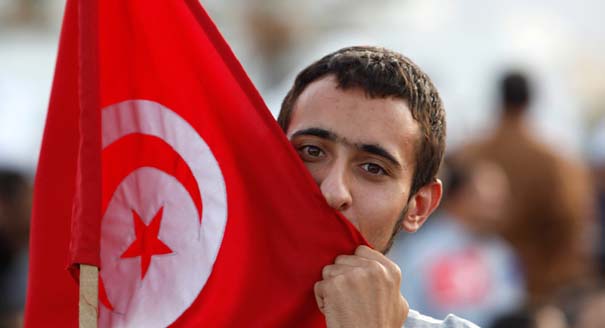
Although some have blamed the lackluster performance of the Tunisian economy on the inexperience of the current Islamist government, the problems Ennahda’s government confronts are complex and there is no easy way out.
Source: Al-Hayat

At the domestic level, the revolution raised many ordinary Tunisians’ economic and political expectations to unprecedented heights. This is evident in a noticeable increase in social protests and labor strikes.
On a regional scale, a state of lawlessness and instability in Libya negatively impacted the Tunisian economy, which for decades has been relying on its wealthier and less populous neighbor for jobs and as a lucrative market for its exports. The economic slowdown in the eurozone, Tunisia’s main trading partner, exacerbated the Tunisian economic crisis as well. To make matters worse, the International Monetary Fund now expects eurozone economies to contract this year.To address those economic hardships, the Tunisian government recently submitted a draft supplementary 2012 budget to the Constituent Assembly. It also submitted its program for 2012, which includes economic and social policy measures aimed at addressing the people’s most basic needs and shoring up the economic goals of the revolution, especially in terms of job creation and the development of inland areas that have suffered decades of marginalization and deprivation.
As part of its program, the Tunisian government spelled out a two-phase economic reform plan to revitalize the economy and boost economic growth, and job creation along with that. The government bets 2012 will be a year of economic recovery that will pave the way for a second phase of growth in 2013, when the economy is expected to take off. In 2012, the government opted for an expansionary budget, regional development, and more jobs in the public sector to help the economy recover.
The government set a target of 3.5 percent economic growth in 2012. That figure is modest considering both the 1.8 percent contraction the Tunisian economy recorded in 2011 and the increase in the budget for 2012, which included a 22 percent rise in public spending from 2011.
The supplementary budget for 2012 allows authorities to tap four exceptional sources of funding: some $800 million worth of deposits and property that belonged to figures of the ousted regime and was confiscated by the state; proceeds from the government’s 2006 sale of its stake in Tunisia Telecom that yielded $600 million; a voluntary fundraising campaign on behalf of Tunisians at home and abroad that the government launched in the hopes of raising $300 million; and finally, foreign donations and grants that the government expects will reach as much as $400 million.
The budget deficit is forecasted to jump to 6.6 percent of GDP in 2012 up from 3.7 percent in 2011, driven mostly by a 20 percent increase in current public spending. The state will add 25,000 public sector jobs, which as a result will inflate public wage payments to 12.5 percent of GDP. Employment expectations will be raised, especially among the youth, who are looking forward to more jobs in the civil service. Subsidies for staple goods, energy, and transport have also been increased to preserve the purchasing power of middle- and low-income households in particular. In an exceptional effort, the government also raised its capital spending in 2012 by 34 percent compared to its level a year earlier.
Without counting the exceptional sources of funding, the budget deficit would have been expected to top 12 percent of GDP in 2012. The government clearly cannot afford to sustain the same level of public spending in the years to come. That would only increase the public debt, which is already expected to surge to 46 percent of GDP in 2012 up from 40 percent in 2010.
Whether the government will be able to bring down the budget deficit to 3 percent of GDP and restore a 40 percent public debt to GDP ratio by 2016 remains to be seen. Its growth targets of 7 percent by 2015 and 8 percent by 2017 also seem to be wishful thinking.
While the current government draws its legitimacy from the ballot box, its one-year mandate means that it is still transitional. This peculiar situation puts the government in further disarray and prompts it to opt for expansionary policies to satisfy the widest possible voter base. Deeper, structural reforms whose results take longer to see are set aside. Unfortunately, such reforms are exactly what the government needs to set Tunisia on the right path to growth and sustainable job creation.
Former Nonresident Senior Associate, Middle East Center
Achy is an economist with expertise in development, institutional economics, trade, and labor and a focus on the Middle East and North Africa.
Recent Work
Lahcen Achy
Lahcen Achy

For every ruble allocated to social policy, health, and education in 2027, double that amount is earmarked for the army, the police, and the security services.

Alexandra Prokopenko

Depleted financial reserves and a shrinking tax base mean it is no longer possible to simultaneously deliver high defense spending, price stability, and economic growth.
Alexandra Prokopenko

A much-discussed disagreement over internet restrictions in Russia was never an existential threat for Putin: It was about elite groups protecting their interests.
Alexandra Prokopenko

The demands of the Kremlin’s war in Ukraine, demographic problems, and public hostility toward Central Asians mean Russia does not have enough workers.

Salavat Abylkalikov

Minsk’s faith in the future of its larger neighbor’s economy is fading as Belarusian firms in Russia see record losses.

Olga Loiko