

Commentary
Judy Dempsey
{
  "authors": [
    "Judy Dempsey"
  ],
  "type": "legacyinthemedia",
  "centerAffiliationAll": "",
  "centers": [
    "Carnegie Endowment for International Peace",
    "Carnegie Europe"
  ],
  "collections": [],
  "englishNewsletterAll": "",
  "nonEnglishNewsletterAll": "",
  "primaryCenter": "Carnegie Europe",
  "programAffiliation": "",
  "programs": [],
  "projects": [],
  "regions": [
    "Europe"
  ],
  "topics": [
    "Foreign Policy"
  ]
}
Source: Getty
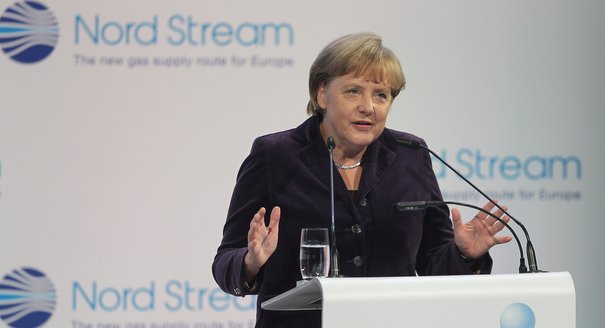
Chancellor Angela Merkel is facing the political repercussions of her decision to shut down Germany's remaining 17 nuclear power plants after the nuclear disaster in Japan last year.
Source: New York Times

Voerdal, an aluminum company employing more than 400 people, has gone into bankruptcy. It will close unless the state government of North Rhine-Westphalia comes up with a rescue package. This state-of-the art company is in such dire financial straits because of rising energy prices. Voerdal officials say that the company’s energy bill went up to 40 percent of total costs, all because of the government’s confused energy policies.
Voerdal is not an isolated case in the energy-intensive sector, which is why Ms. Merkel, who faces re-election next year, is becoming worried.
High energy prices are the Achilles heel of the government,” said Tilman Mayer, a political science professor at Bonn University. “Merkel’s Christian Democrats know that energy price rises will erode their popularity. The chancellor has to reassure her supporters that her energy policies are the right ones.
The political repercussions of energy prices are all too familiar to leaders of other industrialized countries. In the United States, President Barack Obama is trying to avoid a confrontation with Iran because it would push up energy prices in the middle of his re-election campaign.Back in Germany, Ms. Merkel is now paying the price of the radical energy policies she introduced last year following the nuclear catastrophe in Japan. Then, in a decision that grabbed the headlines all over the world, she announced the closure of the last of Germany’s 17 nuclear power plants by 2022.
It was extremely controversial even in her own party, which had voted to prolong the lifetime of Germany’s nuclear power plants just before the tsunami hit Japan. In the 14 months since Ms. Merkel’s dramatic announcement, little has happened to help one of the world’s most highly industrialized countries cope with the chancellor’s energy transformation, known in German as Energiewende.
Much of the blame has fallen on Norbert Röttgen. As environment minister, he was supposed to ensure that Germany would have sufficient and affordable energy supplies once nuclear power was ended. Nuclear power provided 23 percent of electricity in Germany.
He failed to communicate to industry or the public how he was going to do that,” said Hermann-Josef Wagner, a professor of energy systems and energy economics at Ruhr-University-Bochum. Instead, Mr. Röttgen was more focused on his political career, with his sights on succeeding Ms. Merkel one day. His ambitions fell apart this month when he suffered a humiliating electoral defeat in his home state of North Rhine-Westphalia.
Ms. Merkel stood by Mr. Röttgen for a few days, then fired him, and not just because of his miserable election campaign. He was not on top of the energy dossier.
Analysts say Ms. Merkel is perfectly aware of the fact that she will be blamed personally should the Energiewende fail. That explains why she reacted so nervously when, over the past several months, industry officials began to complain about higher energy prices and how they would affect investments, growth and jobs.
Until now, the German economy, Europe’s largest, has been insulated from the euro crisis because of exports and changes to the social welfare system that drove down unemployment. Any significant rise in energy prices, said economists, could make Germany vulnerable to the economic crisis that is pulling down the rest of Europe.
McKinsey & Co., the consulting group, estimated in a recent study that by 2020, German consumers could be paying 60 percent more — to €21.5 billion from €13.5 billion, or $27.1 billion to $17 billion — for their energy bill. That does not include costs the industry will carry.
There were and still are a lot of unanswered questions about the costs of the transition,” Mr. Wagner said.
Electricity grids would need to be built to connect north to south and east to west. There is an urgent need for storage facilities for surplus wind and solar energy to safeguard supplies on calm and cloudy days.
And the pricing system for renewable energy needs to be overhauled. For example, if a grid operator asks a solar or wind power producer to stop generating energy in order to keep the grid stable, the grid operator is obliged by law to pay the producers for the power that has not been generated. Those costs fall on the consumer.
There also is the question of the security of energy supply given that some of the nuclear plants were shut down in 2011. Germany had to cope with serious shortages during a bitterly cold spell last January. Industry officials proposed expanding coal and natural gas production even though that would jeopardize Germany’s commitment to a 40 percent reduction in greenhouse gas emissions by 2020 compared with 1990 levels.
McKinsey now says that Germany can reach a reduction of only 31 percent.
The big energy companies and nuclear producers accepted, with huge reservations, the government’s energy policy. That decision had a hugely negative impact on these companies. Because they are losing substantial income from nuclear plants, they have begun selling assets to offset losses and diversify into renewable energy.
At the same time, they have made clear to Ms. Merkel that they are not prepared to invest in the new grids, or in coal or natural gas plants, until they understand how the Energiewende is going to be implemented and financed.
Still, experts believe that Ms. Merkel will stick to her energy policy.
Politically, she cannot afford to do another U-turn. But neither can she afford to anger voters with ever-rising energy prices. She has no choice but to make the Energiewende work — especially as other big industrial economies want to see if it is feasible.
This article was originally published in the New York Times.

Nonresident Senior Fellow, Carnegie Europe
Judy Dempsey is a nonresident senior fellow at Carnegie Europe
Recent Work
Judy Dempsey
Judy Dempsey
Carnegie does not take institutional positions on public policy issues; the views represented herein are those of the author(s) and do not necessarily reflect the views of Carnegie, its staff, or its trustees.

The European far right might fail to steer EU policy in the direction Russia wants, but they will create enough chaos inside Europe to benefit the Kremlin.

Dimitar Bechev

Minsk clearly expected the dialogue with Washington to yield more results, in particular the lifting of EU sanctions and permission to export potash.

Artyom Shraibman

If the Russian-speaking community in Latvia cannot articulate their interests without being seen as disloyal, they could end up embracing a pro-Kremlin agenda.

Sergejs Potapkins

With the growth in points of friction between the great powers, organizations like the SCO will continue to play a role in the strategic adaptation of the smaller powers caught between them.

Temur Umarov

When faced with fuel shortages in the past, Central Asian governments could always count on additional supplies from Moscow. That safety net no longer exists.

Galiya Ibragimova