

Paper
Yezid Sayigh
{
  "authors": [
    "Yezid Sayigh"
  ],
  "type": "legacyinthemedia",
  "centerAffiliationAll": "",
  "centers": [
    "Carnegie Endowment for International Peace",
    "Malcolm H. Kerr Carnegie Middle East Center"
  ],
  "collections": [],
  "englishNewsletterAll": "",
  "nonEnglishNewsletterAll": "",
  "primaryCenter": "Malcolm H. Kerr Carnegie Middle East Center",
  "programAffiliation": "",
  "programs": [],
  "projects": [],
  "regions": [
    "Levant",
    "Syria"
  ],
  "topics": [
    "Political Reform"
  ]
}
Source: Getty
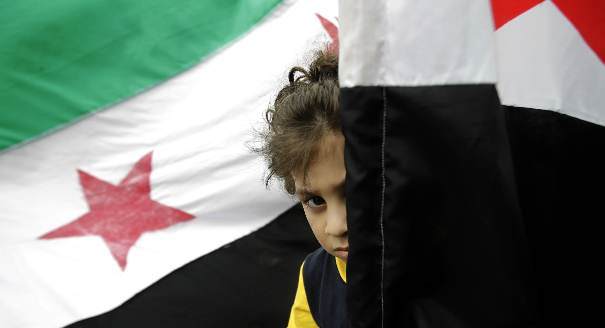
The existing Syrian opposition movements are faced with the prospect of entering into a formal dialogue with the regime. Without substantive proposals, the chances of weakening the regime remain slim, leaving only a prospect of continuing violence.
Source: Al-Hayat

Either way, it is abundantly clear by now that the external actors with the means to unseat Assad by force will go no further than they already have, certainly so long as the opposition remains badly divided.
At the Friends of Syria meeting in Paris on April 19, U.S. Secretary of State Hillary Clinton spoke of the “need to start moving very vigorously in the [UN] Security Council for a Chapter 7 sanctions resolution” and revealed that Turkey might invoke Article 4 of the North Atlantic Treaty. Both of those steps could trigger collective military action in response to threats to international peace or the security of member states.But Russia remains firmly opposed to the Chapter 7 option—which the United Kingdom has also described as “premature.” And Turkey has not yet taken any of the practical steps that would signal that it imminently intends to undertake military action on its common border with Syria.
Instead, when Arab League Secretary General Nabil al-Araby recently invited the divided Syrian opposition factions to meet in Cairo in mid-May, he called on them to unite in order to “negotiate as one bloc with the Syrian government.” This suggests that external actors have no immediate plans to move beyond tightening economic sanctions, even if the diplomatic process remains overshadowed by violence and offers little credible hope for a resolution of the crisis.
These realities apparently left their mark on the Arab League’s Council of Foreign Ministers, which on April 26 called for the UN Security Council to take action to end the killing of civilians in Syria under its Chapter 7 powers to “restore international peace and security.” But the council hastily withdrew that initial statement and issued a revised draft that made no mention of Chapter 7. It instead reaffirmed the Arab action plan of January 22 that called on Assad to hand over power to an interim president—a demand that is conspicuously absent from the Annan peace plan, which the Arab League still endorses. That suggests serious disagreement and uncertainty within the region and international community over how to proceed.
Under these circumstances, the Syrian regime has an opportunity to keep opposition and international ranks divided. There are no genuinely new faces or parties competing in the parliamentary elections scheduled for May 7, but Assad continues to dangle the possibility that the opposition may be allowed to join—or, according to some reports, even head—a new government.
The regime is also said to be floating the idea of reviving the “national dialogue committee” under government auspices. Predictably, this would include supposed “opposition” parties handpicked, if not created, by the regime, while excluding the principal movements that reject dialogue with Assad until the conditions stipulated by the Annan plan are implemented in full. Regime proposals are unlikely to gain traction with the opposition or its regional and international backers, but Russia and some Arab states—such as Iraq and Egypt—may present them as opportunities to keep negotiations going.
In the meantime, those seeking the unconditional departure of Assad have remained focused on identifying “tipping points”—which, when reached, would prompt key institutional actors or social constituencies inside Syria to move decisively against the regime—and searching for the means to reach them. A common expectation among external actors is that senior Alawi military commanders will remove Assad themselves, as the cost to their community in both lives and livelihoods increases and the realization deepens that, in the long run, the regime cannot win. Another is that ever-increasing economic and financial sanctions will push the country’s businessmen and large middle class into openly challenging the regime, delivering the critical mass needed to secure its downfall.
These expectations only serve to highlight the glaring lack of a political strategy capable of generating and expanding these hoped-for splits in regime ranks, or of convincing middle-class Syrians to move into open opposition. These citizens may dislike the regime, but they are deterred by the high personal costs of defiance and worried about the potential alternative to the Assad regime. Any political strategy looking to turn the tide in favor of the opposition will have to convince these Syrians that it is less than suicidal to publicly come out against the Syrian leadership.
Such a strategy must also address the opposition’s most difficult and potentially most divisive questions: Is power sharing an option? If so, under what conditions? And if not, how does it propose to deal with existing senior government officials and civil servants—or with the Baath Party itself—in the new Syria it seeks to establish? These questions demand responses, not because this will persuade the top ranks of the regime to compromise, but rather to reassure those constituencies and the swathe of society they represent and neutralize them, if not win them over.
This is a problem for the opposition as a whole, but it poses a particular problem for the principal opposition coalition in exile, the Syrian National Council. Inside sources reveal that its key Western and Arab backers, which recognized it on April 1 as “the umbrella organization under which Syrian opposition groups are gathering,” do not feel it is living up to expectations. Some privately await the emergence of new leaders and movements within Syria that demonstrate greater political and organizational coherence.
But this will take time. Until then, the existing opposition movements are faced with the prospect of entering into a formal dialogue with the regime for which they remain unprepared. Without substantive proposals that can enhance their credibility among the diverse audiences inside Syria, the chances of weakening the regime remain slim, leaving only a prospect of continuing violence. .

Senior Fellow, Malcolm H. Kerr Carnegie Middle East Center
Yezid Sayigh is a senior fellow at the Malcolm H. Kerr Carnegie Middle East Center in Beirut, where he leads the program on Civil-Military Relations in Arab States (CMRAS). His work focuses on the comparative political and economic roles of Arab armed forces, the impact of war on states and societies, the politics of postconflict reconstruction and security sector transformation in Arab transitions, and authoritarian resurgence.
Recent Work
Yezid Sayigh
Yezid Sayigh
Carnegie does not take institutional positions on public policy issues; the views represented herein are those of the author(s) and do not necessarily reflect the views of Carnegie, its staff, or its trustees.

Despite unhappiness on the ground, Moscow is determined to use both carrot and stick to ensure there is record support for United Russia in occupied Ukraine.

Konstantin Skorkin

Whether PAS can refocus on the unfinished business of state-building may ultimately prove more consequential for Moldova’s European future than the pace of its accession negotiations.

Balázs Jarábik
Medvedev’s defeat in the battle for the position of speaker appears to signal that the long process of his marginalization in Russian politics has passed the point of no return.

Andrey Pertsev
The ruling elites in contemporary Russia are not a political class, but a community of managers who are not subject to competition or public accountability. The state is becoming an operating apparatus without any internal autonomy.

Alexandra Prokopenko
Pashinyan’s pro-European party has been re-elected with a decisive victory. But the pro-Russian opposition could still slow Armenia’s progress toward peace with Azerbaijan and rapprochement with Europe.
Mikayel Zolyan