

Article
- +1
Toby Dalton, Mark Hibbs, Nicole Grajewski, …
{
  "authors": [
    "Mark Hibbs"
  ],
  "type": "legacyinthemedia",
  "centerAffiliationAll": "dc",
  "centers": [
    "Carnegie Endowment for International Peace"
  ],
  "collections": [],
  "englishNewsletterAll": "ctw",
  "nonEnglishNewsletterAll": "",
  "primaryCenter": "Carnegie Endowment for International Peace",
  "programAffiliation": "NPP",
  "programs": [
    "Nuclear Policy"
  ],
  "projects": [],
  "regions": [
    "Middle East",
    "Iran"
  ],
  "topics": [
    "Nuclear Policy"
  ]
}
Source: Getty
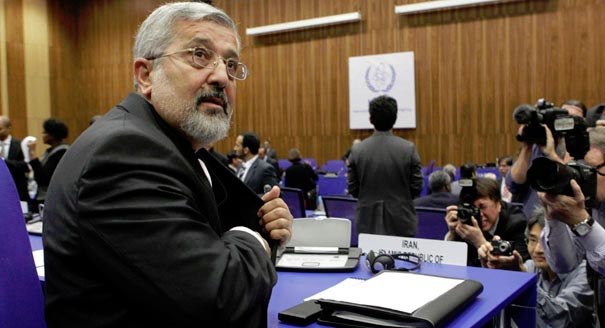
In his recent statement to the IAEA's Board of Governors, Iranian Ambassador Ali Asghar Soltanieh suggested that Iran is not looking to cooperate during the next stage of negotiations over its nuclear program.
Source: Arms Control Wonk

Agenda item 7(d) of this week’s routine quarterly BOG meeting wrapped up today was ”Implementation of IAEA Safeguards and Relevant UNSC Resolutions in the Islamic Republic of Iran.”
Delegates were treated to a broadside by Ambassador Ali Asghar Soltanieh suggesting that Iran isn’t about to come to Moscow in a mood to cooperate. Among other points, Soltanieh told us today:
In any event, Iran on a couple of points today departed somewhat from its usual narrative. For instance, this:
In order to prove to the international community that all such allegations [of military or clandestine activity] are forged and baseless and our nuclear activities are exclusively for peaceful purposes, we have on many occasions worked intensively with the Safeguards Department, and in many cases we had to take steps beyond our obligations under the NPT. The full implementation of the Work Plan (INFCIRC/711) of 2007, which was negotiated and agreeed upon by Iran and the Agency and later endorsed by the Board of Governors, proved the political determination and good will of my Government.
That’s interesting because in the background of the BOG meeting–in a development far more significant than the meeting itself–Iran and the IAEA are negotiating the final text of a proposed agreement for a new Work Plan (these days the IAEA doesn’t use the somewhat tarnished term “Work Plan” but instead calls it a “structured approach document.”)
On the eve of the BOG meeting this week, I and two Carnegie colleagues, Eli Levite and Pierre Goldschmidt, put that ongoing bilateral negotiation into context here.
On Monday this week, IAEA Director General Yukiya Amano told the BOG that the IAEA and Iran will hold a meeting here on Friday, June 8 in Vienna to negotiate further over this new text.
If Soltanieh’s statement that the BOG endorsed the original 2007 Work Plan were true, it would imply that the BOG–the same policy-making organ that has been on Iran’s case for the last nine years–approved the original Work Plan which Iran since 2008 has claimed it has fulfilled. The Soltanieh narrative might also imply that the BOG should now look with favor upon the new version of the agreement that Iran is putting forth now.
But there was no endorsement of the Work Plan by the BOG meeting in September 2007.
The 2007 Work Plan was made available to the BOG as an “information circular,” described by the IAEA Department of Publications as intended to “bring matters of public interest to the attention of its member states.”
Infcirc/711 was accordingly distributed to the BOG on August 27, 2007 in this form.
There’s nothing in the Rules of Procedures of the Board of Governors, in the IAEA publications guidelines, or to my knowledge anywhere else that says that the BOG must approve or endorse any Infcirc document.
In fact, summary records from the September 2007 BOG suggest instead that Russia, China and NAM states welcomed the Work Plan but that other member states on the BOG received Infcirc/711 without enthusiasm and, on the basis of interventions that were recorded by the president of the BOG for that meeting, by expressing skepticism. The U.S. and European states went on record at the time by warning that adoption of the Work Plan might result in Iran’s unduly prolonging the IAEA’s investigation of Iran’s nuclear program and by preventing the IAEA from addressing critical issues on the basis of evidence presented after Iran “closes the file.” These issues are still with us in the discussion between the IAEA and Iran over the new agreement draft put forth by Iran. According to some versions of events, the lack of acceptance of the 2007 Work Plan by Western states and Japan in the boardroom prompted then-DG Mohammed ElBaradei to walk out of the meeting.
When the BOG convened in September 2007, Japan’s resident representative and Ambassador to the IAEA was Yukiya Amano. (He served from September 2005 through his election as IAEA Director General in late 2009). Amano joined his U.S. and European colleagues in registering criticism of the Work Plan, on behalf of the government of Japan.
On Tuesday this week, before Iran addressed the BOG on safeguards in Iran, the 35 governors had taken up agenda item 7(b), “The Safeguards Implementation Report for 2011.” During that discussion, the Russian Federation raised objections to the IAEA’s State-Level Safeguards Approach as arbitrary and subjective. It wasn’t clear to most people why Russia made this intervention; after all, IAEA safeguards in Russia follow from a Russian voluntary safeguards offer to the IAEA (Infcirc/369) and are extremely limited in any case. Come what may, in his statement the next day inside the boardroom, Soltanieh appeared to use Russia’s statement on the SIR as a springboard, attacking the IAEA again and again for exceeding its technical mandate by indulging in arbitrary ”allegations not involving nuclear materials.”

Nonresident Senior Fellow, Nuclear Policy Program
Hibbs is a Germany-based nonresident senior fellow in Carnegie’s Nuclear Policy Program. His areas of expertise are nuclear verification and safeguards, multilateral nuclear trade policy, international nuclear cooperation, and nonproliferation arrangements.
Recent Work


Toby Dalton, Mark Hibbs, Nicole Grajewski, …
Mark Hibbs
Carnegie does not take institutional positions on public policy issues; the views represented herein are those of the author(s) and do not necessarily reflect the views of Carnegie, its staff, or its trustees.
Ongoing uncertainty in the Middle East allows Moscow to both increase its influence in Tehran and continue to enjoy the financial windfall of higher oil prices.

Nikita Smagin
This year’s wars have made alternative routes to transit through Russia no less risky for Central Asian countries.

Galiya Ibragimova
Troubled by the growing salience of nuclear debates in East Asia, Moscow has responded in its usual way: with condemnation and threats. But by exacerbating insecurity, Russia is forcing South Korea and Japan to consider radical security options.

James D.J. Brown
The Russian leadership wants to avoid a dangerous precedent in which it is squeezed out of Iran by the United States and Israel—and left powerless to respond in any meaningful way.
Nikita Smagin
Not only does the fighting jeopardize regional security, it undermines Russian attempts to promote alternatives to the Western-dominated world order.

Ruslan Suleymanov