

Article
Deborah Gordon, Stephen D. Ziman
{
  "authors": [
    "Deborah Gordon"
  ],
  "type": "legacyinthemedia",
  "centerAffiliationAll": "",
  "centers": [
    "Carnegie Endowment for International Peace"
  ],
  "collections": [],
  "englishNewsletterAll": "",
  "nonEnglishNewsletterAll": "",
  "primaryCenter": "Carnegie Endowment for International Peace",
  "programAffiliation": "",
  "programs": [],
  "projects": [
    "Carnegie Oil Initiative"
  ],
  "regions": [
    "North America",
    "United States"
  ],
  "topics": [
    "Climate Change"
  ]
}
Source: Getty
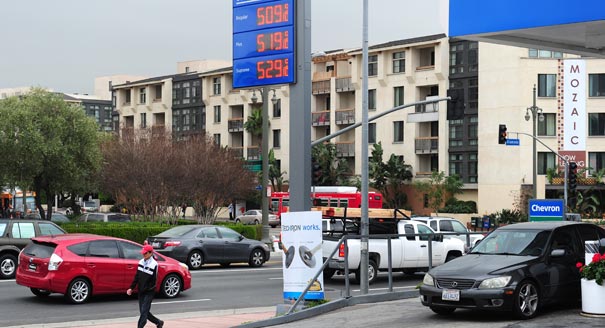
It may seem counterintuitive, but a carbon fee on oil placed far up on the supply chain could stabilize gas prices and benefit American consumers.
Source: Hill

From 1949 to 1973, real gasoline prices remained flat, hovering between $1.50 and $2 a gallon (in 2011 dollars). Following the ’70s oil crises, gas prices once again settled down to $1.50 a gallon from 1986 to 1999. All told, American motorists experienced some 50 years of remarkably stable and low fuel expenditures — albeit interrupted by a volatile decade.
But recent fuel costs have motored up and down, nearly tripling in a single year. An average gallon of regular gasoline swung from a low of $1.55 (2002) up to $3.17 (2008), back down to $2.66 (2009) and up again to $3.71 (2011). This roller coaster signals a wild ride ahead.Essentially all of today’s gasoline is made from crude oil, the very stuff that until recently we thought we were running out of. Today we are witnessing an economic and technological redefinition of oil. New oils are being found in new places and different formulations. These so called unconventional oils are poised to change everything — from extraction techniques to processing protocols to petroleum fuels themselves and their uses.
With change comes uncertainty. As such, the oil boom is expected to trigger a paradigm shift. The vast differentiation in oil feedstocks and geographies upon us could lead to less predictable prices.
From bitumen-laced oil sands in Canada and extra-heavy oil in Venezuela to light shale oils in the Bakken and the crude array throughout the Middle East and North Africa, 21st century oils are a heterogeneous bunch. Add in kerogen-based oil shales in the Rocky Mountains and pre-salt oil in Brazil. No doubt there’s more — all told, Americans are preparing to feast on a super-sized alphabet soup of hydrocarbons.
West Texas Intermediate (WTI) crude — our benchmark — has historically traded at a premium to Europe’s North Sea Brent crude. This is no longer the case. For the past two years, WTI crude has sold at a $15 per barrel (plus) discount to Brent. Moreover, the Energy Information Administration predicts WTI could sell anywhere from $40 to $170 per barrel next year.
Looking ahead, oil traders aren’t forecasting normal market conditions — where prices trend smoothly upward. Why? Worldwide economic recovery appears tentative and the rate of growth in China and India is declining. Still, North American oil production could continue to outpace demand if new infrastructure, including the Keystone XL pipeline, is built. And the Organization of the Petroleum Exporting Countries (OPEC) could resort to cutting oil supply to manipulate global prices.
What does this all mean for American motorists? Uncertainty.
Transforming oil markets need structure. New rules must be established for new fuels in order to ensure their sustainable development and address environmental concerns. One option is to price oils based on their imbedded carbon. The lighter the hydrocarbon feedstock, the lower its carbon, with less processing required and more gasoline produced. Heavier oils, on the other hand, yield greater shares of diesel and petroleum coke — a coal substitute. Americans currently use almost three times the amount of gasoline as diesel. And some 1 million barrels a day is currently being exported. Introducing greater a greater share of heavier oils in the United States, therefore, will not relieve pressure at the gas pump.
A carbon fee on oil is a win-win solution. Switching from a gas tax on consumers to a percentage (ad valorem) fee on oil inputs, domestic and imported, would help prioritize which oils to tap and which to save. Moreover, a carbon-indexed oil fee would encourage system-wide efficiencies and reap revenues at home for the growing share of petroleum products that are refined in the United States and exported — untaxed.
It seems counterintuitive, but a carbon fee on oil placed upstream could stabilize gas prices and benefit Americans. Pricing oil far up on the supply chain based on its carbon content is one way to reduce price volatility by spreading the cost among more users.
It’s a new era for oil. The industry is barreling ahead, learning as it goes. The public is searching for confidence in future markets. If there was ever a time for policy intervention, it is now. Congress must safeguard the public interest regardless of pressures for payoffs in the oil patch.
This article was originially published in The Hill's Congress Blog.

Former Director and Senior Fellow, Energy and Climate Program
Gordon was director of Carnegie’s Energy and Climate Program, where her research focuses on oil and climate change issues in North America and globally.
Recent Work
Deborah Gordon, Stephen D. Ziman
Deborah Gordon, Smriti Kumble, David Livingston
Carnegie does not take institutional positions on public policy issues; the views represented herein are those of the author(s) and do not necessarily reflect the views of Carnegie, its staff, or its trustees.

When faced with fuel shortages in the past, Central Asian governments could always count on additional supplies from Moscow. That safety net no longer exists.

Galiya Ibragimova
Official discussions about mini oil refineries are unlikely to come to anything—but the mere fact they’re happening reveals the regime is failing to deliver a functioning economy.

Sergey Vakulenko

Ongoing uncertainty in the Middle East allows Moscow to both increase its influence in Tehran and continue to enjoy the financial windfall of higher oil prices.

Nikita Smagin

Governments in Estonia, Latvia, and Lithuania want to ensure that a U.S. military withdrawal would not leave them dangerously exposed to a Russian attack.

Sergejs Potapkins
Tokyo would have to surmount a lot of obstacles—not least Western sanctions—if it wanted to return Russian oil imports to even modest pre-2022 volumes.

Vladislav Pashchenko