

Commentary
Judy Dempsey
{
  "authors": [
    "Judy Dempsey"
  ],
  "type": "legacyinthemedia",
  "centerAffiliationAll": "",
  "centers": [
    "Carnegie Endowment for International Peace",
    "Carnegie Europe",
    "Carnegie Russia Eurasia Center"
  ],
  "collections": [],
  "englishNewsletterAll": "",
  "nonEnglishNewsletterAll": "",
  "primaryCenter": "Carnegie Europe",
  "programAffiliation": "",
  "programs": [],
  "projects": [],
  "regions": [
    "Russia",
    "Europe"
  ],
  "topics": [
    "Foreign Policy"
  ]
}
Source: Getty
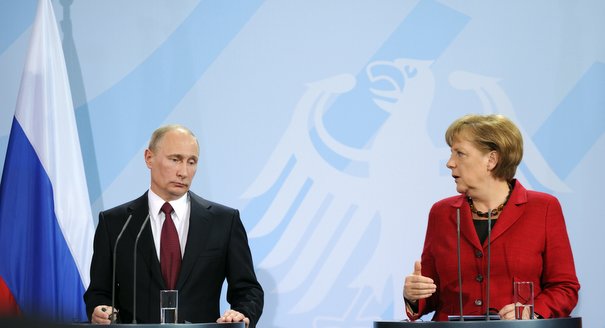
The Petersburg Dialogue was set up to bring together a cross section of Russian society and encourage the country's transition to democracy. It hasn't worked that way.
Source: New York Times

Established in 2001 by her predecessor, Gerhard Schröder, the Petersburg Dialogue was supposed to bring together a cross section of Russian society and give the participants a platform to express their views, in order to encourage the country’s transition to democracy.
It never achieved that.
On the contrary, the Petersburg Dialogue has become a talk shop, unwilling to question the economic, social or political policies of the Kremlin or deal with challenges affecting Russian society.
In my latest column, I write about the tangled and ever more troubled relationship between today’s Russia and Germany, its most loyal European ally: Over the past few weeks, an increasing number of German politicians are questioning Berlin’s special relationship.Ms. Merkel has sometimes tried to raise issues in the context of the Petersburg Dialogue, especially Russia’s weak rule of law and the pressure on non-governmental organizations, bloggers and the media generally. But her points have rarely been taken up by the participants.
Yet, surely such a forum would offer an ideal opportunity for the German side, which includes leading corporate executives, to speak out openly about Russia’s pervasive corruption and how difficult it is to do business there. Surely, the one thing that companies want when dealing with any country is predictability, accountability and transparency.
Russia, however, is special. Germany, which is Russia’s biggest trading partner in Europe, fears that it could lose out on contracts if it adopted a more critical stance towards the Kremlin. The big German companies that do business in Russia just don’t want to rock the boat.
But what does that say about Germany’s commitment to its values?
Ms. Merkel’s own Christian Democrats are now speaking out against “Putin Two’s” style of rule by calling for a much wider dialogue beyond the reach of the Kremlin and the oligarchs and the established lobbies.
Along with the opposition Greens and some Social Democrats, the Christian Democrats realize that Germany must deal differently with a Russia that is changing.
Will Mrs. Merkel set this train in motion when she meets Mr. Putin next month?

Nonresident Senior Fellow, Carnegie Europe
Judy Dempsey is a nonresident senior fellow at Carnegie Europe
Recent Work
Judy Dempsey
Judy Dempsey
Carnegie does not take institutional positions on public policy issues; the views represented herein are those of the author(s) and do not necessarily reflect the views of Carnegie, its staff, or its trustees.

In the discussions made possible by the State Duma election campaign, one question is being asked more and more loudly. “What next?”

Andrey Pertsev
While the Nazis rushed ahead in a revolutionary fervor, Russia’s modern crusaders against enemies of the state work methodically, giving their targets time to adjust to restrictions before closing the loopholes.

Leonid Bershidsky

When faced with fuel shortages in the past, Central Asian governments could always count on additional supplies from Moscow. That safety net no longer exists.

Galiya Ibragimova
Reading the purported correspondence of celebrity Ksenia Sobchak sheds light on her role within the system, and how journalism and politics function in Putin’s Russia.

Vladislav Gorin

When political power is concentrated in the hands of a small circle of people, a country invariably ends up with technological stagnation.
Aleksei Kiselev