

Commentary
Dmitri Trenin
{
  "authors": [
    "Dmitri Trenin"
  ],
  "type": "legacyinthemedia",
  "centerAffiliationAll": "",
  "centers": [
    "Carnegie Endowment for International Peace",
    "Malcolm H. Kerr Carnegie Middle East Center",
    "Carnegie Russia Eurasia Center"
  ],
  "collections": [],
  "englishNewsletterAll": "",
  "nonEnglishNewsletterAll": "",
  "primaryCenter": "Carnegie Russia Eurasia Center",
  "programAffiliation": "",
  "programs": [],
  "projects": [
    "Eurasia in Transition"
  ],
  "regions": [
    "Egypt",
    "Gulf",
    "Levant",
    "Maghreb"
  ],
  "topics": [
    "Political Reform"
  ]
}
Source: Getty
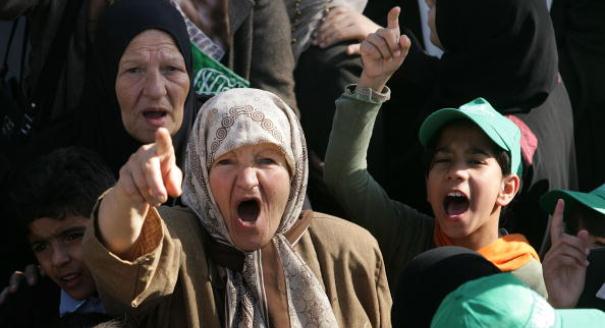
Since 2011, the driving forces in the Middle East have been the Arab people, the Gulf monarchies, Iran, and Turkey, not the United States. As global power realities shift, so must U.S. foreign policy.
Source: China Daily

As symbols go, this one, to some, is proof of the utter failure of the US policy in the region. "Those who sow the wind will reap the storm", was what a Russian official said in Moscow after the US ambassador's killing. The protests over the film have since subsided. However, the larger issue of where the Middle East stands in the US global policy remains. In particular, will the United States be able to extricate itself from the region's conflicts enough to "pivot" to the Asia-Pacific region?
Since Sept 11, 2001, Washington has been responsible for many things in the Middle East, but certainly not for the sudden outbreak of the "Arab Spring". The US was as surprised by the upheavals as any other country. It, however, had more interests to protect in the region than the others and decided to support the change rather than stand in its way and risk being swept away by the wave. Tunisia, where the movement started, was easy, because it was small, peripheral and hopeful.Soon, however, US President Barack Obama had to make an agonizing decision: whether or not to support old and trusted ally Hosni Mubarak, then president of Egypt. He chose the change, because Mubarak could not be rescued anyway. That was the turning point. In Libya, Obama heeded the morally compelling and politically expedient advice of his European allies and his domestic associates over the more sober strategic judgment of the Pentagon and the US intelligence agencies.
In Syria, the strategic rationale for removing an Iranian ally from power happily converged with the US' ideological need to support democracy and human rights. At the same time, much to Washington's secret relief, Russia and China conveniently blocked the UN from sanctioning a costly and dangerous direct military intervention to unseat Bashar al-Assad in Syria.
It needs to be added that when strategic interests demanded, Obama looked the other way, as in Bahrain, where the revolution was crushed thanks to Saudi Arabia's intervention. Yemen was the only country where Obama used diplomacy to successfully negotiate a political resolution to a domestic crisis, which was more like improvise-as-you-go adjustment than leadership.
The situation in the Middle East, however, is becoming more volatile. The Syrian crisis has intensified, and the mounting death toll and rising number of refugees are destabilizing the Levant. Cross-border shellings by NATO member Turkey and Syria, Sunni-Alawi clashes in Lebanon and the flow of refugees into Jordan point to the creeping enlargement of the Syrian conflict that the US can hardly ignore.
Crucially, Jordan's domestic stand-off between the king and the local Muslim Brotherhood has reached a new crisis level. As in Egypt, the situation in Jordan may eventually lead, geopolitically, to yet another key US ally going its own way. Washington hopes that despite being led by Islamists, Egypt and other Middle East countries would still need Washington's aid and diplomatic backing. With this in mind, the US supported Egyptian President Mohamed Mursi in his tug-of-war with the military.
Yet the rules of Arab-American political partnership are changing, with Washington's Arab partners becoming more independent, aid or no aid. This puts the issue of Israel in a new perspective. Since Israel's immediate neighborhood is changing, it, along with the US, will be under greater pressure to accommodate Palestinian demands. Unlike people in the US and Europe, Israel had few illusions about the "Arab Spring" from the start, but it focused on Iran, whose nuclear program it considers to be an existential threat.
The situation in the Middle East is moving inexorably to a point where Iran will either become capable of making nuclear weapons or Israel and/or the US will launch an attack to prevent it from taking a quantum leap in power and status. Such an attack would probably delay Iran's nuclear program but at the same time lead to massive, and in many ways unpredictable, dislocations in the region.
Iran shares its borders with Iraq and Afghanistan, where the US military has been entrenched since the beginning of this century. Afghanistan and Iraq both gave the US early military victories, only to be followed by long and frustrating engagements and ending in less than glorious withdrawals. Iraq eventually decided to do without US troops, and Washington had to accept that.
As the 2014 deadline for US-NATO withdrawal from Afghanistan draws near, the future of that country is as open as ever. Yet the US is unlikely to prolong its active engagement in what has become a local struggle for power in the mountainous country. Afghanistan and Iraq that symbolized the US' supreme power status and its commitment to transform an entire region in the last decade are now being relegated to the margins of Washington's foreign policy.
That means the US is willing to lower its profile in the Middle East, but it will not be easy for it to move on to the next regional hotspot. What has changed, most notably, is the driving force in the Middle East and which country responds readily to the changing situation, real or assumed. In 2001 and in 2003, the driving force was the US. From 2011, the driving forces have been the Arab people, the Gulf monarchies, Iran and Turkey, which have gradually forced the US to the sidelines.
As global power realities shift, so does US foreign policy. Last time, it took 9/11 to delay the process. Now, the side-show is over. Barring a war against Iran or a revolution in Saudi Arabia, there will be no further delay.
Former Director, Carnegie Moscow Center
Trenin was director of the Carnegie Moscow Center from 2008 to early 2022.
Recent Work
Dmitri Trenin
Dmitri Trenin
Carnegie does not take institutional positions on public policy issues; the views represented herein are those of the author(s) and do not necessarily reflect the views of Carnegie, its staff, or its trustees.

In the discussions made possible by the State Duma election campaign, one question is being asked more and more loudly. “What next?”

Andrey Pertsev

Two divergent trends—Putin’s hardline vision of how to prosecute the war in Ukraine, and a growing desire for change in Russia—could tear the regime apart.

Tatiana Stanovaya
Ultimately, Zelensky sided neither with the reform camp nor with the military establishment as such, but with political control.

Balázs Jarábik
Tokayev’s predecessor, Nursultan Nazarbayev, outlined arrangements for a power transition too soon and in too much detail, ultimately losing control over the process. Tokayev is determined not to meet the same fate.

Temur Umarov

Despite unhappiness on the ground, Moscow is determined to use both carrot and stick to ensure there is record support for United Russia in occupied Ukraine.

Konstantin Skorkin