

Paper
Paul Salem
{
  "authors": [
    "Paul Salem"
  ],
  "type": "legacyinthemedia",
  "centerAffiliationAll": "",
  "centers": [
    "Carnegie Endowment for International Peace",
    "Malcolm H. Kerr Carnegie Middle East Center"
  ],
  "collections": [],
  "englishNewsletterAll": "",
  "nonEnglishNewsletterAll": "",
  "primaryCenter": "Malcolm H. Kerr Carnegie Middle East Center",
  "programAffiliation": "",
  "programs": [],
  "projects": [],
  "regions": [
    "Levant"
  ],
  "topics": [
    "Political Reform"
  ]
}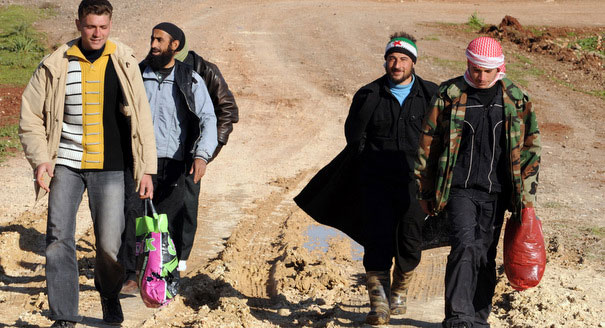
Source: Getty
One hundred years after the countries of the Levant embarked on their journey to build modern political societies, the experiment appears to have failed.
Source: Middle East Voices

Lebanon collapsed in the 1970s, Iraq disintegrated in the 1990s and 2000s, and Syria is in the process of tearing itself apart. Unlike Egypt, Tunisia, and several countries in other parts of the Arab world, the countries of the Levant (namely Lebanon, Syria, and Iraq) have managed to keep neither nation nor state intact. As the Levant—or, as it is referred to in Arabic, the Mashrek—enters a period of profound division and uncertainty, will these societies be able to find a path back to national unity and modern statehood, or is their decline into disunity and conflict irreversible?
The intelligentsia of Levantine societies were part of the Arab awakening (Nahda) that sought to replace the declining Ottoman order with modern nation-states built on the principles of national self-determination, equality, citizens’ rights, women’s empowerment, social justice, economic progress, and enlightenment.The Ottoman order collapsed, but the societies were challenged anew by the political divisions created by the Sykes-Picot Agreement and the rule of European mandate powers. Nevertheless, these societies had the opportunity to build democratic political institutions, active civil societies, and modern educational and economic structures. It was a time of great political creativity that saw the founding of movements and parties endeavoring to shape a better Arab future.
With the Levantine countries gaining independence after World War II, the obstacles of Ottoman and European rule were removed, and these societies became masters of their own destinies. But the hoped-for political progress slowed rather than quickened.
Movements that preached unity and freedom came to power only to establish one-party police states that pursued conflicts among one another. In some countries, nascent democratic institutions were enthusiastically swept away in favor of totalitarian dictatorships, while in others they were left to weaken and decline. Ambitions of national unity and equal citizenship were thrown out in favor of domination by one community.
In countries with a weak state, like Lebanon, the national disintegration showed early, in 1958, and then more devastatingly in 1975. In Syria and Iraq, the iron fist of dictatorship delayed the disintegration but made it all the more painful and bloody when it did occur.
The youth of the Arab Spring recaptured the spirit of the Arab Nahda, calling for freedom, national unity, civil rights, democracy, social justice, and economic progress. But in the Mashrek, the atavisms of confessionalism, ethnicity, and tribalism have had a stronger and more contradictory pull.
In Iraq, the Maliki government has seized upon the opportunity of the American withdrawal to eliminate its opponents, exclude real partners in government, and try to consolidate its narrow hold on power, inconsiderate of the disintegration and near civil war into which it is leading the country.
In Syria, the Assad regime, supposedly founded on the Baathist principles of unity, freedom, and socialism, is intent on fuelling sectarian civil war, bludgeoning its people into bloodied submission, and protecting the billions of dollars accumulated by its corrupt leaders. The Syrian opposition, initially broadly in agreement about seeking a democratic and pluralist post-Assad order, is now being overtaken by a radical jihadist movement that wants to establish an ultraconservative Islamic state that would make the Ottoman Empire look like an enlightened order.
And in Lebanon, the best that political minds could put forward was the so-called Orthodox election law that proposes segregating religious communities from each other. It effectively suggests a leap backward to political arrangements of Ottoman times when each sectarian community (Millet) lived a separate political existence without participation in any cumbersome national project.
Indeed, the societies of the Levant—and I am a citizen of one of them—are politically bankrupt. Without new ideas and new movements to unite these societies and point to a national, rational, inclusive way forward, the states will sink deeper and deeper into division and decay.
But where are the ideas that will carry these countries forward? The dreams of Arab unity clashed with the realities of Arab divisiveness and authoritarianism. The ambitions of Arab socialism clashed with the realities of corruption and abuse of power. The momentum of civil society was undermined by the pull of family and tribe and by the strength of religious and ethnic affiliations. The drive for women’s empowerment came up against the hard edges of pervasive Arab patriarchy.
Indeed, as the late Lebanese journalist, politician, and diplomat Ghassan Tueni described it, the twentieth century has been a “lost century” for the people of the Levant. In 2013, they find themselves at an even worse starting point than in 1913. Then, the region was buzzing with activity and optimism to build a new enlightened, democratic, civil, united, prosperous Arab future. Societies were emerging from five centuries of stifling Ottoman rule and looking toward opportunities for emancipation, national determination, and a new civic order.
The region’s destiny is in its own hands now that foreign armies have departed. But the absence of a unifying vision, a common hope, an inclusive national or state-building project to take advantage of the existing opportunities is glaring. With each community eager to maximize its dominance or advantage, what has been sacrificed is the common project that could have provided security, dignity, participation, and prosperity for all.
Emerging from this dark night will take many years. It will require first appreciating the depth of sectarian and ethnic division and dysfunction to which all the societies of the Levant have sunk, then beginning to reformulate the ideas and projects that can chart a path out of this hellish reality. These projects must build on the principles of freedom, democracy, social justice, and economic progress that were renewed by the youth of the Arab uprisings. Then Levantine societies must organize the social and political movements that will get them there. This will take many long years to accomplish.
The Levant has already wasted one century. It must not risk wasting another.
Senior Fellow at the Middle East Institute
Paul Salem is a senior fellow at the Middle East Institute.
Recent Work
Paul Salem
Paul Salem
Carnegie does not take institutional positions on public policy issues; the views represented herein are those of the author(s) and do not necessarily reflect the views of Carnegie, its staff, or its trustees.

In the tenth year of his presidency, President Mirziyoyev’s system is becoming even more personalized than that of his predecessor Karimov.

Galiya Ibragimova

The greater threat to Zelensky comes not from Fedorov alone, but from the convergence between the former defense minister’s political campaign and the anti-corruption investigations moving ever closer to the presidential administration.

Balázs Jarábik

With his public call for new elections in Ukraine, ex-defense minister Mykhailo Fedorov has opened Pandora’s box.

Konstantin Skorkin

In the discussions made possible by the State Duma election campaign, one question is being asked more and more loudly. “What next?”

Andrey Pertsev

Two divergent trends—Putin’s hardline vision of how to prosecute the war in Ukraine, and a growing desire for change in Russia—could tear the regime apart.

Tatiana Stanovaya