

Commentary
Konstantin Skorkin
{
  "authors": [
    "Konstantin Skorkin"
  ],
  "type": "commentary",
  "blog": "Carnegie Politika",
  "centerAffiliationAll": "",
  "centers": [
    "Carnegie Endowment for International Peace",
    "Carnegie Russia Eurasia Center"
  ],
  "englishNewsletterAll": "",
  "nonEnglishNewsletterAll": "",
  "primaryCenter": "Carnegie Russia Eurasia Center",
  "programAffiliation": "",
  "regions": [
    "Ukraine"
  ],
  "topics": [
    "Political Reform",
    "Civil Society"
  ]
}
Source: Getty
With his public call for new elections in Ukraine, ex-defense minister Mykhailo Fedorov has opened Pandora’s box.
Since Ukrainian President Volodymyr Zelensky fired Mykhailo Fedorov as defense minister last month, the conflict between the two men has escalated and plunged the country into a period of competitive politics that it hasn’t seen since Russia’s full-scale invasion in 2022. Zelensky now has an opponent who is prepared to mount an open political challenge here and now, rather than wait for the fighting to end.
Fedorov has also articulated something that Ukrainian society has long been afraid to acknowledge: There will be no return to “prewar life.” The fighting has resulted in too many irreversible changes. The old Ukraine is gone, Fedorov argues, and domestic politics needs to catch up with the new reality.
It’s possible that Fedorov’s demand for wartime presidential elections will prove a false start in his nascent political career. But it is too late to stop this idea from taking root in the minds of Ukraine’s elite and the general public. After all, for the first time, it was presented not as a threat to the state at a time of war, but as the key to its revitalization and survival.
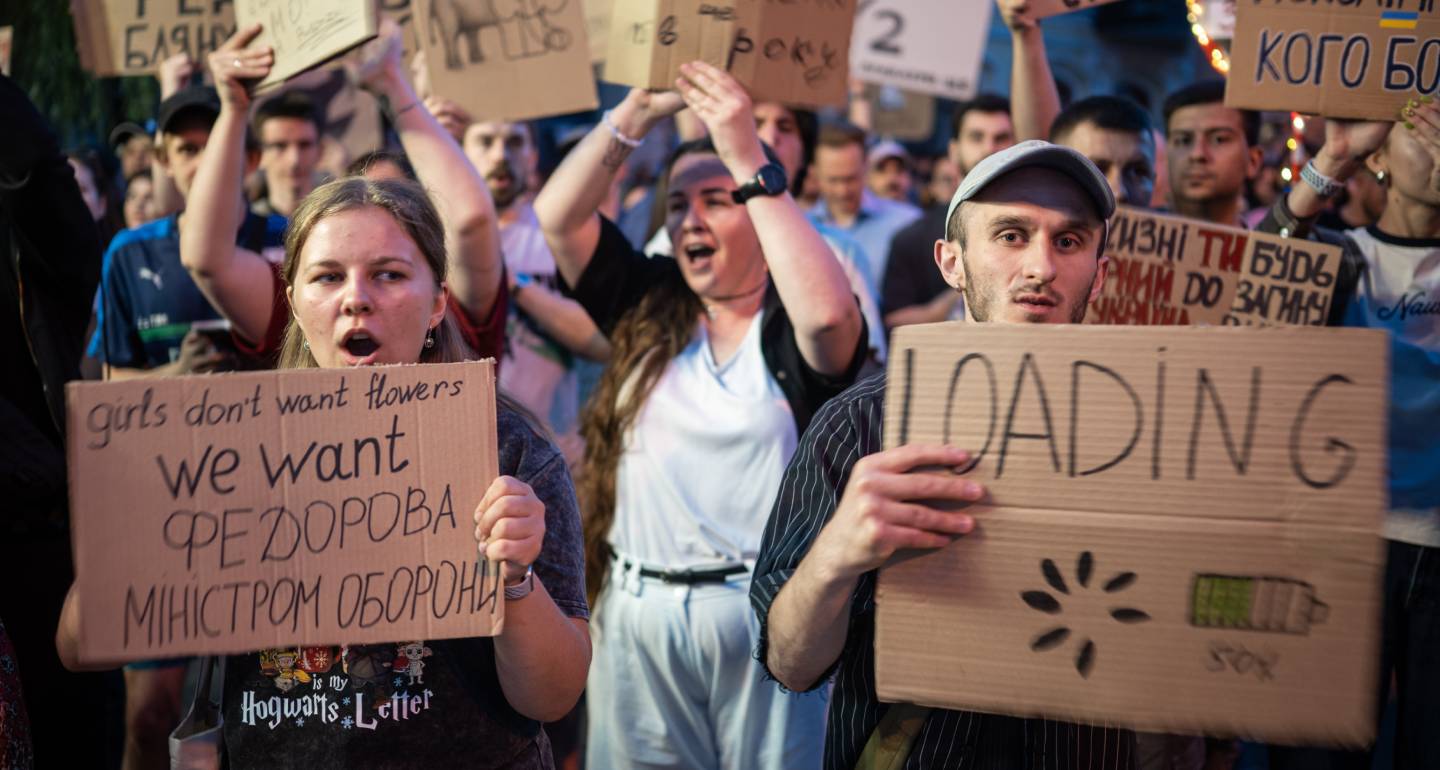
The ongoing street protests triggered by Fedorov’s dismissal have long since surpassed those prompted by a 2025 law that many feared would destroy the independence of Ukraine’s anti-corruption agencies. It’s clear the current protests have less to do with Fedorov’s personal qualities than with him embodying a desire for change shared by many Ukrainians.
The demonstrations have obliged Zelensky to make some concessions, including sacking commander in chief Oleksandr Syrsky, one of Fedorov’s opponents. But in the case of Fedorov himself, Zelensky stood firm, clearly suspecting that the ex-defense minister’s desire to be reinstated was motivated by political ambition. And he was correct: Once it became clear there was going to be no return to government under Zelensky, Fedorov doubled down, calling for elections and political change.
The wave of popularity generated by his dismissal has made Fedorov one of the three most popular candidates in a hypothetical presidential election, according to an opinion poll. The other two are Zelensky and ex-commander in chief Valery Zaluzhny. There are also rumors that Fedorov might be about to set up a new political party.
It all bears a striking resemblance to the start of Zelensky’s own bid to become president: a campaign that Fedorov himself helped mastermind. Fedorov has cultivated the image of a young visionary untainted by the backing of toxic oligarchs. He could be supported by liberal media outlets and young, IT-savvy businesspeople working in the defense sector.
At the same time, Fedorov has his weaknesses. Most importantly, he is a longtime member of Zelensky’s team: Until his dismissal, he was the only minister to have been in government since 2019. For many years, he worked to strengthen Zelensky’s position. As a result, many will question his sudden transformation. If everything is so terrible, why did he remain quiet for so long?
The idea of holding elections in wartime—the centerpiece of Fedorov’s media campaign—remains unpopular. Polling suggests that up to two-thirds of Ukrainians believe elections should wait until after the war. Even some of Fedorov’s own supporters are ambivalent over this demand. Many came out onto the streets to protest Zelensky’s decision to fire an effective defense minister, not to endorse Fedorov’s bid for Ukraine’s top job. Given the speed with which idols can be toppled in Ukraine, his popularity could wane quickly.
Fedorov’s political fortunes have been boosted in recent weeks by new corruption charges leveled against yet more top members of Zelensky’s team by the National Anti-Corruption Bureau of Ukraine (NABU). This time, the focus of the investigation is Iryna Mudra, the deputy head of the presidential administration who is considered to be close to Yermak. Notably, the latest NABU accusations are the first to implicate Zelensky’s current chief of staff, Kyrylo Budanov: previously the most untarnished member of the president’s inner circle.
The corruption allegations—including lurid stories about bags of cash—have lent weight to Fedorov’s call for new elections. At least for the moment, though, the government is standing firm. Zelensky quickly dismissed Mudra, and in response to Fedorov, said wartime elections would risk becoming a “tsunami” that could “split Ukraine.” The overwhelming vote of approval in parliament for Zelensky’s choice to replace Fedorov as defense minister, Yevhenii Khmara, illustrated not only that Zelensky retains the full support of his Servant of the People party, but that Fedorov does not even have the backing of opposition lawmakers.
Still, it will not be simple for Zelensky to bring an end to this crisis: Corruption is becoming a more and more acute problem. On the one hand, Ukrainians see their president as their supreme commander in chief who has led the country through five bloody years of existential warfare. On the other, he is a politician who has served past his five-year presidential term and surrounded himself with some venal friends. The former helps Zelensky remain popular; the latter undermines him.
Going forward, much will depend on external factors. While Ukraine’s European allies took a firm line amid the apparent attack on anti-corruption agencies in 2025, they have been noncommittal about the prospect of elections.
Ultimately, it is the course of the war that will determine the direction of Ukrainian politics. The Kremlin likely sees the recent political upheaval in Kyiv as a good moment for military escalation. It’s perfectly possible that a new flare-up as early as September will push Ukrainian domestic politics into the background.
But if the tide starts to turn against Ukraine, the idea of elections as a way to save the country might gain ground. After all, the challenge to Zelensky’s government is not being mounted by the remnants of the prewar opposition drawn from the old elites, or the cautious general Zaluzhny, but by the ambitious Fedorov—who has ties to the West, the support of the street, and can portray himself as the country’s only hope for a fresh start.

An independent journalist.
Recent Work
Konstantin Skorkin
Konstantin Skorkin
Carnegie does not take institutional positions on public policy issues; the views represented herein are those of the author(s) and do not necessarily reflect the views of Carnegie, its staff, or its trustees.

Putin’s conservative staffing policies and search for ever greater control have cemented parliament’s transformation into a bureaucratic appendage of the executive branch.

Andrey Pertsev

Russian strikes are weakening the economy sustaining Ukraine’s war effort. Closing the growing funding gap will require more European support and politically contentious reforms in Kyiv.

Balázs Jarábik

Ex-president Gurbanguly Berdimuhamedov remains interested in politics, but his son Serdar, Turkmenistan’s current president, is becoming increasingly independent and willing to break with his father’s legacy. If their covert rivalry goes too far, both risk losing power.

Galiya Ibragimova

Despite a new textbook, an influx of Russian teachers and managers, and an end to the teaching of Ukrainian, the Kremlin is unlikely to have “reprogrammed” locals.
Konstantin Skorkin

Sergei Kiriyenko used Russia’s parliamentary vote to further hone his strategy of corporate mobilization that is designed to maximize votes for United Russia.
Andrey Pertsev