

Research
- +5
Alper Coşkun, Fatih Ceylan, Tacan İldem, …
{
  "authors": [
    "Sinan Ülgen"
  ],
  "type": "legacyinthemedia",
  "centerAffiliationAll": "",
  "centers": [
    "Carnegie Endowment for International Peace",
    "Carnegie Europe",
    "Malcolm H. Kerr Carnegie Middle East Center"
  ],
  "collections": [
    "Turkey’s Transformation"
  ],
  "englishNewsletterAll": "",
  "nonEnglishNewsletterAll": "",
  "primaryCenter": "Carnegie Europe",
  "programAffiliation": "",
  "programs": [],
  "projects": [],
  "regions": [
    "Middle East",
    "Europe",
    "Türkiye"
  ],
  "topics": [
    "Political Reform"
  ]
}
Source: Getty
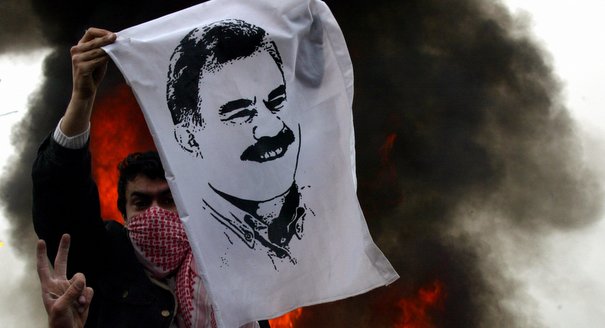
Three murders in Paris underscore the obstacles in the way of a Turkish-Kurdish settlement.
Source: New York Times

Neither the killers nor the motive in the deaths of the three women, all associated with the P.K.K., are known at this stage. But the murders were most likely an attempt to sabotage the talks.
The recently initiated negotiations involving Abdullah Ocalan, the imprisoned leader of the P.K.K., and Hakan Fidan, the head of Turkey’s intelligence services, are to address some of the main demands of the Kurds in return for a cease-fire in the P.K.K.’s long guerrilla war against the Turkish authorities, followed by the disarmament of the P.K.K. and eventually its repudiation of armed violence.Turkey’s large Kurdish minority has long chafed under restrictions on its culture and language, including the lack of public education in Kurdish or the inability to use Kurdish in official dealings and courts. Some Kurds seek more autonomy for Kurdish-dominated areas in southeastern Turkey; most want a lowering of the 10 percent threshold for political parties to enter Parliament, which Kurdish parties cannot achieve. These requests have so far proved to be anathema to Turkey’s rulers, who fear that moves in this direction could unravel national unity.
The P.K.K. was formed in 1978 and in the 1980s resorted to armed violence, leaving little room for a political settlement.
The latest attempt at one was prompted by the civil war in neighboring Syria, which has also fed Kurdish national ambitions. In Ankara’s view, a settlement with the Kurds in Turkey would safeguard the country from the ethnic turbulence in Syria, and would strengthen Turkey’s regional authority.
The Turkish leadership, however, is not certain that Ocalan will be able to convince others leaders and members of the P.K.K. to abandon the armed struggle. The historical analogy with Northern Ireland, where a cease-fire by the I.R.A. in 1997 led militants to break away and form the “Real I.R.A.,” which continues to wage a terror campaign, fuels the skepticism.
For his part, Ocalan also must have doubts that the Turkish government is interested in anything more than the disarmament of the P.K.K.
To overcome this mutual distrust, the negotiations are supposed to produce a road map with a progression of confidence-building measures. Each side will be expected to implement specific measures before they proceed to the next step. The idea is to start with easier step and to move toward more difficult ones as confidence grows.
For instance, as a first move the Turkish government is expected to pass a judicial reform package that decriminalizes all nonterror political activities, thus leading to the freeing of several hundred Kurdish activists from prison. More difficult and politically sensitive measures, such as the total disarmament of the P.K.K. or the improvement of Ocalan’s own conditions of imprisonment on a Turkish island, would be tackled later.
The question is whether Turkey’s body politic would allow the process to proceed in the face of more attempts to derail it. The P.K.K. has often been used in the past by Turkey’s regional foes as an instrument to contain Ankara’s influence. In the 1990s, President Hafez al-Assad of Syria harbored Ocalan and the P.K.K.’s armed fighters. Tehran has also been occasionally accused by the Turkish authorities of engaging in similarly unfriendly practices. There is every reason to believe that there will more efforts by forces fearful of Turkey’s growing regional influence to encourage the extremist wing of the P.K.K. to sabotage the peace process.
But there are also grounds for optimism.
This time around, other domestic political groups, including the Kurdish Peace and Democracy Party (B.D.P.) and the main Turkish opposition party in Parliament, the Republican People’s Party (C.H.P.), have demonstrated a sense of responsibility. The B.D.P. leadership is willing to act as a facilitator for the talks and C.H.P. has given its clear support to the government for the negotiations.
More can and should be done. In particular, Turkey’s friends and allies abroad should focus their efforts on helping Turkey’s political leaders resist any inclination to leave the negotiating table before a settlement is reached.

Senior Fellow, Carnegie Europe
Sinan Ülgen is a senior fellow at Carnegie Europe in Brussels, where his research focuses on Turkish foreign policy, transatlantic relations, international trade, economic security, and digital policy.
Recent Work

Alper Coşkun, Fatih Ceylan, Tacan İldem, …
Carnegie does not take institutional positions on public policy issues; the views represented herein are those of the author(s) and do not necessarily reflect the views of Carnegie, its staff, or its trustees.

The European far right might fail to steer EU policy in the direction Russia wants, but they will create enough chaos inside Europe to benefit the Kremlin.

Dimitar Bechev

If the Russian-speaking community in Latvia cannot articulate their interests without being seen as disloyal, they could end up embracing a pro-Kremlin agenda.

Sergejs Potapkins

Russia’s ruling party would have benefited from Putin appearing as its distant patron, but as an active frontman imposing his views on the public, he has done nothing but harm both the party’s election campaign and the ruling system overall.

Andrey Pertsev

In the tenth year of his presidency, President Mirziyoyev’s system is becoming even more personalized than that of his predecessor Karimov.

Galiya Ibragimova

The greater threat to Zelensky comes not from Fedorov alone, but from the convergence between the former defense minister’s political campaign and the anti-corruption investigations moving ever closer to the presidential administration.

Balázs Jarábik