

Commentary
Thomas de Waal
{
  "authors": [
    "Thomas de Waal"
  ],
  "type": "legacyinthemedia",
  "centerAffiliationAll": "dc",
  "centers": [
    "Carnegie Endowment for International Peace",
    "Carnegie Europe"
  ],
  "collections": [],
  "englishNewsletterAll": "ctw",
  "nonEnglishNewsletterAll": "",
  "primaryCenter": "Carnegie Europe",
  "programAffiliation": "russia",
  "programs": [
    "Russia and Eurasia"
  ],
  "projects": [],
  "regions": [
    "Caucasus",
    "Azerbaijan",
    "Armenia"
  ],
  "topics": [
    "Political Reform",
    "Security"
  ]
}
Source: Getty
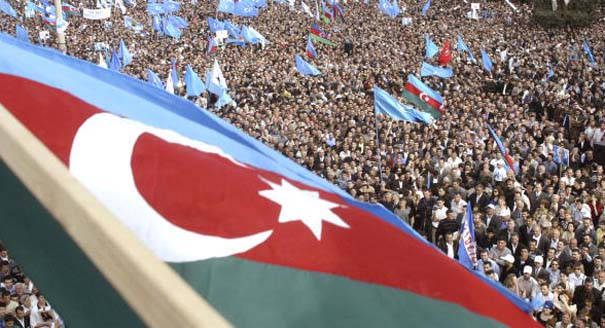
The situation in the South Caucasus continues to be perilous as leaders of both Armenia and Azerbaijan find themselves increasingly boxed in by domestic political constraints.
Source: Voice of America
Speaking on Voice of America Armenian Service, Carnegie's Thomas de Waal explained that February has brought added tension to the South Caucasus as both Armenia and Azerbaijan continue to politicize the anniversaries of the Sumgait 1988 pogrom and the Khojali 1992 massacre, respectively. The two states have increasingly less room to maneuver as domestic political developments have constrained the leadership in Baku and Yerevan.
In Azerbaijan, he explained, an economic slowdown after years of strong growth has left the government feeling increasingly insecure even before a series of protests unfolded in January. In Armenia, although the hotly contested presidential election between Serzh Sargsyan and Raffi Hovannisian has been deemed satisfactory by most observers, president Sargsyan will have to deal with many potentially destabilizing domestic political trends.De Waal argued that if a planned direct air connection between Yerevan and Nagorny Karabakh goes ahead, it is likely to provoke an Azerbaijani response, with unpredictable consequences. Moreover, he added, the opposition presidential candidate, Raffi Hovannisian, continues to champion the idea of recognition of Nagorny Karabakh by Yerevan which, if it went ahead, would probably spell the end of the Minsk Peace Process.
Within this increasingly unpropitious climate, de Waal concluded, Akram Aylisli's novel which portrays Armenians in a sympathetic light, Stone Dreams, has unfortunately been the catalyst for recrimination in Azerbaijan rather than enhanced dialogue.
The interview was originally broadcast on Voice of America Armenian Service.

Senior Fellow, Carnegie Europe
Thomas de Waal is a senior fellow at Carnegie Europe, specializing in Eastern Europe and the Caucasus.
Recent Work
Thomas de Waal
Thomas de Waal
Carnegie does not take institutional positions on public policy issues; the views represented herein are those of the author(s) and do not necessarily reflect the views of Carnegie, its staff, or its trustees.

Sergei Kiriyenko used Russia’s parliamentary vote to further hone his strategy of corporate mobilization that is designed to maximize votes for United Russia.

Andrey Pertsev

The European far right might fail to steer EU policy in the direction Russia wants, but they will create enough chaos inside Europe to benefit the Kremlin.

Dimitar Bechev

If the Russian-speaking community in Latvia cannot articulate their interests without being seen as disloyal, they could end up embracing a pro-Kremlin agenda.

Sergejs Potapkins

Russia’s ruling party would have benefited from Putin appearing as its distant patron, but as an active frontman imposing his views on the public, he has done nothing but harm both the party’s election campaign and the ruling system overall.
Andrey Pertsev

In the tenth year of his presidency, President Mirziyoyev’s system is becoming even more personalized than that of his predecessor Karimov.

Galiya Ibragimova