

Paper
Lora Saalman
{
  "authors": [
    "Lora Saalman"
  ],
  "type": "legacyinthemedia",
  "centerAffiliationAll": "",
  "centers": [
    "Carnegie Endowment for International Peace",
    "Carnegie China"
  ],
  "collections": [
    "China’s Foreign Relations"
  ],
  "englishNewsletterAll": "",
  "nonEnglishNewsletterAll": "",
  "primaryCenter": "Carnegie Endowment for International Peace",
  "programAffiliation": "",
  "programs": [],
  "projects": [],
  "regions": [
    "South Asia",
    "India",
    "East Asia",
    "China"
  ],
  "topics": [
    "Security",
    "Foreign Policy"
  ]
}
Source: Getty
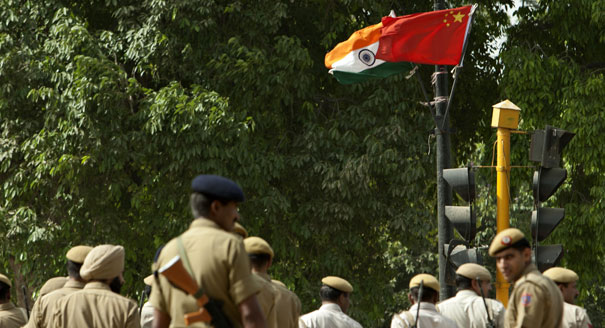
China and India have long-standing unresolved border issues but the Indian media too often acts to further inflame tensions by over-hyping the situation.
Source: Global Times
Among the issues impacting Indian External Affairs Minister Salman Khurshid's visit to Beijing and Chinese Premier Li Keqiang's visit to India over the past few weeks, the recent Ladakh incident loomed large.
It all started with a few tents. Then, in a few days, it developed into a media firestorm in India. Television and print reports began to spin tales of a fire-breathing "dragon" and a political party too weak to slay it.
While the border issue was largely put aside in bilateral high-level meetings between the two countries, this 21-day standoff led Chinese and Indian soldiers to stand, as reporters in India put it, "eyeball-to-eyeball," and once again cast a light on lingering tensions and allegations of coercive diplomacy in Sino-Indian relations.
Yet, a more direct light needs to be shone on the role of media, in particular Indian media, in complicating bilateral ties.What became most apparent from the intensity of coverage was the unfettered media access at the border.
Ladakh, once tightly controlled with permits and passes, had its floodgates opened. Photo montages, shown again and again, fueled sensationalist reports on the assumed grand strategy of China's government to test Indian mettle and resolve the border issue in Beijing's favor.
Despite indications that the Indian government had sought over the past few years to stem information leaks about the border that could fuel media frenzy, this time its reporters had full access. There are competing potential reasons behind this shift. For the opposition party, media criticism of government weakness on Ladakh offered fodder for India's upcoming elections. For the ruling party, these reports distracted attention from corruption scandals involving railway ministers and rape cases.
Regardless of the motivations, there have been suggestions that the Indian media spurred its government to act and served as an information source in an opaque environment. This characterization, however, needs to be carefully assessed. There is a case to be made for the ability of the media to pressure the government into taking a stronger stand, but there are costs to such an approach. Media reports rapidly crossed from fact into speculation and spin.
Calls for military action against an aggressive China were not uncommon in Indian media coverage during the crisis. These statements do damage to views of bilateral relations not only within India's domestic populace, but also within that of China.
While the Chinese media tended to downplay the Ladakh incident, in doing so they instead recounted Indian reports.
Extreme views soon filtered their way into a young Chinese netizen community still forming its views on India.
The peaceful resolution of the Ladakh incident was a triumph of political and military diplomacy, not media brinkmanship.
The measured tone of both governments may not have been what the media sought, but it allowed both sides to withdraw in parallel and relatively quickly.
Through flag meetings and official channels, combined with setting up tents across from those of the Chinese military, the Indian military made full use of crisis-management mechanisms.
By applying leverage to pending reciprocal visits, Indian politicians used diplomatic pressure without rupturing ties. This balanced approach occurred in spite of Indian media sensationalism, not because of it.
This is not to say that media does not have a role to play in informing the public and allowing for vigorous debate. But serious questions remain when reporting is not only intemperate, but also wrong.
Out of dozens of interviews conducted during my visit to India during the Ladakh incident, only one newspaper used accurate quotations and comments from our exchange. This hardly bodes well for the veracity and integrity of reporting on something as prone to bias as the border issue.
After recent high-level visits between India and China, hopefully both sides can take a step back from the "coercive diplomacy" that seems to be driven not so much by government or military, but rather by the media.
This article was originally published by Global Times as part of feature offering contrary perspectives. Read Binod Singh's opposing take on the Global Times.

Former Nonresident Associate, Nuclear Policy Program
Saalman was a nonresident associate in the Nuclear Policy Program at the Carnegie Endowment for International Peace. Her research focuses on China’s nuclear and strategic policies toward India, Russia, and arms control.
Recent Work
Lora Saalman
Lora Saalman
Carnegie does not take institutional positions on public policy issues; the views represented herein are those of the author(s) and do not necessarily reflect the views of Carnegie, its staff, or its trustees.

Cargo traffic through Russia’s Northern Sea Route has increased because of the disruption caused by the conflict in the Middle East, the Ukraine war, and U.S.-China tensions.

Mikhail Korostikov

The European far right might fail to steer EU policy in the direction Russia wants, but they will create enough chaos inside Europe to benefit the Kremlin.

Dimitar Bechev

Minsk clearly expected the dialogue with Washington to yield more results, in particular the lifting of EU sanctions and permission to export potash.

Artyom Shraibman

With the growth in points of friction between the great powers, organizations like the SCO will continue to play a role in the strategic adaptation of the smaller powers caught between them.

Temur Umarov

When faced with fuel shortages in the past, Central Asian governments could always count on additional supplies from Moscow. That safety net no longer exists.

Galiya Ibragimova