

Research
- +10
Rosa Balfour, Frances Z. Brown, Yasmine Farouk, …
{
  "authors": [
    "Moisés Naím"
  ],
  "type": "legacyinthemedia",
  "centerAffiliationAll": "",
  "centers": [
    "Carnegie Endowment for International Peace"
  ],
  "collections": [],
  "englishNewsletterAll": "",
  "nonEnglishNewsletterAll": "",
  "primaryCenter": "Carnegie Endowment for International Peace",
  "programAffiliation": "",
  "programs": [],
  "projects": [],
  "regions": [
    "North America"
  ],
  "topics": [
    "Political Reform",
    "Economy",
    "Global Governance"
  ]
}
Source: Getty
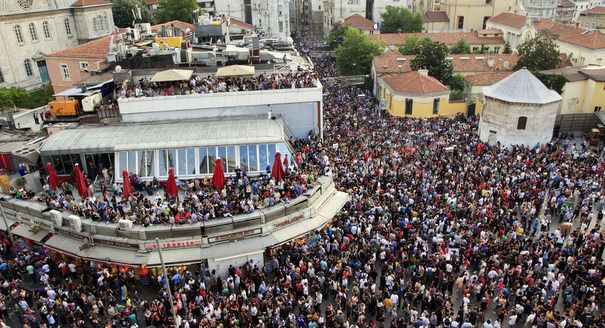
The “hyper-connecting” of the world has led to a profusion of people, countries, and institutions. However, this has come at the expense of those who held a high concentration of power.
Source: NYT Conferences
Speaking to Thomas Friedman of the New York Times, Carnegie’s Moisés Naím explained that the “hyper-connecting” of the world has led to a profusion of people, countries, and institutions. Today, more people are living in cities than on farms, as urbanization has grown faster than ever before. Moreover, the planet’s population is the youngest it has ever been. Tourism reached the 1 billion mark, with people moving from one country to another 37 percent more than a decade ago. Naím argued that this profusion has led to the erosion of the power of the most influential institutions, bosses, and leaders. In order to have power, an actor needs to have something special to shield it from competitors. The more, mobility, and mentality revolutions are challenging those in power, and all barriers are being undermined by them, asserted Naím.
Recent social movements have further challenged the legitimacy of these high power- yielding institutions. The movements have been successful in disrupting the current system, but have not been successful in organizing a solution. All of these widespread movements have a number of grievances—including quality of life, quality of housing, and inequality. These are all challenges that are very difficult to address immediately by an action-oriented political movement, Naím concluded.

Distinguished Fellow
Moisés Naím is a distinguished fellow at the Carnegie Endowment for International Peace, a best-selling author, and an internationally syndicated columnist.
Recent Work



Rosa Balfour, Frances Z. Brown, Yasmine Farouk, …
Moisés Naím
Carnegie does not take institutional positions on public policy issues; the views represented herein are those of the author(s) and do not necessarily reflect the views of Carnegie, its staff, or its trustees.

The demands of the Kremlin’s war in Ukraine, demographic problems, and public hostility toward Central Asians mean Russia does not have enough workers.
Salavat Abylkalikov

Minsk’s faith in the future of its larger neighbor’s economy is fading as Belarusian firms in Russia see record losses.

Olga Loiko
With no key agreement signed on the Power of Siberia 2 gas pipeline, there is a risk that the window of opportunity for Russia will close if Chinese power generation becomes so green that new gas sources are no longer of any interest to Beijing.

Alexander Gabuev

Though Orban is gone, Putin can still count on some like-minded individuals in Central and Eastern Europe. However, they will seek to avoid open confrontation with EU institutions over Ukraine and their ties with Moscow.

Dimitar Bechev

The truth is that Japan’s government is seeking a degree of reengagement but at a vastly reduced level than under Abe. Most significantly, Japan has shown no willingness to ease sanctions.

James D.J. Brown