

Article
C. Raja Mohan, Darshana M. Baruah
{
  "authors": [
    "C. Raja Mohan"
  ],
  "type": "legacyinthemedia",
  "centerAffiliationAll": "dc",
  "centers": [
    "Carnegie Endowment for International Peace",
    "Carnegie China",
    "Carnegie India",
    "Carnegie Russia Eurasia Center"
  ],
  "collections": [
    "China’s Foreign Relations"
  ],
  "englishNewsletterAll": "ctw",
  "nonEnglishNewsletterAll": "",
  "primaryCenter": "Carnegie India",
  "programAffiliation": "SAP",
  "programs": [
    "South Asia"
  ],
  "projects": [],
  "regions": [
    "South Asia",
    "India",
    "East Asia",
    "South Korea",
    "China",
    "Japan"
  ],
  "topics": [
    "Security",
    "Military",
    "Arms Control"
  ]
}
Source: Getty
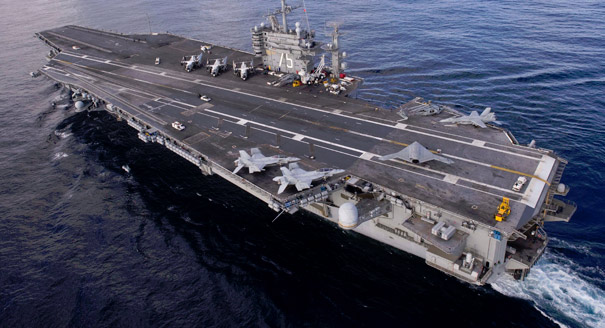
As India celebrates the launch of the Vikrant, the much delayed first indigenous aircraft carrier, Delhi is not the only one in Asia focused on the virtues of airpower at sea.
Source: Indian Express
As it celebrates the launch this week of the Vikrant, the much delayed first indigenous aircraft carrier, India is not the only one in Asia focused on the virtues of airpower at sea. While the Western powers are struggling to maintain their existing aircraft carriers, leading Asian nations are investing, big time, in naval aviation. The residual European capabilities for carrier design and construction are actively feeding into Asian warship-building.
India also plans to build a larger second indigenous aircraft carrier in the coming years. Meanwhile, it has begun the sea trials of the long awaited Vikramaditya, the carrier acquired from Russia (the Gorshkov). By the end of the next decade, the Indian navy should be close to realising the dream of operating three carriers. But India, the first Asian country to acquire an aircraft carrier after World War II, will no longer have monopoly over naval airpower in the region.
China, Japan, Russia, Korea and Australia are all beefing up airpower capabilities at sea. Aircraft carriers were, until recently, the symbol of American naval primacy in Asia. But airpower at sea is now integral to the regional military balance in Asia. As the naval ambitions of the regional powers intersect in the Indo-Pacific, there will be much jockeying for positions of advantage in the waters of Asia.Beijing's anxieties about the expanding naval capabilities of Japan and India are mirrored by New Delhi's concerns about the rising Chinese naval presence in the Indian Ocean. Future maritime balance in Asia will be shaped not just by the individual capabilities of Asian powers, but the kind of alignments they might generate among themselves and with the United States.
China, which is building a powerful blue water navy, commissioned its first aircraft carrier, the Liaoning, last year. Like the Vikramaditya, the Liaoning is a refurbished version of a carrier built in the Soviet Union many years ago. Like India, China has plans to have more than one carrier and is building an indigenous carrier of its own. Reports also suggest that a nuclear powered aircraft carrier may be on Beijing's drawing board.
Meanwhile, Japan and South Korea are boosting naval aviation. Both operate helicopter carriers. Japan had commissioned two powerful Hyuga-class destroyers carrying helicopters in 2009 and 2011. Korea has one helicopter carrier called Dokdo in operation since 2005 and is building a second one. Russia too is constructing a helicopter carrier, named Vladivostok, in collaboration with France. If it does join the Russian Pacific fleet, it will underline Moscow's new determination to strengthen its naval power in the waters of Asia. Australia is building two helicopter carriers, Canberra and Adelaide, which are expected to be commissioned in the next few years.
The helicopter carriers may not have the profile of their muscular cousins, but will have a profound impact on the Asian maritime security environment.
Japan's commissioning of a third helicopter carrier, the Izumo, last week has created a flutter in East Asia. The Izumo is much larger than the two Hyuga-class destroyers and, at 24,000 tonnes, is the biggest ship now in the Japanese navy. Japan says the Izumo's tasks include disaster relief and the rescue of its overseas nationals trapped in crises. China, however, is not impressed by the humanitarian justification for the Izumo. Chinese analysts have called the Izumo an "aircraft carrier in disguise" and believe is meant for power projection. In a formal statement, China's defence ministry called on Tokyo to reflect on its imperial history and limit itself to self-defence.
Given the enduring memories of Japan's colonial occupation, some in Asia are deeply concerned about the resurgence of Japanese nationalism and its attempt to break out of the political constraints of the post-war pacifist constitution. For the current leadership of Japan, though, the logic is different. Facing a rising China and concerned about the growing reluctance of its only ally, the US, to be drawn into Tokyo's conflicts with Beijing, Japan may have no choice but to tone of up its military muscle.
Not everyone in Asia, however, is worried about Japan. Some are looking for Japanese military support to counter Chinese assertiveness. Vietnam and the Philippines, two countries that came under Japanese colonialism, are now eagerly seeking greater naval cooperation with Tokyo.
This article was originally published in the Indian Express.
Former Nonresident Senior Fellow, Carnegie India
A leading analyst of India’s foreign policy, Mohan is also an expert on South Asian security, great-power relations in Asia, and arms control.
Recent Work

C. Raja Mohan, Darshana M. Baruah


Alexander Gabuev, Paul Haenle, C. Raja Mohan, …
Carnegie does not take institutional positions on public policy issues; the views represented herein are those of the author(s) and do not necessarily reflect the views of Carnegie, its staff, or its trustees.

The European far right might fail to steer EU policy in the direction Russia wants, but they will create enough chaos inside Europe to benefit the Kremlin.

Dimitar Bechev

With the growth in points of friction between the great powers, organizations like the SCO will continue to play a role in the strategic adaptation of the smaller powers caught between them.

Temur Umarov

Two divergent trends—Putin’s hardline vision of how to prosecute the war in Ukraine, and a growing desire for change in Russia—could tear the regime apart.

Tatiana Stanovaya

Andrey Melnichenko’s essay offers no answer to the fundamental question of how, under any kind of negotiated settlement, Europe can protect itself from the Russian ressentiment that is inevitable in all scenarios except for an outright victory for Putin.

Leonid Bershidsky
The recent damage inflicted by Ukrainian drones and missiles on Russia has made Belarus aware of its own vulnerabilities—and surprisingly amenable to Kyiv’s demands.

Artyom Shraibman