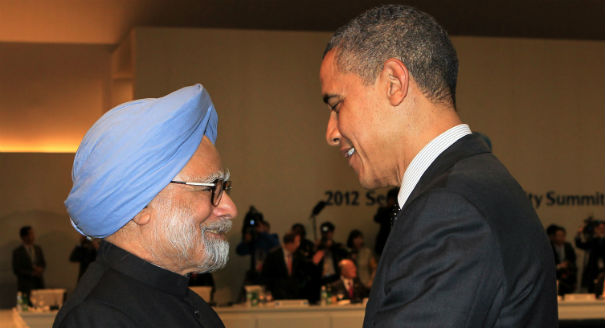
Source: Indian Express
If you compare Prime Minister Manmohan Singh's trip to America this week with that of his predecessor Atal Bihari Vajpayee 15 years ago, a paradox stares at you. India's economic weight and political standing in the world have risen remarkably over the last decade and a half. Yet, Singh's diplomacy looks listless while that of Vajpayee radiated energy. Representing India at one of its most difficult moments, Vajpayee thought big and acted boldly to pull India out of a tricky diplomatic corner and alter the terms of its global engagement. Singh, who speaks for a much stronger India, appears irresolute.
In September 1998, Vajpayee arrived at the United Nations in New York to a hostile international audience, thanks to the five nuclear tests he had conducted four months earlier in May. In response, the UN Security Council passed a resolution condemning the nuclear tests of India and Pakistan (which had followed a few weeks later), and demanding that the two countries roll back their nuclear and missile programs.
Tensions with Pakistan were boiling over and there was a growing international perception that Jammu and Kashmir was the "world's most dangerous nuclear flashpoint." Any number of world leaders, from America's Bill Clinton to South Africa's Nelson Mandela, thought a forced mediation between India and Pakistan on Kashmir might be a good idea. Unlike Singh, Vajpayee was not invited to visit Washington. The U.S. had imposed a range of nuclear sanctions against India in May 1998 and pressed Europe and Japan to intensify the economic pressure on India. Walking into this minefield, Vajpayee did two important things.
One was to leverage the shock of the nuclear tests to turn the ties with the U.S. on their head. In New York, Vajpayee declared India and the U.S. are "natural allies". After the nuclear defiance of the U.S., Vajpayee was inviting Washington to a strategic re-imagination of bilateral relations. Vajpayee's thesis offended not just the Left and sections of the Congress party, but also a large number of nativists in the BJP long reared on a diet of anti-Americanism. Foreign policy pundits were apoplectic at Vajpayee's heresy against the canon of non-alignment. It was Vajpayee's departure from received wisdom that opened the door to U.S. support for ending India's nuclear isolation, American neutrality on Kashmir, expanded bilateral defense cooperation and Washington's endorsement of a stronger Indian role on the global stage.
As he reordered ties with America, Vajpayee also confronted head-on the more complex relationship with Pakistan at a moment when cross-border terrorism was at its peak. In New York, Vajpayee sat down with his Pakistani counterpart, Nawaz Sharif, and announced the launch of what was then called "composite and integrated dialogue" with Islamabad. Vajpayee broke the long-standing taboo on talking to Pakistan about Kashmir and took the first steps towards expanding people-to-people contact between the two nations, including a decision on starting a bus service between Delhi and Lahore. India's bilateral talks with Pakistan took much of the international heat off on the Kashmir question.
Since 1998, there have been many twists and turns in India-Pakistan relations, including the Kargil War, the attack on Parliament in December 2001, and the outrageous terror assaults on Mumbai, including the one in November 2008. Yet, Vajpayee sought to sustain the peace process against all odds, for he recognized that limiting tensions with Pakistan is in India's own interest.
History will record that Singh eagerly embraced Vajpayee's legacy on the U.S. and Pakistan. He understood that the restructuring of relations with the U.S. and a careful management of those with Pakistan were a critical part of India's advancement on the regional and global stage. Singh took Vajpayee's atomic engagement with America to its logical conclusion—the integration of India into the global nuclear order. Singh pursued the dialogue with Pakistan under turbulent conditions, negotiated a framework for the resolution of the Kashmir dispute, came close to signing accords on the Siachen and Sir Creek disputes, expanded people-to-people contact, and worked out a roadmap for normalising trade relations.
Despite Singh's conviction and commitment to these two relationships, there is no escaping the strange defensiveness that has crept into Delhi's current approach to Washington and Islamabad. The Congress was never too enthusiastic about ties with the U.S. The risk-averse party is also opposed to any bold initiatives towards Pakistan. As a result, the pace of engagement with the U.S. has slowed, and even the simple question of the PM meeting Sharif has become contentious.
This week in Washington and New York, Singh has an opportunity to inject fresh momentum in the engagements with America and Pakistan. The PM's conversations with U.S. President Barack Obama and Pakistan PM Sharif should not be about negotiating the nitty-gritty. They should be about reaffirming the political will in Delhi to deepen the strategic partnership with the U.S. and to pursue normalization of relations with Pakistan.
While there are many issues to be sorted out with both, India is in a much better position with the U.S. and Pakistan than the one Vajpayee found himself in. What is missing is the self-confidence that marked Vajpayee's bold outreach to the U.S. and Pakistan in 1998. Singh's trip to America will show if there is any political energy left in the UPA government for purposeful international engagement. If the answer is in the negative, the rest of the world will simply wait for stronger leadership to re-emerge in Delhi. India might pay a price for the wasted moments, but the ruling party may not much care, having grown rather comfortable with a do-nothing foreign policy.