

Commentary
Dmitri Trenin
{
  "authors": [
    "Dmitri Trenin"
  ],
  "type": "legacyinthemedia",
  "centerAffiliationAll": "",
  "centers": [
    "Carnegie Endowment for International Peace",
    "Malcolm H. Kerr Carnegie Middle East Center",
    "Carnegie Russia Eurasia Center"
  ],
  "collections": [],
  "englishNewsletterAll": "",
  "nonEnglishNewsletterAll": "",
  "primaryCenter": "Carnegie Russia Eurasia Center",
  "programAffiliation": "",
  "programs": [],
  "projects": [
    "Eurasia in Transition"
  ],
  "regions": [
    "Levant",
    "Middle East",
    "Syria"
  ],
  "topics": [
    "Security",
    "Foreign Policy",
    "Global Governance"
  ]
}
Source: Getty
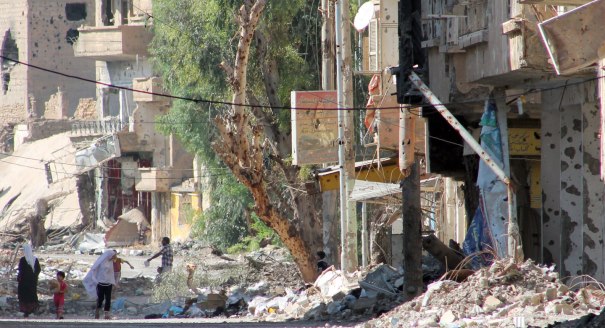
A strike against the Syrian government continues to look likely. What is less certain is what kind of strike, with what aims and what sort of strategy, and whether such a strike would put the Syrian conflict onto a truly regional level.
Source: Global Times
US President Barack Obama's staying order, announced on August 31, does not mean stepping back from war. With or without congressional backing, Obama is determined to punish Bashar al-Assad's regime for its alleged use of chemical weapons.
Washington has no intention to seek a UN Security Council mandate, which it will not get anyway due to the position taken by Russia and China. Thus a strike against the Syrian government and military targets continues to look likely. What is less certain is what kind of strike, with what aims and what sort of strategy.
Virtually everyone in the US excludes the possibility of an Iraq-style ground invasion followed by a military occupation of Syria.Obama has talked about a limited campaign. Pentagon planners are said to be looking at cruise missiles based on US ships in the eastern Mediterranean and at US aircraft stationed in Turkey. These could destroy a range of Syrian targets even without entering the country's airspace or risking a single American life. Some experts suggest, for example, totally knocking out the Syrian air force.
Save for the very important support from Hezbollah, Assad will be fighting alone. Moscow has recently decided to put off the delivery of fighter aircraft to Syria, and even before that had put on hold the transfer of the highly effective S-300 air defense system.
All his many disagreements with the US notwithstanding, Russian President Vladimir Putin does not want a head-on confrontation with Washington. Neither Iran nor Hezbollah are expected to launch attacks against US targets or Israel in response to the US limited strike.
The problem with this limited option is that it will not necessarily lead to regime change in Damascus.
Obama has said the US does not seek the toppling of the Assad regime by military means, but this sounds disingenuous, since Assad's removal has been Washington's precise goal in Syria for a long time.
A slap on the wrist that leaves Assad in power and does not turn the tide on the battlefield in favor of the opposition would strengthen Damascus, and expose Obama as a paper tiger.
Obama's limited approach is dictated by his own political limitations. However, once the US actually uses force against Syria, a different strategic logic will start dictating things. "Limited" strikes will have to be repeated to become militarily meaningful.
The scenario Obama has presented to the world looks like then US president Bill Clinton's 1998 strikes against Iraq, but the reality may be that of an incremental, yet steady escalation of Vietnam-style US involvement.
If this eventual US military strategy in Syria appears risky, the political strategy is even more problematic. Getting rid of Assad may be difficult, but it is the easiest of the tasks facing Washington in Syria.
Syria has been divided into many enclaves, ruled by forces deeply hostile to one another. Whatever happens to Assad, the Iranian connection to Syria's Alawites and, more importantly, Lebanon's Hezbollah is unlikely to wither away.
As to Assad's foes, some of them, allied to Al Qaeda, are much more dangerous to the US and its interests than the current Syrian government has ever been.
In a conflict increasingly dominated by the Shia coalition of the Alawites and Hezbollah on the one hand, and the Sunni allies and affiliates of Al Qaeda on the other, making sure that a pro-Western secular and democratic force emerges as the winner will be tough.
Obama's "red line" rhetoric was not directed at Syria alone, but equally, or even more, at Iran. The recent election of Hassan Rouhani as Iran's president has opened a fresh opportunity for dialogue between Washington and Tehran.
A direct US intervention in Syria, where Iran has important interests, may limit or even foreclose that option.
Turning Syria into a war by proxy between the US- and Gulf-supported Sunni forces and the Shia-Alawite coalition backed by Iran would put the conflict onto a truly regional level.
There is no question that the use of chemical weapons, especially against innocent civilians, is a heinous crime. It stands to reason that those responsible for such a crime should answer for their actions.
However, an unconvincing case for swift punishment, either leaving the presumed perpetrators in place, only slightly bruised, or inviting the US to join a sectarian war in a Muslim country, should be dismissed.
Instead, establishing the truth about the attack should be the first step in the search for a political settlement in Syria. Pushing back another Geneva conference proudly announced by the US and Russia last May will only result in many more casualties in Syria. For the victims, whether they die by chemical or conventional weapons makes little difference.
Former Director, Carnegie Moscow Center
Trenin was director of the Carnegie Moscow Center from 2008 to early 2022.
Recent Work
Dmitri Trenin
Dmitri Trenin
Carnegie does not take institutional positions on public policy issues; the views represented herein are those of the author(s) and do not necessarily reflect the views of Carnegie, its staff, or its trustees.

When faced with fuel shortages in the past, Central Asian governments could always count on additional supplies from Moscow. That safety net no longer exists.

Galiya Ibragimova

Two divergent trends—Putin’s hardline vision of how to prosecute the war in Ukraine, and a growing desire for change in Russia—could tear the regime apart.

Tatiana Stanovaya

Andrey Melnichenko’s essay offers no answer to the fundamental question of how, under any kind of negotiated settlement, Europe can protect itself from the Russian ressentiment that is inevitable in all scenarios except for an outright victory for Putin.

Leonid Bershidsky

Despite unhappiness on the ground, Moscow is determined to use both carrot and stick to ensure there is record support for United Russia in occupied Ukraine.

Konstantin Skorkin
The recent damage inflicted by Ukrainian drones and missiles on Russia has made Belarus aware of its own vulnerabilities—and surprisingly amenable to Kyiv’s demands.

Artyom Shraibman