

Report
- +3
James M. Acton, Alexey Arbatov, Vladimir Dvorkin, …
{
  "authors": [
    "Petr Topychkanov"
  ],
  "type": "commentary",
  "centerAffiliationAll": "",
  "centers": [
    "Carnegie Endowment for International Peace",
    "Carnegie Russia Eurasia Center"
  ],
  "collections": [],
  "englishNewsletterAll": "",
  "nonEnglishNewsletterAll": "",
  "primaryCenter": "Carnegie Russia Eurasia Center",
  "programAffiliation": "",
  "programs": [],
  "projects": [],
  "regions": [
    "Russia"
  ],
  "topics": [
    "Political Reform",
    "Civil Society"
  ]
}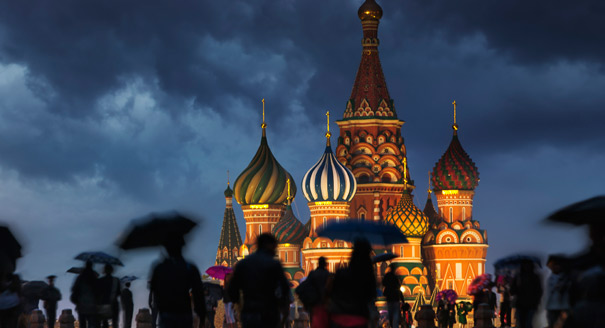
Source: Getty
There is no need to invent a special day like the National Unity Day for strengthening national identity, because one day in a year cannot change people's vision of their nation. This is an everyday job for the citizens at all levels of Russian society.
If the authorities have decided to invent the National Unity Day, it can mean that they believe in the need for special activities in the field of nation-building.
As it usually happens in Russia, the idea is correct, but its realization is poor. A special day, dedicated to the national unity, looks like the Women’s Day on March 8, when many Russian men buy flowers and gifts for their women. The question is whether there is a need for a special day to buy flowers for your woman? Of course, there is none. It can be done as often as you want.
The same can be said about the National Unity Day. There is no need to invent a special day for strengthening national identity, because one day in a year cannot change people's vision of their nation. This is an everyday job for the citizens at all levels of our society.
No doubt, the state has its own role. It has a lot of means of nation-building policy, including the state system of education, state museums and galleries, state-sponsored events, and so on.
I have not mentioned the armed forces and political parties, usually regarded as the instruments of nation-building policy, because the effectiveness of these instruments is not so evident.
The United Russia Party is a good example. Sometimes it seems that this party exists in a parallel reality, which has nothing to do with the Russian nation. Other parties do not differ a lot.
As for the army, it is a classic example of the nation-building instruments. The military history, the memories about heroes, the military service can help build the national identity. And they do this every day.
But there are a lot of problems in the armed forces today, which can destroy people's expectations, replacing their pride of their nation with disappointment. Unsuccessful launches of space rockets, widely discussed in our society, can prove this.
Even if the authorities learn how to use the nation-building instruments in a proper way, it does not mean that someday they will be able to state that their mission has been accomplished.
The nation-building is an infinite mission, firstly because of a change of generations, secondly because of the continuous development of the political environment, and thirdly because of an on-going cultural transformation of the society.
Former Fellow, Nonproliferation Program, Moscow Center
Topychkanov was a fellow in the Carnegie Moscow Center’s Nonproliferation Program.
Recent Work


James M. Acton, Alexey Arbatov, Vladimir Dvorkin, …
Petr Topychkanov
Carnegie does not take institutional positions on public policy issues; the views represented herein are those of the author(s) and do not necessarily reflect the views of Carnegie, its staff, or its trustees.

A leak of Russian gas price data helps establish that China is paying Russia far less than Central Asian countries and Gazprom’s former European customers.

Sergey Vakulenko

Japan’s long-term security policy is driven by concerns about China, and there is little appetite for (or interest in) pursuing a confrontation with Moscow.

James D.J. Brown

The truth of the strategic situation is that Europe and Russia are extremely unlikely to be able to “turn the page” on their confrontation within the next two decades.

Arkady Moshes

Russia spent years building a “sovereign internet,” concentrating web infrastructure exclusively within Russian territory. Ukrainian drone attacks have shown how vulnerable that approach has left the Russian internet.

Maria Kolomychenko

Putin’s conservative staffing policies and search for ever greater control have cemented parliament’s transformation into a bureaucratic appendage of the executive branch.

Andrey Pertsev