

Q&A
Dara Massicot, Aaron David Miller, Andrew S. Weiss
{
  "authors": [
    "Andrew S. Weiss"
  ],
  "type": "legacyinthemedia",
  "centerAffiliationAll": "dc",
  "centers": [
    "Carnegie Endowment for International Peace"
  ],
  "collections": [],
  "englishNewsletterAll": "ctw",
  "nonEnglishNewsletterAll": "",
  "primaryCenter": "Carnegie Endowment for International Peace",
  "programAffiliation": "russia",
  "programs": [
    "Russia and Eurasia"
  ],
  "projects": [],
  "regions": [
    "Russia",
    "Eastern Europe",
    "Ukraine"
  ],
  "topics": [
    "Foreign Policy"
  ]
}
Source: Getty
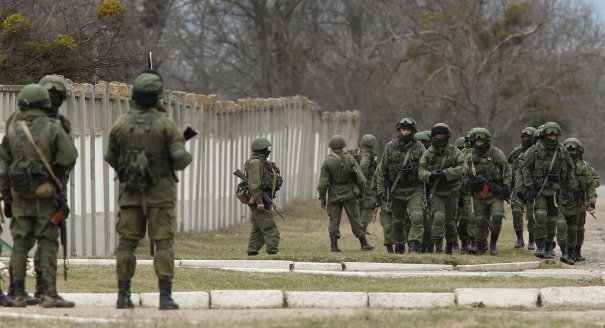
Russia’s actions in Crimea, which aim to make the region more autonomous from Kiev, have disrupted the status quo. The international community must recognize how dangerous this situation really is.
Source: NPR
MEGHNA CHAKRABARTI, HOST:
It's HERE AND NOW. Of the many questions looming in Ukraine, one of the biggest is: What are Russia's intentions toward Ukraine? Ukraine's new interior minister today accused Russia of, quote, "military invasion and occupation," saying that Russian troops have taken up positions at two airports and a coast guard base in the Ukrainian region of Crimea.
And yesterday, armed men overran the Crimean parliament and raised a Russian flag over the building. Russian President Vladimir Putin has remained largely silent about Ukraine, but ousted Ukrainian President Viktor Yanukovych, who's in Russia, spoke to reporters today, to insist that he is still the legitimate president, and that he intends to keep fighting for, quote, "Ukraine's future."
Yanukovych added that he was not calling for military intervention from his Russian hosts, but when asked about Russia's role in Ukraine, he said...
(SOUNDBITE OF SPEECH)
VIKTOR YANUKOVYCH: (Through translation) I think that Russia should and must act. Knowing the character of Vladimir Vladimirovich Putin, I am surprised why he is, until now, still so restrained and not talking. This is the question.
CHAKRABARTI: So another question there regarding Russia and Ukraine, Viktor Yanukovych there, of course, speaking through an interpreter. Andrew Weiss is vice president of the Carnegie Endowment for International Peace. He was also an advisor on Russia and Ukraine in the Clinton White House, and he joins us now. Andrew Weiss, welcome to the program.
ANDREW WEISS: Thanks so much for having me.
CHAKRABARTI: So, first of all, let's start with Viktor Yanukovych's press conference this morning. What did you make of it, and what kind of message do you think Yanukovych was trying to get out?
WEISS: It was a sad, pathetic spectacle. It really made one think that Baghdad Bob had re-emerged and was now based in the southern Russian city of Rostov-na-Donu. You have a person, in Yanukovych, who's basically completely yesterday's news. He was removed from power about a week ago. He had led, you know, a brutal crackdown on demonstrators in his capital city, and there he was today on TV, insisting that the bad stuff all happened after he signed an agreement with three European Union mediators and the opposition.
So it was - again, it was an exercise in political theater, and it was a pretty pathetic one, at that.
CHAKRABARTI: Interesting. Now, what did you make of that cut that we played? That while, you know, he's not saying that he's asking for Russia to act on the Ukraine, he's, quote, "surprised" that Vladimir Putin hasn't done anything yet.
WEISS: I think the, what would you say, the kabuki between the Russian leadership and Mr. Yanukovych is what's really interesting here. Putin has maintained a very conspicuous silence on events in Ukraine since the government was removed over the weekend. And at this point, the Russian official position is that Yanukovych remains the legitimate president and that the new government took power by a coup d'etat.
So the Russian government has not recognized the new government. They've withdrawn their ambassador. And what we've seen on the ground in Crimea over the past couple days are a very sort of chilling and interesting set of moves that seem to suggest - although there's no firm proof - that the Russian government is basically trying to cut off part of Ukraine's territory from the government in Kiev and say this part of Ukraine, the Crimea, is basically going to be autonomous.
They'll hold a referendum at the end of May that will somehow solidify that autonomous status - some of which is already part of the legal status of Crimea - and a cavalcade of prominent Russian politicians, including the famous nationalist leader Zhirinovsky, have arrived on the ground in Crimea.
So there's kind of an element of serious geopolitical drama and political theater, all of which is very dangerous. And I'll end here, because there are a lot more people in Ukraine today who have guns than there were a week ago. It's a very, very fluid situation.
CHAKRABARTI: Well, tell us then, remind us a little bit why Russia is particularly interested or focused on Crimea, and why so much of the uncertainty is there, I mean, beyond the fact that the majority - or at least, as I understand - the majority of the people living in the Crimean region are Russian-speaking.
WEISS: When I served in the Bush 41 administration and in the Clinton administration, some form of confrontation between Russia and Ukraine over Crimea was basically always the nightmare scenario. And now what we're seeing day in, day out are events unfolding, both very quickly and very dangerously, that give rise to those fears.
And what happened at the end of the Soviet period was that borders were all frozen in place, and this very weird state of affairs where Crimea - which is basically a Russian-dominated peninsula and home to Russia's Black Sea Fleet - was given to Ukraine sort of arbitrarily in the mid-'50s by the former Soviet leader Khrushchev.
And it was one of these very untidy, leftover pieces of the weirdness of how borders were drawn during the Soviet period. When the Soviet Union collapsed, the Ukrainian leadership actually thought the Russians were going to ask for it back, but then President Yeltsin basically took a pass, and a lot of steps were taken over the last 20 years to basically create an international regime around these borders and to basically say they're all screwy, but we're going to make them sacrosanct.
What's happening right now on the ground in Crimea seems to throw all of that out the window.
CHAKRABARTI: OK. So, since you spent so many years in the Clinton White House really focused on Russia and the Ukraine, help us think through, you know, what are the follow-on scenarios from what, as you said, basically the nightmare scenario we're seeing possibly unfolding in Crimea right now. I mean, what are Moscow's options?
WEISS: Moscow has plenty of options. I think the real problem is that the West has very few. So, the Ukrainian government is now rushing around, trying to find international support. It's a government which, in many ways, is just struggling to turn the lights on, having just named its interim government yesterday and getting ready for presidential elections at the end of May.
The U.S., the European governments are all expressing outrage and concern, but no one's about to about to go to war for Crimea, and no one's going to go to war to restore Ukraine's territorial integrity. The question is: Can we get both sides, or all three sides, to - if we understand there are people in Crimea who may be acting independently - to sort of back off and avoid further confrontation?
Ukraine nearly fell into civil war last week, we have to remember. The situation is incredibly delicate.
CHAKRABARTI: Well, tell us a little bit more about what levers the U.S. and the European Union, for example, have, because we know that in the past, you know, Russia, as you said, has many options, and it's used some of them. What was it, in 2006 and 2009, they went even so far as to shut off natural gas supplies to the Ukraine. I mean, what are the - I don't want to say corollary levers, but, you know, the areas of diplomatic push that the United States could use short of, you know, threatening any kind of military action? Not that we're - anyone's been saying that so far.
WEISS: You know, we haven't come to the point where the U.S. or the Europeans are going to take concrete actions. I think what we're really in a realm now is of diplomacy, and very careful multilateral diplomacy at that, looking at this problem and trying to find ways to take the temperature down.
Part of the predicate for this change of the status of Crimea is concern that the new government in Ukraine is going to be overly nationalistic, and is going to do things that sort of disadvantage the local Russian population. So there are plenty of steps that the new Ukrainian government could take to demonstrate that they don't intend to do anything of the kind, that they intend to be very pluralistic and very supportive of the different groups that live inside Ukraine.
And they could probably find a way to blur some of the differences about what Crimea's status is, mindful that their territorial integrity needs to be protected.
CHAKRABARTI: But at this point in time, in the last few seconds that we have, it doesn't sound like - that you're feeling terribly confident about what may happen in the next weeks or so.
WEISS: Every morning, I'm waking up and I'm seeing events that, you know, I didn't dream were going to come to pass. Right now I think this looks a lot like the Russian rush to the airport in Pristina, Kosovo, which was a very scary event at the end of the Balkan Wars. This is a very dangerous place. It's something that I hope that your listeners and that the international community are going to really focus on in the days ahead.
CHAKRABARTI: Well, Andrew Weiss is vice president of the Carnegie Endowment for International Peace, and was an advisor on Russia and Ukraine in the Clinton White House. Thanks so much for joining us. You're listening to HERE AND NOW.
This interview was originally broadcast on Seattle's KUOW NPR affiliate.
James Family Chair, Vice President for Studies
Andrew S. Weiss is the James Family Chair and vice president for studies at the Carnegie Endowment for International Peace, where he oversees research on Russia, Ukraine, and Eurasia. His graphic novel biography of Vladimir Putin, Accidental Czar: the Life and Lies of Vladimir Putin, was published by First Second/Macmillan in 2022.
Recent Work

Dara Massicot, Aaron David Miller, Andrew S. Weiss

Frances Z. Brown, Nate Reynolds, Priyal Singh, …
Carnegie does not take institutional positions on public policy issues; the views represented herein are those of the author(s) and do not necessarily reflect the views of Carnegie, its staff, or its trustees.

The European far right might fail to steer EU policy in the direction Russia wants, but they will create enough chaos inside Europe to benefit the Kremlin.

Dimitar Bechev

Minsk clearly expected the dialogue with Washington to yield more results, in particular the lifting of EU sanctions and permission to export potash.

Artyom Shraibman

If the Russian-speaking community in Latvia cannot articulate their interests without being seen as disloyal, they could end up embracing a pro-Kremlin agenda.

Sergejs Potapkins

Russia’s ruling party would have benefited from Putin appearing as its distant patron, but as an active frontman imposing his views on the public, he has done nothing but harm both the party’s election campaign and the ruling system overall.

Andrey Pertsev

Depleted financial reserves and a shrinking tax base mean it is no longer possible to simultaneously deliver high defense spending, price stability, and economic growth.

Alexandra Prokopenko