

In The Media
Vikram Nehru
{
  "authors": [
    "Vikram Nehru"
  ],
  "type": "legacyinthemedia",
  "centerAffiliationAll": "dc",
  "centers": [
    "Carnegie Endowment for International Peace",
    "Carnegie China"
  ],
  "collections": [
    "China’s Foreign Relations",
    "China and the Developing World"
  ],
  "englishNewsletterAll": "asia",
  "nonEnglishNewsletterAll": "",
  "primaryCenter": "Carnegie China",
  "programAffiliation": "AP",
  "programs": [
    "Asia"
  ],
  "projects": [],
  "regions": [
    "Southeast Asia"
  ],
  "topics": [
    "Global Governance",
    "Foreign Policy"
  ]
}
Source: Getty
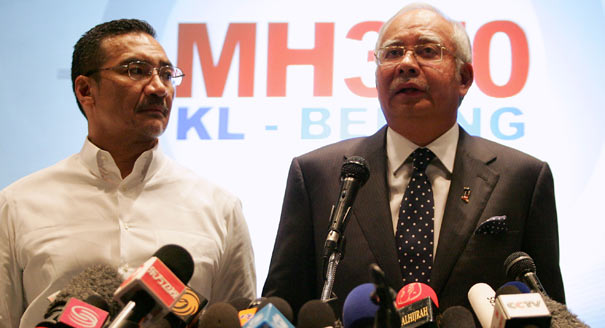
The mystery and confusion surrounding Malaysia Airlines Flight 370 have been the subject of intense scrutiny. The resulting portrait, of Malaysia specifically and Southeast Asia more generally, has revealed multiple deficiencies in credibility, capacity, cooperation, and trust.
Source: Nikkei Asian Review
Over the last fortnight, the mystery and confusion surrounding Malaysia Airlines Flight 370 have been the subject of intense scrutiny by the global media. The resulting portrait, of Malaysia specifically and Southeast Asia more generally, has been less than flattering. The picture is one of multiple deficiencies -- in credibility, capacity, cooperation and trust.
In a part of the world often praised for its many accomplishments, it is unfortunate that it takes a tragedy of this kind to shine a spotlight on some of these darker realities. In normal times, it is the full part of the glass that receives attention. In trying times, it is the part half-empty that comes into focus.To be fair to Malaysia, following the aircraft's disappearance the government tried hard to stay ahead of the curve with an unprecedented effort at transparency. There was some delay in the initial announcement as well as occasional misinformation and backtracking, but this was to be expected in a confused and confusing situation.
What was not expected was the skepticism with which the press and social media greeted every announcement. There were and continue to be suspicions that the government was purposely withholding information. Even the Chinese government expressed doubts about the truthfulness of statements by Malaysian officials. Regardless of how forthcoming it has actually been in these last two weeks, the Malaysian government clearly faces a substantial credibility deficit.
Fed a steady diet of innuendo and misinformation, Southeast Asians, especially Malaysians, have learned to take announcements by their governments with a grain of salt. Even the gravity of the current situation has not been enough to make people overcome their instincts and believe the Malaysian government's pronouncements.
It did not help that the day before the disappearance of MH370, in what was widely believed to be politically motivated timing, the Malaysian Court of Appeal overturned the acquittal of Malaysia's opposition leader, Anwar Ibrahim. Anwar was poised to run in a by-election that would have positioned him to continue to challenge the government and be a thorn in the side of its prime minister, Najib Razak. Instead, he now faces a possible five-year jail sentence, which he is appealing. The government insists it was not involved with the court decision, but many Malaysians are not buying it -- just as they did not buy the government's account of the missing airplane a day later.
Southeast Asians should also be worried about what Flight 370 says about their air defense and radar systems and the region's "capacity deficit." The emerging account of the plane's flight path has it turning around in the Gulf of Thailand and then flying over the Malaysian peninsula and the Malacca Straits toward the southern Indian Ocean. Malaysian and Thai military radars did pick up the plane but did not reveal this until days after its disappearance. After these sightings, the plane remained undetected by civilian or military radar as it flew over the Malacca Straits -- the world's second-busiest shipping channel and an area of immense strategic importance.
This leads to one of only two conclusions: that a 777 aircraft traversed an area adjacent to the radar systems of Malaysia, Indonesia, Thailand and perhaps even Singapore without being detected, or that the plane was in fact detected but no one is willing to admit they spotted it. The first scenario suggests a capacity deficit in the region, the second a dearth of trust. Neither gives cause for comfort.
Equally troubling is the delayed cooperation by Malaysia's closest neighbor, Indonesia. Aircraft from many nations were dispatched to Malaysia to assist with the search, but they were unable to conduct missions over the Indian Ocean because Indonesia took days to give permission for them to fly through Indonesian airspace. The Indonesian military said it gave such permission quickly and pointed a finger instead at the ministries of defense, transportation and foreign affairs for not responding quickly enough despite the urgency of the situation.
Indonesia's insensitivity toward its neighbor in a time of need is difficult to understand, especially when Indonesia is party to Asean's 1972 agreement with the International Civil Aviation Organization calling for cooperation in search-and-rescue missions in the case of aircraft distress. If cooperation is not forthcoming in such an obvious emergency, what cooperation can be expected on Asean's more esoteric agreements?
The disappearance of MH370 was a tragic event, and the mystery surrounding its final hours will hopefully be resolved once its black box is found and analyzed. Just as the lessons from the plane's last journey can help to improve safety procedures for all flights, one hopes that the region's governments can draw the right lessons from the events that followed and take corrective action.
Those lessons are clear. Trust is an essential asset in times of crisis, but like all assets, it takes time to build. Governments can build trust only through consistently credible and transparent processes. Malaysia's experience shows how lack of trust can hobble governments when they need to be trusted the most. Another lesson is that cooperation arises through actions, not agreements. Southeast Asia must move beyond the rhetoric of cooperation and begin to live it. And finally, Southeast Asian nations must bury their deep distrust of one another to build joint capabilities that will allow them to deal with these kinds of emergencies. Some good can come from the tragedy of MH370 only if it helps to mitigate or perhaps avoid such disasters in the future.
This article was originally published in the Nikkei Asian Review.

Former Nonresident Senior Fellow, Asia Program
Nehru was a nonresident senior fellow in the Carnegie Asia Program. An expert on development economics, growth, poverty reduction, debt sustainability, governance, and the performance and prospects of East Asia, his research focuses on the economic, political, and strategic issues confronting Asia, particularly Southeast Asia.
Recent Work
Vikram Nehru
Vikram Nehru
Carnegie does not take institutional positions on public policy issues; the views represented herein are those of the author(s) and do not necessarily reflect the views of Carnegie, its staff, or its trustees.

Though Orban is gone, Putin can still count on some like-minded individuals in Central and Eastern Europe. However, they will seek to avoid open confrontation with EU institutions over Ukraine and their ties with Moscow.

Dimitar Bechev

The truth is that Japan’s government is seeking a degree of reengagement but at a vastly reduced level than under Abe. Most significantly, Japan has shown no willingness to ease sanctions.

James D.J. Brown

Azerbaijan’s relations with the EU appear to be going from strength to strength after several years in the deep freeze following the military escalation in Karabakh in 2023 and Azerbaijan’s bitter fallout with France and several other EU member states.

Shujaat Ahmadzada
Governments in Estonia, Latvia, and Lithuania want to ensure that a U.S. military withdrawal would not leave them dangerously exposed to a Russian attack.

Sergejs Potapkins
Baku’s backing for Ukraine is less about confronting Russia than about quietly broadening the mix of partners it relies on.

Zaur Shiriyev