

Commentary
Dmitri Trenin
{
  "authors": [
    "Dmitri Trenin"
  ],
  "type": "legacyinthemedia",
  "centerAffiliationAll": "",
  "centers": [
    "Carnegie Endowment for International Peace",
    "Carnegie Russia Eurasia Center"
  ],
  "collections": [],
  "englishNewsletterAll": "",
  "nonEnglishNewsletterAll": "",
  "primaryCenter": "Carnegie Russia Eurasia Center",
  "programAffiliation": "",
  "programs": [],
  "projects": [],
  "regions": [
    "Russia",
    "Eastern Europe",
    "Ukraine"
  ],
  "topics": [
    "Foreign Policy"
  ]
}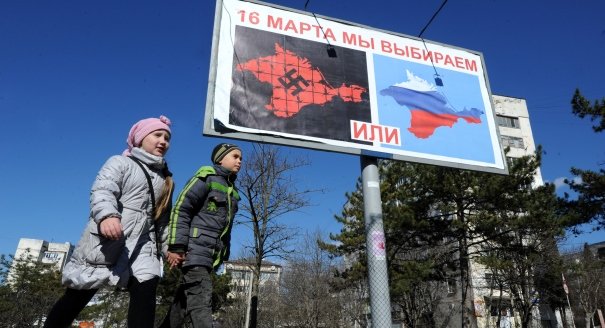
Source: Getty
Putin sees himself as repairing the damage done a quarter century ago by Gorbachev and Yeltsin. He is challenging not only the 1991 geopolitical arrangements but an entire world order in which only the United States has the right to decide what is right and what is wrong.
Source: Al Jazeera America
In his speech to the Russian parliament on Tuesday, Vladimir Putin moved to include Crimea in the Russian Federation. At the same time, he said Moscow had no intention to move into southeastern Ukraine or to support a “Crimea scenario” there. The situation, however, is fast unfolding, and the crisis that led to the toppling on Feb. 21–22 of Ukrainian President Viktor Yanukovich is far from over.
Over the past four weeks, Russia’s foreign policy and its relations with the United States and the European Union have been fundamentally transformed. Even if historical analogies are often tricky, Russia and the West have entered something that can be described as a new cold war.Neither side has thus far developed a strategy for dealing with the other in this new scenario. The Russian approach, however, is basically clear. Putin, who in a 2006 address to the Russian parliament famously described the breakup of the Soviet Union as a major catastrophe, sees himself as repairing the damage done a quarter century ago by the last Soviet leader, Mikhail Gorbachev, and the first Russian president, Boris Yeltsin.
To Putin, eastern Slavs — Belarusians, Ukrainians and Russians — are part of an Orthodox Christian civilization closely tied by the bonds of ethnicity, language, culture and shared history. To the Russian leader, they are all one people.
During the Ukraine crisis, however, Putin has for the first time publicly described ethnic Russians as a divided nation — a description previously avoided so as not to alarm neighboring countries whose borders with Russia create those divisions. Putin used the idea of reuniting Russians to rationalize incorporating Crimea within the Russian Federation. He also noted that southeastern Ukraine, from Odessa to Kharkiv, was originally southern Russia and is still home to millions of ethnic Russians. ...
Former Director, Carnegie Moscow Center
Trenin was director of the Carnegie Moscow Center from 2008 to early 2022.
Recent Work
Dmitri Trenin
Dmitri Trenin
Carnegie does not take institutional positions on public policy issues; the views represented herein are those of the author(s) and do not necessarily reflect the views of Carnegie, its staff, or its trustees.

Cargo traffic through Russia’s Northern Sea Route has increased because of the disruption caused by the conflict in the Middle East, the Ukraine war, and U.S.-China tensions.

Mikhail Korostikov
An analysis of traffic accident data suggests that Ukrainian drone attacks caused a material but not disastrous fall in Russian gasoline consumption over the summer.

Sergey Vakulenko

Sergei Kiriyenko used Russia’s parliamentary vote to further hone his strategy of corporate mobilization that is designed to maximize votes for United Russia.

Andrey Pertsev

The European far right might fail to steer EU policy in the direction Russia wants, but they will create enough chaos inside Europe to benefit the Kremlin.

Dimitar Bechev

Minsk clearly expected the dialogue with Washington to yield more results, in particular the lifting of EU sanctions and permission to export potash.

Artyom Shraibman