

Commentary
Sarah Chayes
{
  "authors": [
    "Sarah Chayes"
  ],
  "type": "legacyinthemedia",
  "centerAffiliationAll": "dc",
  "centers": [
    "Carnegie Endowment for International Peace"
  ],
  "collections": [],
  "englishNewsletterAll": "democracy",
  "nonEnglishNewsletterAll": "",
  "primaryCenter": "Carnegie Endowment for International Peace",
  "programAffiliation": "DCG",
  "programs": [
    "Democracy, Conflict, and Governance",
    "South Asia"
  ],
  "projects": [],
  "regions": [
    "South Asia",
    "Afghanistan"
  ],
  "topics": [
    "Political Reform",
    "Democracy"
  ]
}
Source: Getty
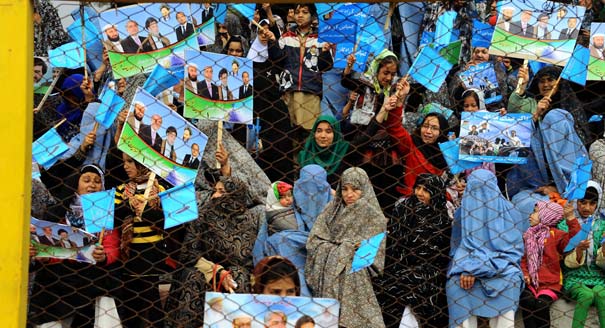
Despite threats from the Taliban, Afghans flocked to ballot boxes in high numbers.
Source: WNYC Takeaway
Afghanistan, a nation that has seen war for more than a generation, took the polls over the weekend for the country's first-ever free elections.
Despite threats from the Taliban, Afghans flocked to ballot boxes in high numbers. About 7 million of 12 million eligible voters turned out for the election, according to preliminary estimates.
"We commend the Afghan people, security forces, and elections officials on the turnout for today’s vote," President Barack Obama said in a statement. "These elections are critical to securing Afghanistan’s democratic future, as well as continued international support, and we look to the Afghan electoral bodies to carry out their duties in the coming weeks to adjudicate the results—knowing that the most critical voices on the outcome are those of Afghans themselves."
Though the election was largely peaceful, according to reports, at least 23 people were killed, and several others were injured in attacks by Taliban fighters—though they were fewer than feared. At least 200 polling stations were closed at the last minute because of security threats.
Sarah Chayes, formerly a special adviser to the chairman of the Joint Chiefs of Staff and now senior associate in the Democracy and Rule of Law Program at the Carnegie Endowment, weighed in on the election, the future relationship between the U.S. and Afghanistan, and the role of the Taliban.
Former Senior Fellow, Democracy, Conflict, and Governance Program
Sarah Chayes is internationally recognized for her innovative thinking on corruption and its implications. Her work explores how severe corruption can help prompt such crises as terrorism, revolutions and their violent aftermaths, and environmental degradation.
Recent Work
Sarah Chayes
Carnegie does not take institutional positions on public policy issues; the views represented herein are those of the author(s) and do not necessarily reflect the views of Carnegie, its staff, or its trustees.

Two divergent trends—Putin’s hardline vision of how to prosecute the war in Ukraine, and a growing desire for change in Russia—could tear the regime apart.

Tatiana Stanovaya
Ultimately, Zelensky sided neither with the reform camp nor with the military establishment as such, but with political control.

Balázs Jarábik
Tokayev’s predecessor, Nursultan Nazarbayev, outlined arrangements for a power transition too soon and in too much detail, ultimately losing control over the process. Tokayev is determined not to meet the same fate.

Temur Umarov

Despite unhappiness on the ground, Moscow is determined to use both carrot and stick to ensure there is record support for United Russia in occupied Ukraine.

Konstantin Skorkin

Whether PAS can refocus on the unfinished business of state-building may ultimately prove more consequential for Moldova’s European future than the pace of its accession negotiations.
Balázs Jarábik